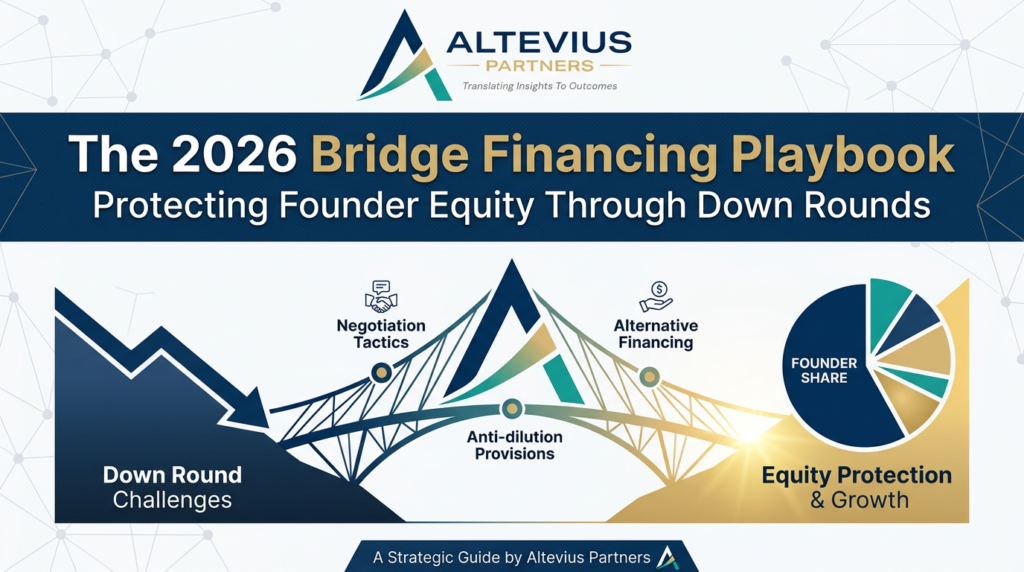

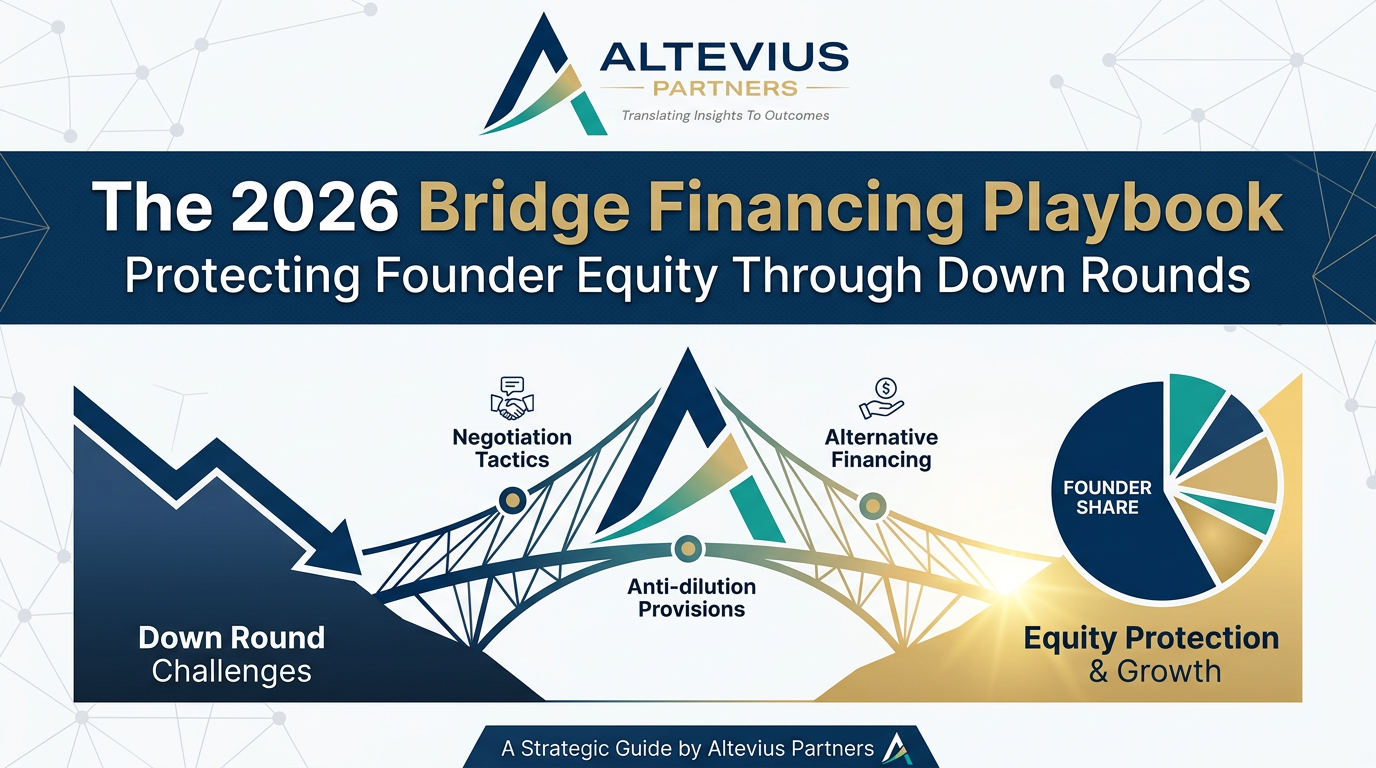
Securing bridge financing is often the single most critical move a founder makes when the next priced round hits turbulence. Market corrections and valuation resets mean that cash runways can shrink faster than expected, making careful navigation essential to avoid severe equity dilution. Over the past decade of working alongside early-stage and growth founders, I have watched brilliant teams stumble not because their product lacked market fit, but because they treated interim liquidity as a panic button rather than a calculated tactical maneuver. When cash burn collides with a cold funding environment, your survival depends entirely on how well you understand the mechanics of cap table preservation.
Key Takeaways:
- Bridge Financing Purpose: Provides short-term liquidity to extend operational runways (typically 12–18 months) when the next priced equity round stalls.
- Down Round Dangers: Triggers anti-dilution clauses (weighted average or full-ratchet) that exponentially compress founder and employee common stock.
- Strategic Alternatives: Evaluate non-dilutive capital (revenue-based financing, venture debt) and inside round extensions before agreeing to a formal down round.
- Cap Table Defense: Harmonize legacy convertible notes, protect pro-rata rights for early angels, and establish retention pools to keep key talent motivated.
1. Why Modern Startups Face Valuation Gaps
The venture ecosystem has shifted dramatically. Gone are the days when top-line growth at all costs could comfortably mask broken unit economics or indefinite paths to profitability. Today’s investors underwrite deals with a microscope, demanding rigorous capital efficiency.
- Shifting Investor Sentiment: Institutional backers now prioritize sustainable margins, gross retention, and predictable cash flow over vanity metrics, leaving hyper-growth startups with mismatched valuations.
- Enterprise Sales Cycle Compression: B2B buying committees are taking twice as long to approve budgets, shrinking standard 24-month operational runways down to single-digit survival windows.
- The Cost of Waiting: Many founders wait until their bank balance touches three months of cash before looking for bridge financing, completely stripping away their negotiating leverage and forcing acceptance of predatory terms.
When I advise founders facing this crunch, my first rule is simple: math doesn’t care about your last valuation. If your monthly burn is forty thousand dollars and your cash reserves are dipping below six months, you are already in the danger zone. Admitting that the market has changed is the first step toward protecting what you have built.
Read more: Startup Cap Table Management: Fixing Dilution Errors Before Series B
2. Mechanics of a Down Round and Common Stock Impact
When a company raises capital at a lower valuation than its previous priced round, it enters a down round. For founders who cut their teeth during the 2021 bull run, the structural brutality of a down round can come as a severe shock.
- Preferred Stock Protections: Institutional investors secure protective provisions when they buy preferred shares. When a down round occurs, these clauses activate to shield investors, often at the direct expense of common stockholders.
- Broad-Based Weighted Average vs. Full-Ratchet: Most standard term sheets utilize a broad-based weighted average formula to adjust conversion prices. However, aggressive or distressed terms feature full-ratchet penalties that reset an investor’s conversion price to the exact new lower price, regardless of how few shares were sold.
- The Compounding Effect: If your cap table is already littered with multiple legacy convertible notes and unharmonized SAFEs, a down round creates a cascading dilution effect that can wipe out a founder’s majority control overnight.
I remember sitting across from a seed-stage founder two years ago who casually accepted a full-ratchet clause from a desperate angel syndicate. When they hit a valuation reset during their bridge phase, that single clause multiplied the preferred share count by a factor of three. The founders went from holding fifty-five percent of the company to under fifteen percent before they even reached Series B. You must read every single line of your prior investor agreements to understand what triggers lie dormant in your legal stack.
3. Inside Round vs. Down Round Comparison
When liquidity runs low, you face a strategic crossroads: do you go back to your existing backers for an inside extension, or do you open the books to new external leads in a formal down round?
| Strategic Dimension | Inside Round Extension | Formal Down Round |
| Primary Capital Source | Existing major insiders and angels | New venture funds and syndicate leads |
| Valuation Structure | Flat valuation or structured convertible notes | Explicitly lower price per share |
| Execution Speed | Rapid closing with minimal legal overhead | Extended term sheet negotiations and complex voting |
| Dilution Distribution | Concentrated among active participants | Widespread across common holders via anti dilution terms |
| Market Signaling | Neutral to positive vote of confidence from insiders | Cautious signal regarding missed prior milestones |
Choosing the inside route keeps your cap table clean and avoids public valuation haircuts, but it requires existing investors to dig deep into their pockets. If your insiders are tapped out, a formal down round becomes inevitable.
4. Structuring a Smart Bridge Financing Startup Guide
Executing a successful bridge round is an exercise in surgical precision. You want to buy enough time to fix your core metrics without chaining your company to impossible repayment terms.
- Choosing Instruments: Decide whether to use convertible notes with valuation caps, uncapped notes with deep discounts, or a structured priced equity bridge. In a volatile market, convertible instruments allow you to defer the valuation debate until your product metrics catch up.
- Negotiating Pay-to-Play Provisions: If you run an inside round, enforce pay-to-play terms. This means existing investors must participate pro-rata in the bridge to keep their preferred status or anti-dilution privileges, preventing free-riders from diluting active supporters.
- Setting Realistic Maturity Windows: Always target a maturity window between 12 and 18 months. Anything shorter puts undue stress on your operating team; anything longer signals a lack of urgency to hit your core KPIs.
When building your bridge financing startup guide internally, treat the term sheet as a boundary marker. Do not accept onerous covenants or personal guarantees that put your personal assets at risk.
5. Non Dilutive Capital Options for Startups
Before trading away precious equity during a market trough, explore every avenue of non-dilutive capital. Dilution is permanent; debt is temporary if managed correctly.
- Venture Debt and Revenue-Based Financing: If your recurring revenue is stable and predictable, specialized lenders can provide capital against your future receivables without touching your equity structure.
- Government Grants and R&D Credits: Look closely at regional innovation grants, export market development funds, and research tax offsets that put cold cash directly back into your working capital.
- Customer Financing Models: Restructure your enterprise sales contracts. Offering discounts for annual upfront prepayments or milestone-based deposits can instantly self-fund your development cycles.
I once worked with a SaaS startup that was three weeks away from a painful equity bridge. By simply restructuring their enterprise contracts to require quarterly prepayments instead of net-60 terms, they generated enough immediate cash flow to cancel the bridge entirely. Always look at your customer ledger before looking at your investor list.
6. Cap Table Restructuring Strategies
A cluttered cap table makes new institutional investors run for the hills. If you want to prevent equity dilution startup stakeholders must clean up historical debt before inviting new money in.
- Consolidating Scattered Notes: Work with legal counsel to roll older, disparate seed notes and micro-safes into a single, harmonized security class with unified conversion triggers and maturity dates.
- Managing Option Pool Demands: New investors often demand an expanded employee option pool before pricing the round. Always negotiate whether that pool expansion comes out of the pre-money or post-money valuation.
- Preserving Pro-Rata Pathways: Keep lines of communication open with your earliest angel investors. Giving them clear, structured pathways to maintain pro-rata participation prevents ownership fragmentation and keeps your cap table manageable.
7. Employee Stock Dynamics During a Down Round
Your team is the engine of your turnaround. When a company undergoes a valuation reset, employee morale can plummet if their stock options suddenly sit underwater.
- Managing Underwater Options: When strike prices exceed current fair market value, options lose their motivational power. Boards frequently need to reprice or issue top-up options to restore alignment.
- Implementing Dedicated Retention Pools: Carve out a specific equity reserve exclusively for core operators who steer the ship through the storm.
- Transparent Communication: Be radically honest with your team. Explain why the bridge is happening, what milestones it unlocks, and how their continued work directly impacts the eventual recovery of share value.
8. Strategic Advisory Partnerships with Altevius Partners
Navigating a valuation reset, structuring complex bridge financing, and protecting your cap table from the dilution trap requires seasoned, objective financial guidance. Founders do not have to manage these high-stakes negotiations alone.
Altevius Partners works directly with early-stage and growth companies to build dynamic financial models, design stress-tested cash flow forecasts, and manage strategic investor relations. Whether you are evaluating your first bridge round, restructuring a complex cap table, or mapping out non-dilutive working capital alternatives, our team provides the quantitative clarity and strategic backing you need to secure your company’s long-term future.
Read more: Decoding SAFE Notes vs. Priced Equity Rounds: What Indian Founders Must Choose for Seed Fundraising
How does bridge financing actually work when a startup cannot close its Series A or B on time?
Bridge financing works by providing short-term capital usually structured as convertible notes, SAFEs, or priced equity extensions to extend your operational runway by 12 to 18 months. When your revenue growth stalls or macroeconomic headwinds delay your next major priced round, a bridge gives you the cash needed to hit the specific performance milestones institutional investors want to see before they sign.
- Practical Example: If you have six months of cash left and need twelve months to scale enterprise ARR from 1 million to 2 million dollars, a bridge note from your existing insiders keeps the lights on while you fix your sales metrics.
- Expert Insight: Never treat a bridge as free money. It adds liquidation preference stack onto your cap table, so you must tie the loan amount strictly to hard milestones that materially increase your valuation before the next conversion trigger.
What is the difference between an inside round bridge and a formal down round?
An inside round relies primarily on your current major investors and angels to chip in pro-rata funds via convertible instruments, often at a flat valuation or with a mild discount. A formal down round, by contrast, issues new shares at a lower price per share than your previous valuation, officially resetting your company’s worth downward and triggering legal mechanisms.
- Comparison Breakdown:
- Inside Round: Keeps your cap table clean, avoids public valuation haircuts, and closes quickly with minimal legal overhead.
- Formal Down Round: Triggers anti-dilution protections, resets employee option pools, and requires extensive negotiations with new lead funds.
- Expert Insight: Whenever possible, negotiate an inside extension or a capped convertible note first. A formal down round changes your governance dynamics and can severely damage team morale if communication is mishandled.
How do anti-dilution provisions impact founder equity during a valuation reset?
Anti-dilution provisions protect early institutional investors by automatically adjusting their conversion price downward if you subsequently issue shares at a lower price. When a down round occurs, these clauses multiply the preferred shares held by investors, which directly compresses the relative ownership percentage held by founders and common stockholders.
- Mechanism: Most standard term sheets use a broad-based weighted average formula, which dilutes common shares proportionally based on the size of the new round. Aggressive terms use full-ratchet clauses that drop the investor’s conversion price to the exact new low, regardless of how few shares were sold.
- Expert Insight: Review your historic legal stack before taking outside money. Knowing whether your lead investors hold broad-based or full-ratchet protections tells you immediately how painful a future down round will be.
What non-dilutive capital options should startups consider before raising a bridge round?
Before trading away precious equity during a market trough, founders should evaluate alternative funding mechanisms that provide liquidity without sacrificing ownership stakes. Dilution is permanent, whereas structured debt or accelerated cash flow can bridge a temporary revenue slump.
- Primary Options:
- Revenue-Based Financing (RBF): Specialized lenders advance capital against your predictable monthly recurring revenue, repaid as a fixed percentage of incoming sales.
- Venture Debt: Term loans paired with minor warrant coverage, ideal for startups with existing institutional backing and tangible assets.
- Customer Prepayments: Restructuring enterprise contracts to incentivize annual upfront cash payments instead of net-60 terms.
- Expert Insight: I once helped a SaaS client avoid a painful equity bridge entirely by shifting their enterprise client base to quarterly prepayments, which generated enough immediate working capital to fund six months of engineering salaries.
How can founders protect and motivate employees when underwater stock options occur?
When a company undergoes a valuation reset or accepts a lower bridge valuation, the current fair market value of the company may drop below the strike prices of previously issued employee stock options. This leaves team members holding underwater options that lose their motivational and retention value.
- Actionable Strategies:
- Option Repricing: Work with your board of directors to legally reprice existing options to match the new fair market value.
- Top-Up Grants: Issue additional retention grants to key engineering and product leaders who are critical to the company’s operational recovery.
- Transparent Communication: Explain the bridge financing context honestly to your team so they understand how hitting the next set of revenue milestones restores the long-term value of their equity.
- Expert Insight: Your team is your primary engine for a turnaround. Hiding financial realities destroys trust, whereas sharing the tactical roadmap builds collective ownership over the company’s survival.