
Over the past decade of working directly with founders across India’s vibrant tech and manufacturing corridors, I have noticed a recurring pattern. When a venture reaches that critical inflection point where growth requires external capital, founders instantly panic about cap table health. They stare at term sheets, worry about giving away too much of their company too early, and often treat funding decisions like a binary choice between selling pieces of their dream or taking on heavy liabilities.
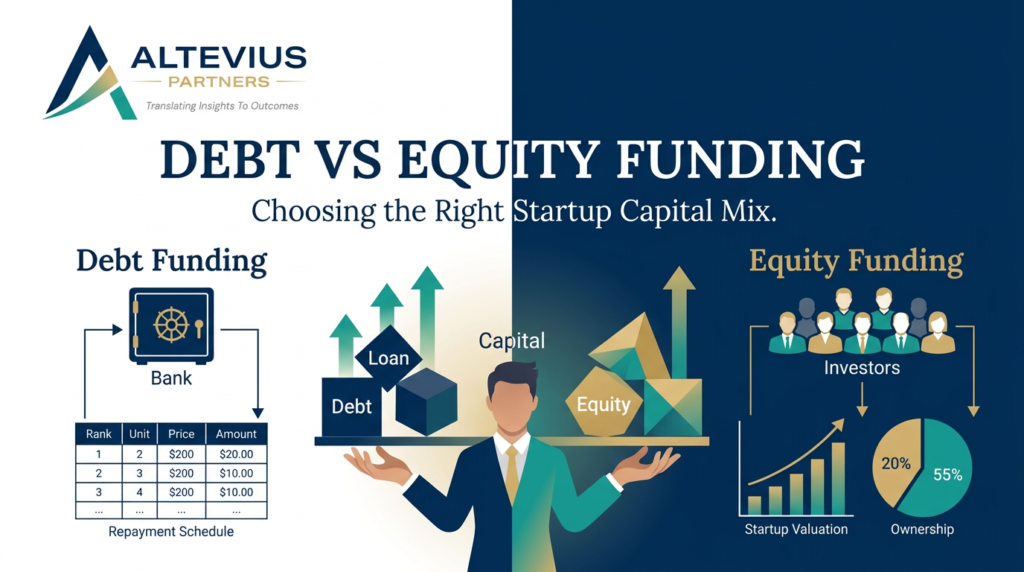
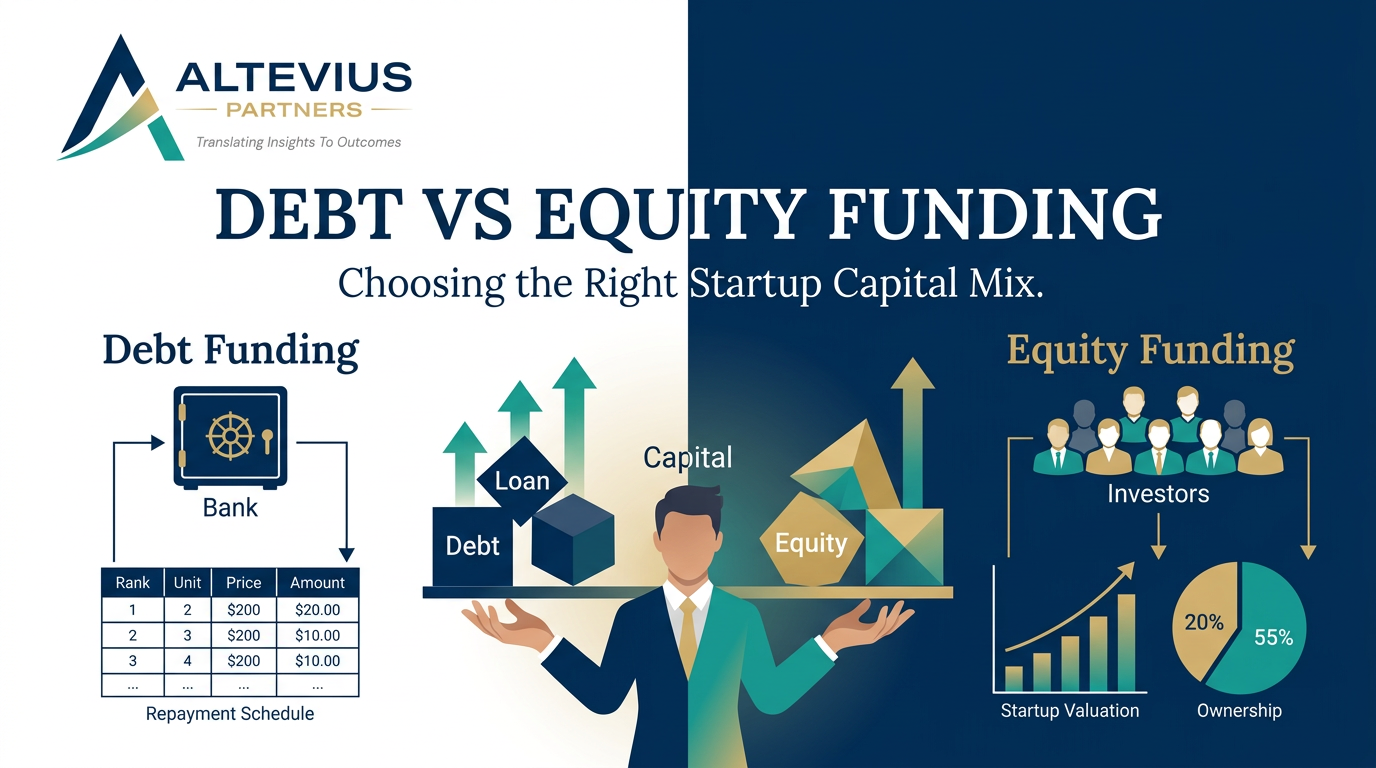
But looking at debt vs equity funding for startups as an either/or battle misses the bigger picture. The reality of modern corporate finance is that your capital structure is a dynamic blend, and finding the sweet spot determines whether your business scales smoothly or chokes under financial friction.
Key Takeaway
- Evaluating debt vs equity funding for startups requires balancing immediate ownership preservation against fixed repayment obligations.
- Regional ecosystems across India offer distinct financial instruments, from tech-focused venture debt in southern hubs to traditional credit lines in commercial centers.
- Partnering with strategic advisors like Altevius Partners helps founders design a resilient capital mix tailored to their specific cash flow patterns and growth velocity.
- Minimizing dilution while maintaining healthy financial leverage protects long-term founder control and maximizes enterprise valuation at later exit stages.
The Modern Capital Dilemma for Growing Companies
Shift in funding priorities under current market conditions
The funding winters and market corrections have completely rewritten how venture capitalists and lenders evaluate early-stage and growth-stage companies. Gone are the days when hyper-growth at all costs excused a messy cap table or runaway burn rates. Today, investors want to see clear paths to profitability and disciplined capital allocation. This economic shift has forced leadership teams to look beyond traditional venture capital and seriously evaluate debt vs equity funding for startups as a primary strategic pillar rather than a secondary backup plan.
Why balancing financial leverage protects long-term ownership
Every time you issue common or preferred stock, you permanently trade away a slice of future equity upside. Conversely, debt is a finite obligation. Once a loan or venture debt instrument is fully serviced, the lender exits the picture, leaving founders and early team members with a higher concentration of ownership. Maintaining a balanced level of financial leverage means you can fund inventory, expansion, or marketing campaigns without giving away board seats or diluting your voting power prematurely.
The core goal of optimizing funding structures for sustainable expansion
The ultimate objective is not just raising money; it is raising the right kind of money at the lowest possible cost of capital. When you master debt vs equity funding for startups, you align your funding instruments with your revenue cycles. Predictable, recurring SaaS revenue behaves very differently than cyclical manufacturing cash flows, and your financing strategy must reflect those operational realities to ensure sustainable growth.
Read more: Decoding UPI Taxation and Merchant Compliance: What Growing Businesses and Fintechs Need to Know
Understanding Debt vs Equity Dilution for Indian Startups
How borrowing capital preserves ownership percentages
When you secure capital through a term loan, credit line, or non-dilutive instrument, your equity distribution remains completely untouched. Your existing shareholders do not see their percentage ownership shrink. For Indian founders who have spent years building a company from scratch, keeping that equity intact is crucial for maintaining morale, ensuring long-term alignment, and retaining majority control when bigger institutional checks arrive down the road.
The trade-offs of trading equity shares for immediate cash
Equity is expensive capital. While venture capitalists bring invaluable mentorship, network access, and strategic guidance, they also demand significant ownership chunks, typically ranging from 15% to 25% in early institutional rounds. If your business achieves rapid valuation multipliers, that early equity chunk becomes enormously expensive in hindsight. Evaluating debt vs equity funding for startups forces you to weigh whether giving up a permanent piece of your company is worth the risk-free nature of equity capital.
Financial obligations and repayment schedules associated with loans
Debt is not free either, and it introduces a very different kind of stress: mandatory cash outflow. Unlike equity, where investors share the downside if revenue dips, lenders expect their principal and interest payments on strict calendar dates. If your business experiences a sudden market downturn or delayed customer collections, servicing a rigid debt schedule can quickly strain your operational liquidity and create severe cash flow bottlenecks.
Read more: The Hidden Tax & Reconciliation Risks of High-Volume UPI Transactions for Indian Businesses
Navigating Regional Funding Ecosystems Across India
Startup funding debt vs equity Bangalore
Bangalore remains the undisputed tech capital of the country, where founders have access to a sophisticated ecosystem of specialized venture debt funds, angel networks, and aggressive domestic banks. When looking at startup funding debt vs equity Bangalore options, tech founders often leverage venture debt alongside their Series A or B equity rounds to extend their runway by 12 to 18 months without triggering a down-round valuation.
- Tapping into tech-centric venture debt funds and specialized angel networks for non-dilutive runway extensions.
- Balancing local investor expectations with debt instruments to avoid over-leveraging high-burn software ventures.
Debt vs equity financing Mumbai
Mumbai operates on a different financial heartbeat, deeply rooted in corporate banking, structured credit, large family offices, and established institutional lenders. Founders exploring debt vs equity financing Mumbai paths find that traditional banking partners look heavily at historical asset backing, cash flow predictability, and established commercial traction before issuing large credit lines.
- Leveraging traditional banking partnerships and corporate venture arms for large-scale commercial credit lines.
- Structuring asset-backed debt facilities for capital-intensive operations and working capital expansion.
Startup capital mix Delhi
The Delhi-NCR startup ecosystem thrives on a diverse mix of consumer brands, quick-commerce players, and government-backed innovation grants. Crafting an effective startup capital mix Delhi approach often involves combining micro-venture capital with state-sponsored credit schemes and institutional term loans to support rapid inventory scaling and consumer acquisition.
- Engaging government-backed startup initiatives and local micro-VCs to lower the overall cost of capital.
- Combining institutional loans with early-stage equity to fund regional supply chain infrastructure.
Founder funding strategy Pune
Pune’s industrial heritage and burgeoning deep-tech and automotive software sectors foster a distinct bootstrapping mindset. A pragmatic founder funding strategy Pune typically leans toward capital efficiency, utilizing operational cash flows and selective debt instruments to build sustainable businesses before seeking massive external dilution.
- Capitalizing on manufacturing and tech corridors for non-dilutive financing and equipment leasing.
- Aligning local bootstrapping habits with structured debt to fund heavy R&D cycles safely.
Managing equity dilution Hyderabad startups
Hyderabad has evolved into a powerhouse for life sciences, biotechnology, enterprise software, and deep-tech innovation. Managing equity dilution Hyderabad startups requires careful structuring of milestone-based funding tranches, ensuring that founders do not surrender heavy equity before clinical trials, regulatory approvals, or major software deployment milestones are achieved.
- Preserving founder stakes in life sciences and software hubs through staged financial milestones.
- Utilizing milestone-based tranches to control ownership loss during capital-intensive research phases.
Read more: Financial Modeling Services Guide for Indian Startups
Strategic Options for Regional Expansion
Venture debt vs equity financing in Bangalore
In competitive hubs like Bangalore, timing your funding instruments is everything. Knowing when to deploy venture debt vs equity financing in Bangalore can prevent painful equity dilution during bridge periods. Venture debt is exceptionally useful for financing inventory, server infrastructure, or user acquisition campaigns right before a major value-inflection milestone, keeping your board seats and voting control secure.
- Using venture debt for inventory or user acquisition without losing precious board seats.
- Protecting valuation milestones during bridging rounds while market conditions stabilize.
Startup funding options in Mumbai
Mumbai offers unique financial engineering tools that go beyond standard vanilla loans. Evaluating diverse startup funding options in Mumbai allows growth-stage businesses to explore revenue-based financing, where repayments scale dynamically up or down based on monthly top-line revenue performance.
- Evaluating revenue-based financing alongside traditional term loans to cushion cash flow shocks.
- Managing collateral requirements for service and product businesses looking to scale commercial operations.
Growth capital strategy for founders in Pune
Scaling across regional markets demands rigorous financial discipline. A sound growth capital strategy for founders in Pune focuses heavily on matching working capital cycles with appropriate credit tenures, ensuring that machinery purchases or factory expansions are funded via long-term debt rather than short-term equity sacrifices.
- Scaling operations using operational cash flow and selective medium-term credit lines.
- Minimizing equity dilution during regional market penetration and supply chain expansion.
Managing equity dilution Hyderabad startups
For founders managing large engineering or biotech teams in Hyderabad, keeping the cap table clean is vital for future institutional syndication. Managing equity dilution Hyderabad startups effectively means designing thoughtful employee stock option pools and advisory share allocations that incentivize top talent without creating massive overhangs that scare away Series B and C investors.
- Retaining voting control while securing large institutional checks from global venture funds.
- Structuring option pools and advisory shares carefully to protect founder equity integrity.
Read more: Beyond the Burn Rate: How to Build Dynamic Rolling Forecasts to Survive Macroeconomic Volatility
Crafting Your Optimal Capital Mix with Altevius Partners
Evaluating cash flow predictability before taking on debt service obligations
Before you sign any loan agreement or term sheet, you must conduct a rigorous stress test of your cash flows. Debt has zero emotional intelligence; it demands repayment regardless of whether your top client delayed an invoice or your marketing campaign underperformed. Analyzing your historical cash conversion cycles, churn rates, and gross margins ensures that you only take on financial leverage that your baseline operations can comfortably service.
Assessing cap table health and future valuation trajectories
Your cap table is the financial blueprint of your company’s future. Bringing in the wrong type of capital too early can create a “cap table poison pill” that makes subsequent institutional rounds nearly impossible to close. By carefully mapping out your projected valuation growth across upcoming funding milestones, you can determine precisely how much equity you can afford to part with versus how much debt your balance sheet can safely absorb.
How Altevius Partners assists founders in designing custom capital strategies
Navigating the complex interplay of debt vs equity dilution for Indian startups and optimal capital mix for founders is rarely something a leadership team should tackle in isolation. This is where experienced financial advisory makes all the difference. Organizations like Altevius Partners work alongside founders to analyze financial statements, model debt service coverage ratios, connect with specialized lenders and venture funds, and structure bespoke funding rounds that safeguard long-term shareholder value.
Actionable steps to approach lenders and investors with confidence
- Audit your financial models: Ensure your unit economics, customer acquisition costs, and lifetime values are crystal clear and validated by actual historical data.
- Define your capital requirement purpose: Lenders and equity investors want to exactitude; specify whether funds are going toward product development, geographic expansion, or working capital.
- Engage advisory support early: Partner with experienced firms like Altevius Partners to review your pitch decks, term sheet conditions, and financial covenants before entering formal negotiations.
- Maintain competitive tension: Never rely on a single term sheet or lender; keeping multiple financing options open gives you leverage on interest rates, warrants, and equity dilution terms.
Read more: UAE and GCC Business Setup and Expert Expansion Guidance: The Definitive Professional Blueprint
How do I determine the precise tipping point when my startup should transition from equity dilution to taking on debt?
The shift from equity to debt depends almost entirely on the predictability of your cash inflows and your gross margin profile. If your business operates on recurring SaaS contracts or repeat purchase patterns with stable unit economics, you can comfortably service regular debt payments.
- The Rule of Thumb: If a rupee of borrowed capital reliably generates more than a rupee of operating margin within a tight timeframe, debt is safer than giving away permanent equity.
- Expert Insight: I always advise founders to map out a 24-month rolling cash flow forecast under a stress-test scenario (assuming a 25% drop in projected sales). If you can comfortably cover your principal and interest obligations during that downturn without risking payroll, you are ready for debt. If your revenue stream is still experimental or volatile, stay with equity until product-market fit hardens.
What specific metrics do venture debt lenders in tech hubs like Bangalore analyze that differ from traditional equity pitch criteria?
Equity investors fall in love with your total addressable market, founding vision, and hockey-stick user growth projections. Venture debt lenders, conversely, treat your startup like a credit risk. They skip the visionary narrative and look hard at your historical data room.
- Core Underwriting Metrics: Lenders scrutinize your monthly burn multiple, net revenue retention (NRR), customer concentration ratios, and gross churn.
- Practical Example: When a Bangalore-based enterprise SaaS startup approaches a venture debt fund, the credit committee cares less about how many users downloaded the app last month and more about whether existing enterprise clients pay on time and maintain a low default probability. Working alongside strategic advisors like Altevius Partners ensures your historical financial models match what debt underwriters look for in their credit box.
How can founders in manufacturing and deep-tech hubs like Pune structure non-dilutive financing without risking physical asset seizure?
Founders in industrial corridors often hesitate to use debt because they fear losing factory equipment or IP if a quarter goes south. The key is structuring asset-backed facilities with flexible covenants rather than rigid, short-term commercial bank loans.
- Structuring Strategy: Look for equipment leasing lines or venture debt instruments that view your intellectual property or future purchase orders as collateral rather than demanding personal guarantees or seizing core operating machinery.
- Expert Perspective: Negotiate grace periods on principal repayments that align with your manufacturing cycle or R&D lead times. If your assembly line takes six months to yield commercial products, your debt structure must feature an initial moratorium on principal repayment so you are not choking on EMIs before revenue generation begins.
Can early-stage startups combine revenue-based financing with traditional equity rounds without triggering investor friction?
Yes, but transparency with your existing equity holders is non-negotiable. Revenue-based financing (RBF), where repayments fluctuate as a fixed percentage of your monthly top-line revenue, has become popular in commercial hubs like Mumbai.
- Managing Friction: Venture capitalists typically dislike senior secured debt that encumbers all company assets because it jeopardizes their equity recovery in a liquidation event. However, subordinated RBF or venture debt structured with clear inter-creditor agreements can easily coexist with an equity round.
- Practical Tip: Always review the negative covenants in your term sheets. Ensure your equity agreements permit subordinate debt baskets up to a specific threshold so you can plug short-term working capital gaps without requiring formal board approval for every credit line draw.
What are the hidden costs of venture debt that founders frequently overlook beyond the stated 12% to 18% interest rate?
Many founders look at a venture debt term sheet, see a 14% annual interest rate, and assume it is cheaper than giving up 20% of their company. However, total cost of capital calculations often conceal secondary components.
- Warrant Coverage: Lenders frequently demand equity kickers or warrants (typically 5% to 20% of the loan value) that allow them to purchase shares at your previous round valuation. If your company’s valuation triples by the next round, those warrants translate into a substantial hidden dilution cost.
- Processing & Covenant Fees: Factor in legal diligence fees, facility arrangement fees, and mandatory minimum cash balance covenants (which force you to lock up 3 to 6 months of operating expenses in the lending bank’s account, reducing your working liquidity). Evaluating the true effective cost requires running a comprehensive financial model that accounts for both cash outflows and warrant dilution.