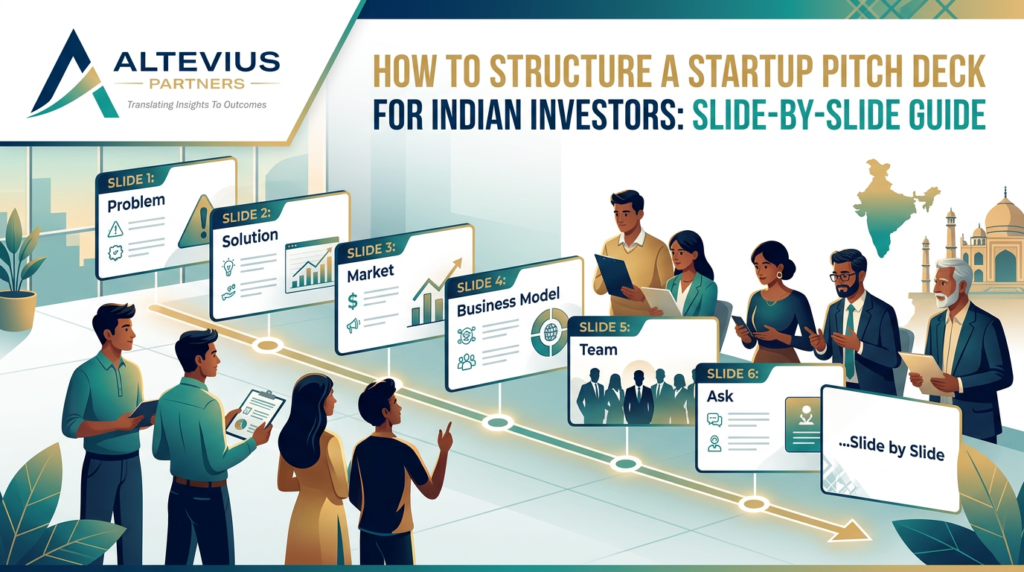

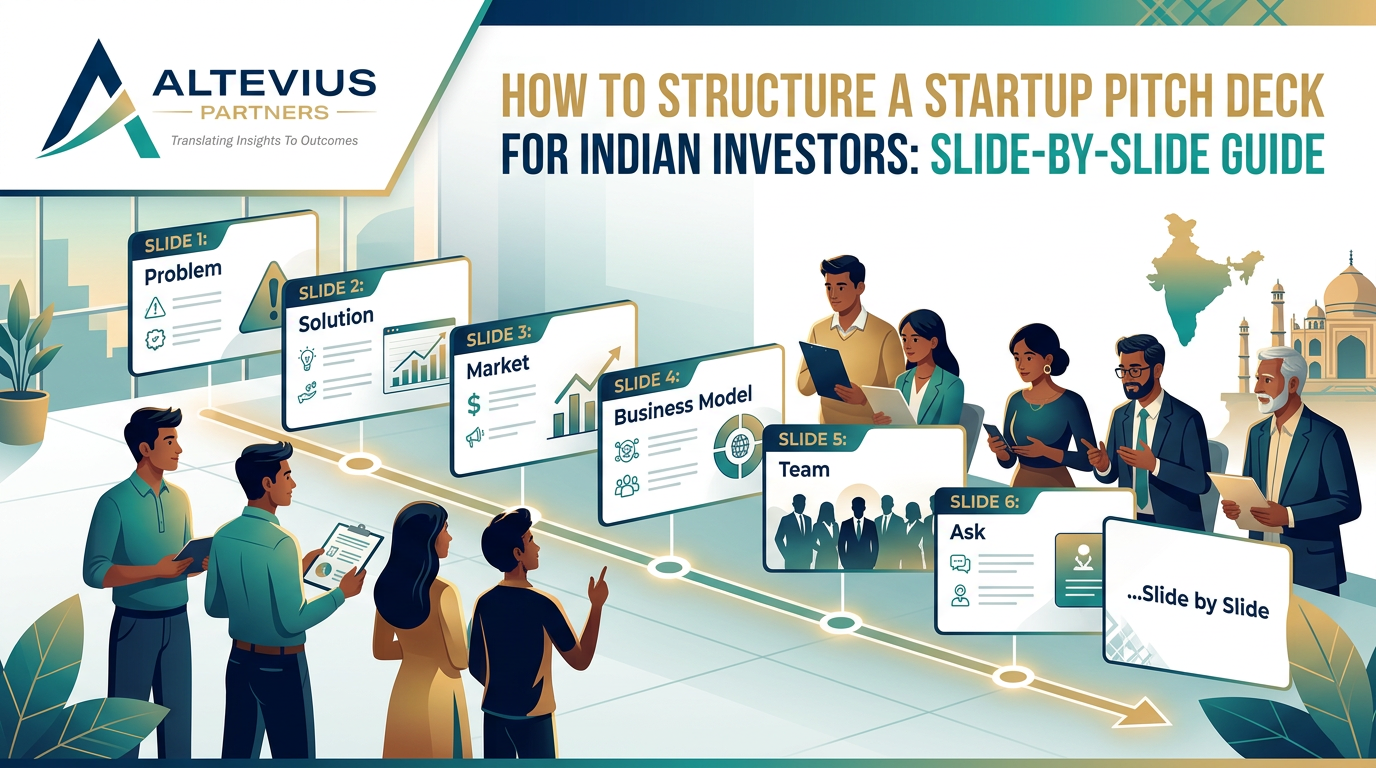
Raising capital in Mumbai, Bengaluru, or Delhi NCR plays by a very different set of rules than pitching on Sand Hill Road. If you download a standard Silicon Valley template and simply swap out dollar signs for rupees, seasoned domestic funds will spot the disconnect within seconds. Building a winning Startup pitch deck India founders can actually rely on means adapting your story to local consumer behaviour, price sensitivity, and unit-level profitability.
- What Indian Investors Prioritize: Domestic angels and venture funds evaluate decks primarily on capital efficiency, localized distribution channels, regulatory readiness, and a clear path to positive unit economics rather than pure user growth.
- Ideal Slide Count: A sharp 10 slide pitch deck structure for startups works best for initial cold outreach, leaving deep financial cohorts and technical architecture for a separate appendix.
- Initial Review Time: Most analysts and partners spend under three minutes scanning a first-version deck before deciding whether to take a discovery call.
- Core Financial Proof: Showing real contribution margins, realistic bottom-up market sizing, and Customer Acquisition Cost (CAC) payback periods matters far more than five-year hockey-stick projections.
Over the past decade of working closely with early-stage founders and reviewing hundreds of fundraising presentations at Altevius Partners, I have noticed a consistent pattern. Great builders often lose investor interest not because their product is weak, but because their narrative buries the metrics that actually matter in India. When a partner opens your PDF between meetings, they want immediate clarity on how you make money, how cheaply you acquire customers, and why your team can survive brutal domestic competition. Getting the pitch deck structure for Indian investors right turns a polite pass into a serious term-sheet conversation.
What VCs Look for in a Pitch Deck India Founders Often Overlook
Indian venture capital has matured significantly. Gone are the days when subsidized customer acquisition and blitzscaling without margin discipline could carry a Series A round. Today, what VCs look for in a pitch deck India wide boils down to operational pragmatism and repeatable economics.
Unit Economics Over Vanity Metrics
Downloads, website visits, and gross merchandise value (GMV) without take-rate context rarely impress an investment committee anymore. Domestic funds want to see healthy Contribution Margin 1 and Contribution Margin 2 early on. If you are losing money on every delivery or onboarding cycle, you need to show the exact operational levers that will flip those numbers positive within twelve to eighteen months.
Read more: Startup M&A and Exit Readiness Guide: How Founders Prepare Financials for Acquisition in 2026
India 1 vs Bharat Market Clarity
India is not a single homogenous consumer market. A SaaS tool selling to enterprise CTOs in Gurugram operates differently from a vernacular fintech app targeting kirana owners in Indore or Surat. Investors immediately look for whether you understand the purchasing power, digital trust barriers, and payment preferences of your specific cohort. Trying to claim your product serves both affluent metro households and rural mass-market buyers simultaneously usually signals a lack of focus.
Regulatory and Compliance Readiness
Whether you operate in fintech, healthtech, gaming, or cross-border commerce, regulatory shifts can reshape your business overnight. Addressing RBI guidelines, DPDP data privacy compliance, or sector-specific licensing early in your pitch deck presentation for startup funding shows maturity. Investors love founders who treat compliance as a competitive moat rather than an afterthought.
Founder Market Fit
Because early-stage execution in India involves navigating fragmented supply chains, complex vendor negotiations, and long enterprise sales cycles, domestic investors bet heavily on grit and domain familiarity. Why are you and your cofounders uniquely equipped to solve this messy problem? Highlighting relevant industry scar tissue or prior operational wins builds instant credibility.
Angel Investors vs Institutional VCs: Adapting Your Deck Format
Many founders make the mistake of sending the exact same file to a syndicate of angel operators and an institutional seed fund. While the core business truth remains identical, the emphasis and depth of data should shift depending on who is reading the screen.
| Evaluation Factor | Angel Investors in India | Institutional VCs in India |
| Primary Decision Driver | Founder passion, early intuition, and initial customer validation | Scalable business model, TAM depth, and defensible moats |
| Financial Detail Needed | 12 to 18 month burn rate and immediate milestone targets | 3 to 5 year projections, cohort retention, and CAC to LTV ratios |
| Ideal Deck Length | 10 to 12 concise, story driven slides | 12 to 15 data backed slides with a detailed appendix |
| Due Diligence Speed | Fast decisions based on personal conviction and reference checks | Multi stage committee reviews and deep financial audits |
Tailoring for Early Checks
When learning how to make a pitch deck for angel investors in India, remember that most angels are successful founders or senior executives writing checks from personal capital. They want to connect with your insight and customer obsession. Keep the narrative crisp, showcase early user love, and clearly explain how their capital gets you to your next major proof point.
Structuring a Seed Round
Institutional funds manage other people’s money and must justify every investment to an Investment Committee. A seed funding pitch deck India micro-VCs or institutional seed funds evaluate needs stronger cohort data, clearer market sizing math, and a well-reasoned competitive matrix. Put your core narrative in the main slides and move detailed unit cost tables into an appendix so the primary flow stays clean.
The Proven 10 Slide Pitch Deck Structure for Startups in India
When selecting a startup pitch deck format India investors can digest quickly, restraint is your biggest asset. A disciplined 10 slide pitch deck structure for startups forces you to cut fluff and highlight only high-signal information. Here is how each slide should work together.
Slide 1: The Hook and Company Purpose
Your opening slide has one job: tell the reader what your company does in plain English before they even scroll. Skip vague taglines like “reimagining the future of commerce.” Instead, write a sharp one-liner: “Automated GST reconciliation and working capital credit for mid-sized textile manufacturers in Western India.” Include your logo, founder contact details, and the specific round you are raising right at the bottom.
Slide 2: The Real Indian Market Problem
Frame the problem around a painful, expensive friction that exists right now on the ground. Use a concrete example rather than abstract macro statistics. If you are building B2B logistics software, explain how a mid-sized distributor loses 14% of monthly margin to manual truck detention and paper invoicing errors. Show why existing spreadsheets, WhatsApp groups, or legacy ERP systems fail to fix the issue.
Slide 3: Your Product and Core Solution
Now that the pain is clear, introduce your product as the obvious relief. Show clean product screenshots, a simple three-step workflow diagram, or actual hardware photos. Focus entirely on user outcomes time saved, revenue recovered, or errors eliminated rather than listing every backend feature you built.
Slide 4: Why Now and Market Timing
Great ideas fail when they arrive five years too early or two years too late. Connect your timing to real shifts in India’s infrastructure: widespread UPI adoption, ONDC rails, cheaper 5G penetration, PLI manufacturing incentives, or rising disposable incomes in Tier 2 cities. Follow this with realistic bottom-up market sizing:
- TAM (Total Addressable Market): Total annual revenue if you captured 100% of your broader category in India.
- SAM (Serviceable Available Market): The specific segment and geography your current product model can realistically reach.
- SOM (Serviceable Obtainable Market): Your concrete 3-to-5-year revenue target based on current pricing and sales capacity.
Slide 5: Early Traction and Proof of Demand
Nothing quiets investor skepticism faster than paying customers. Highlight month-over-month revenue growth, active retention curves, repeat purchase rates, or signed Letters of Intent (LOIs) with reputable enterprise logos. If you are pre-revenue, showcase pilot completion metrics, waitlist conversion rates, or a short quote from a real customer explaining why they cannot go back to their old workflow.
Slide 6: Business Model and Monetization Strategy
Spell out exactly how cash enters your bank account. Do you charge a SaaS subscription, a transaction take rate, an upfront setup fee, or a hardware-plus-software bundle? Be transparent about pricing tiers and billing cycles. In India, where B2B payment cycles can stretch to 60 or 90 days, showing upfront annual collections or automated mandate billing instantly boosts your valuation perception.
Slide 7: Unit Economics Slide in Pitch Deck
This is often the make-or-break slide during partner meetings. A dedicated unit economics slide in pitch deck presentations should break down the math of a single customer or order clearly:
- Average Order Value (AOV) or Annual Contract Value (ACV)
- Gross Margin after direct fulfillment, cloud, or payment gateway costs
- Customer Acquisition Cost (CAC) blended and paid
- Lifetime Value (LTV) and CAC payback period in months
Show how your current contribution margin looks today versus where it lands once you reach higher volume, backed by clear operational reasons rather than wishful thinking.
Read more: Startup Board Deck and Investor MIS Playbook: Metrics, Cadence and CFO Architecture
Slide 8: Go to Market and Distribution Engine
In a country as vast and noisy as India, building a great product is only half the battle; distributing it affordably is the real moat. Detail the specific acquisition channels already producing leads for you. Whether you rely on field sales teams in industrial clusters, vernacular content creators, channel distributor partnerships, or targeted performance ads, show the conversion math behind your repeatable growth engine.
Slide 9: Competitive Edge and Defensibility
Never claim you have zero competition. If a real market exists, customers are already spending money or time solving the problem somehow even if their current alternative is a local accountant or manual register. Use a simple two-by-two matrix or comparison grid to map direct Indian startups alongside traditional offline alternatives. Explain your sustainable edge clearly, such as proprietary workflow data, switching costs, exclusive supplier lock-in, or superior unit cost efficiency.
Slide 10: The Founding Team and The Ask
Close strong by showing why your leadership team is built to win. Highlight domain experience, past exits, scale handled in previous roles, and how the cofounders complement one another across product, sales, and operations. Right beside your team bios, state your exact fundraising ask: the capital amount you are raising, how many months of runway it buys, and the three concrete business milestones you will hit before raising your next round.
Investor Pitch Deck Slides Breakdown: Common Mistakes That Kill Deals
During a detailed investor pitch deck slides breakdown, certain red flags almost always trigger an immediate rejection, regardless of how promising the underlying startup might be.
Inflated Top Down Market Numbers
Saying “India has 1.4 billion people, and if just 1% buy our ₹999 product, we will make ₹1,400 crore” is the fastest way to lose credibility. Investors treat top-down math as a sign that you haven’t studied your actual buyer base. Always build your market size from the bottom up: number of verified target customers multiplied by your realistic annual contract value.
Text Heavy Slides
A pitch deck is a visual storytelling aid, not a printed legal contract. When slides are packed with 12-point paragraphs, investors stop listening to you and start reading or worse, close the file out of fatigue. Stick to one clear headline takeaway per slide, use clean charts, and keep body text scannable in five seconds.
Hiding Weak Metrics
Every early-stage startup has messy numbers maybe retention dipped in Q2 during a pricing experiment, or enterprise onboarding takes longer than expected. Trying to obscure churn behind cumulative user charts backfires during due diligence. Acknowledge weak spots openly, explain what you learned, and show the corrective steps already underway.
Read more: Best Fractional CFO Services in the USA: Top Firms, Costs, Benefits, and How to Choose
Pre Send Startup Fundraising Deck Checklist India Founders Should Run
Before attaching your PDF to an email or sharing a DocSend link, run through this practical startup fundraising deck checklist India founders use to avoid unforced errors:
- Mobile Readability Check: Over 60% of angel investors and VC associates open incoming decks on their smartphones first. Open your PDF on your phone; if you have to pinch and zoom to read a chart label, simplify the slide.
- File Size Compression: Keep your exported PDF under 10 MB so it loads instantly on mobile networks without degrading image sharpness.
- Data Room Alignment: Double-check that every revenue figure, CAC number, and burn rate in your Startup pitch deck India presentation matches your monthly MIS sheet and Excel financial model down to the decimal.
- Standalone Clarity: Ensure your deck makes complete sense without your voiceover, because analysts frequently forward the file internally to partners before scheduling a call.
- Objective External Review: Fresh eyes catch blind spots you stop seeing after staring at your own slides for weeks. Getting a structured pre-raise critique from experienced fundraising advisors like Altevius Partners can help sharpen your narrative, stress-test your unit economics, and position your round confidently before you approach top-tier funds.
Ready to Turn Your Pitch Deck into Investor Conversations?
Your pitch deck is your company’s sharpest fundraising asset it opens doors, frames your valuation, and proves you respect an investor’s time. By focusing on real Indian unit economics, clear market segmentation, and a tight ten-slide narrative, you put yourself ahead of ninety percent of decks sitting in VC inboxes today.
If you are preparing for an upcoming seed or Series A round and want an honest, experienced perspective on your fundraising story, reach out to the advisory team at Altevius Partners. Share your draft deck with us for a thorough slide-by-slide diagnostic so you can walk into every investor meeting with clarity and conviction.
How much does reverse flipping a startup to India typically cost in 2026?
A reverse flip to India generally costs between $50,000 and $250,000 in legal, valuation, and regulatory filing fees, excluding any capital gains or exit taxes triggered in the foreign parent jurisdiction. The final budget depends heavily on how many investor classes sit on your cap table and whether your holding entity is in Singapore or the United States. Companies with clean, single-class cap tables using the Section 233 fast-track route spend far less than startups with multiple convertible notes, complex liquidation waterfalls, or intellectual property held offshore that must be valued and transferred separately.
Can a startup reverse flip to India if it has convertible notes or SAFE instruments?
Yes, a startup with outstanding SAFEs or convertible notes can reverse flip to India, but those instruments must either convert into equity before the merger scheme is filed or be restructured to comply with Indian FEMA rules. Under Indian foreign exchange regulations, an Indian company cannot simply inherit open-ended foreign SAFE notes without mapping them to recognized capital instruments like Compulsorily Convertible Preference Shares (CCPS) or compliant External Commercial Borrowings (ECBs). If you leave convertible instruments unaddressed until mid-filing, your Authorised Dealer bank will hold up the share allotment while demanding revised valuation certificates.
Do Indian startups need prior RBI approval for a fast-track inbound merger after the 2026 FEMA amendment?
Even after the RBI’s May 29, 2026 amendment to the Cross-Border Merger Regulations, startups using the fast-track Section 233 route should still secure explicit prior RBI clearance alongside Regional Director approval. While the 2026 amendment replaced references to NCLT with “Competent Authority” so fast-track mergers fit within FEMA’s deemed-approval framework, Rule 25A(5) of the Companies Act still explicitly requires both the foreign holding company and the Indian subsidiary to obtain prior RBI approval. Walking your Authorised Dealer bank through the draft scheme early ensures there are no surprises over Press Note 3 checks or sectoral caps.
What happens to foreign intellectual property and SaaS customer contracts during a reverse flip?
In a statutory inbound merger, all intellectual property, global SaaS customer agreements, and vendor contracts belonging to the foreign holding company transfer automatically to the Indian parent once the Competent Authority sanctions the scheme. However, automatic legal vesting does not update payment gateways, cloud billing accounts, or enterprise procurement portals on its own. Your finance and operations teams must proactively novate major customer contracts, update W-8BEN-E tax forms for US clients, and migrate Stripe or international bank collection accounts so recurring subscription revenue is not interrupted after the foreign entity dissolves.
Should a startup complete a reverse flip before or after raising a Series B or pre-IPO round?
Completing your reverse flip before raising a late-stage Series B, Series C, or pre-IPO round is almost always cheaper and cleaner than waiting. Every new funding round increases your company’s fair market valuation, which directly raises potential exit tax exposure in jurisdictions like the United States and complicates share-swap ratios across fresh preference share classes. Domestic institutional investors and merchant bankers preparing an Indian DRHP also require at least 12 to 24 months of clean, consolidated Indian parent financials before filing for a public listing.