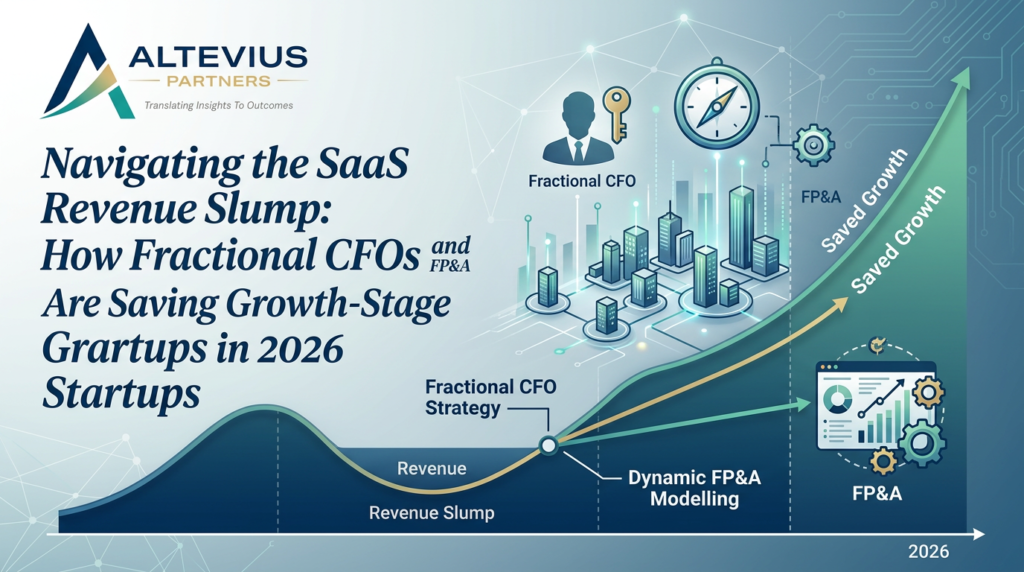

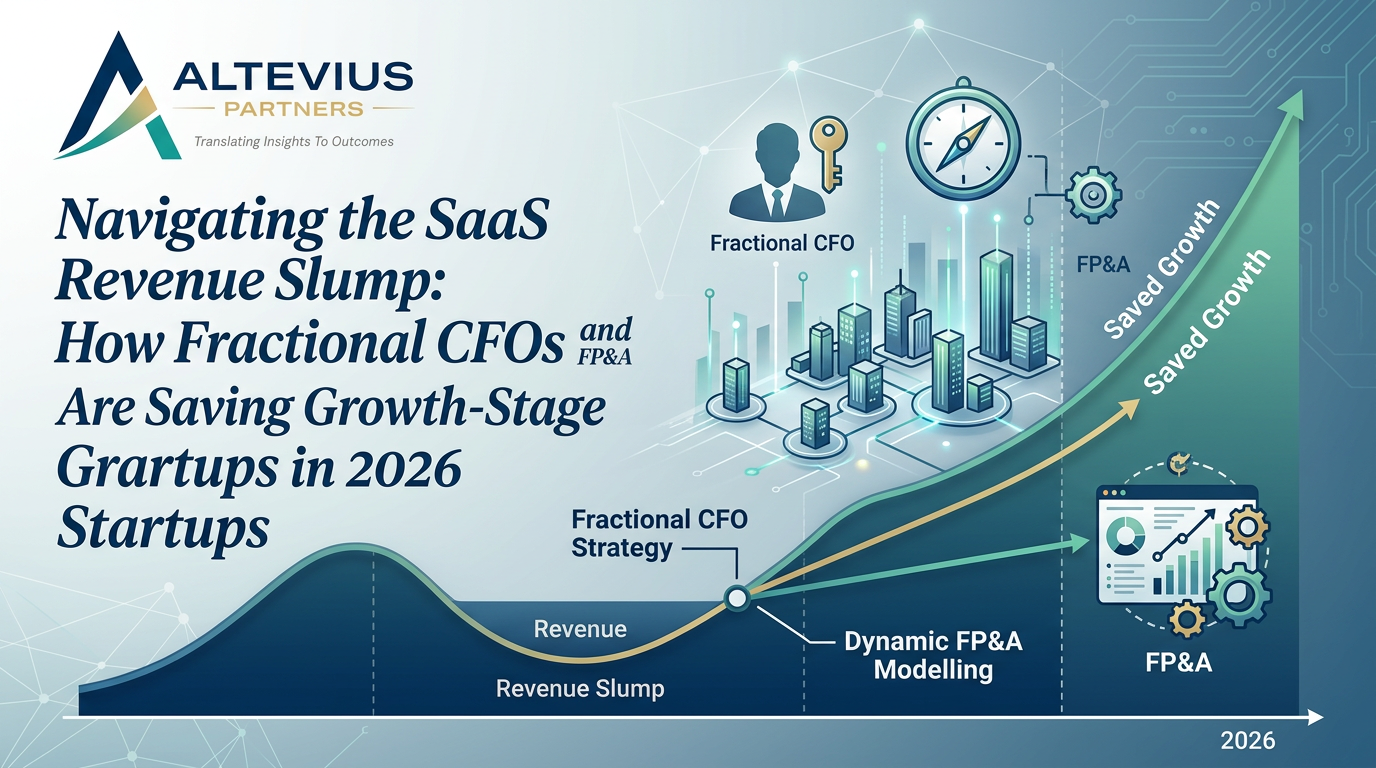
When you sit down across from a software founder who is staring at a flatlining MRR chart, the tension in the room is palpable. Over the past decade advising scaling tech companies, I have watched the economic climate shift dramatically. The old venture playbook of buying growth at all costs has evaporated, leaving many growth-stage businesses grappling with a stubborn market correction.
If your annual recurring revenue has hit a ceiling while customer acquisition costs continue to climb, you are not alone. Solving this puzzle requires more than basic bookkeeping. It demands a fundamental shift toward agile financial architecture, which is why bringing on a Fractional CFO for Startups and implementing Dynamic FP&A strategies for growth stage companies have become the ultimate survival tools for modern tech leaders.
Executive Summary
- The Challenge: Growth-stage SaaS companies in 2026 face prolonged sales cycles, rising customer acquisition costs, and plateauing annual recurring revenue.
- The Solution: Integrating part-time executive financial leadership and agile planning models instead of relying on rigid, historical accounting or expensive full-time hires.
- Core Strategies: Leveraging Fractional CFO for Startups to optimize runway, adopting Dynamic FP&A strategies for growth stage companies, implementing SaaS revenue churn reduction strategies 2026, and closely tracking unit economics weekly.
- Key Benefits: Preserving cash, avoiding disruptive layoffs, upgrading forecasting accuracy, and enhancing institutional credibility for venture capital networks like Altevius Partners.
The Anatomy of the 2026 SaaS Revenue Slump
Why Subscription Growth Stalled
For years, software startups operated in an environment of abundant capital where customer acquisition could easily outpace churn. Today, enterprise spending behavior has undergone a fundamental transformation. Procurement committees take weeks longer to approve software contracts, scrutinizing every line item for immediate return on investment.
When your customer acquisition cost stays fixed or increases while expansion revenue slows down, cash flow compresses rapidly. Many founders mistake this top-line slowdown for a temporary sales slump, only to realize months later that their unit economics were broken all along. Recognizing early warning signs like lengthening sales cycles and creeping collection days is vital before liquidity tightens to a critical point.
Moving Past Raw Bookkeeping
Most early-stage companies rely on traditional bookkeeping that simply records what happened last month. While necessary for tax compliance, historical accounting tells you where your car has been, not what is around the next blind curve.
When your leadership team relies on static spreadsheets built at the start of the fiscal year, you are essentially flying blind through market turbulence. Modern operational decision-making requires forward-looking architecture that connects sales pipelines directly to cash runway and hiring velocity.
Read more: Beyond the Pitch Deck: How to Build an Investor-Ready Financial Model That Survives Due Diligence
Fractional CFO for Startups: High-Level Guidance Without Full-Time Overhead
What a Fractional Leader Brings to the Table
When cash flow tightens, hiring a seasoned chief financial officer with a six-figure salary and equity package is rarely an option for a mid-stage company. Yet, the complexity of managing capital allocation, investor relations, and board reporting requires executive-level competence.
A fractional financial leader steps in to provide high-level strategic direction on a flexible, part-time schedule. They cut through the noise, build institutional-grade reporting packs, and give founders the data-backed confidence required to steer through a down market.
Fractional CFO Cost vs Full-Time CFO Salary for Startups
Let us look at the raw economics. A full-time, top-tier tech CFO in today’s market commands a substantial base salary alongside significant stock options and benefits. For a startup trying to preserve its runway, that fixed overhead can accelerate burn dangerously fast.
In contrast, retaining part-time executive guidance provides access to the exact same caliber of strategic expertise at a fraction of the monthly cash outlay. This financial efficiency allows growing businesses to invest their primary capital into product innovation and customer success rather than top-heavy executive compensation.
How to Hire a Fractional CFO for a SaaS Startup
Finding the right external partner requires looking beyond generic accounting credentials. You need someone who understands subscription metrics, cohort retention, and software gross margins inside and out.
- Industry Specialization: Ensure the candidate has direct experience scaling B2B software or tech companies through similar market cycles.
- Cultural Fit and Communication: A great financial partner must translate complex financial models into plain English for non-financial founders and board members.
- Proactive Problem Solving: Look for advisors who focus on growth levers and risk mitigation rather than just compliance and historical reporting.
- Clear Scope of Work: Define whether you need help with fundraising preparation, cash flow restructuring, or building automated management reporting dashboards.
Dynamic FP&A Strategies for Growth Stage Companies
Shifting from Annual Budgets to Rolling Forecasts
Fixed yearly budgets belong in a museum. When market conditions shift from quarter to quarter, a budget written twelve months ago becomes completely detached from reality.
Implementing monthly rolling projections allows your organization to update revenue assumptions and expense run rates continuously. If churn ticks up or a major enterprise deal slips into the next quarter, your leadership team sees the cash flow impact immediately and can adjust hiring or marketing spend before a crisis hits.
Read more: Financial Modeling Services Guide for Indian Startups
Outsourced Financial Planning and Analysis Services Benefits
Building an internal analytics team from scratch is expensive and time-consuming. Utilizing Outsourced financial planning and analysis services benefits your organization by instantly plugging you into an external analytics infrastructure.
These external teams bring cross-industry benchmarks, advanced scenario-modeling tools, and objective viewpoints that internal teams may miss. They relieve your core management group from administrative spreadsheet wrangling, turning financial data into clean, actionable dashboards.
Agile Forecasting Models for Software Companies
Software companies face unique forecasting challenges, from usage-based billing fluctuations to delayed pipeline conversions. Building agile forecasting models means incorporating probabilistic modeling rather than single-point guesses.
By stress-testing your cash positions under various downside scenarios, such as a 20% drop in new customer acquisition combined with an increase in churn, you create operational buffers that keep your business safe under pressure.
Plugging the Leaks: SaaS Revenue Churn Reduction Strategies 2026
Identifying Retention Bottlenecks
In a tight revenue environment, plugging existing leaks is infinitely more cost-effective than acquiring new customers. Too many founders pour money into top-of-funnel marketing while ignoring accounts quietly drifting toward cancellation.
Analyzing product usage telemetry helps spot accounts showing signs of disengagement weeks before their renewal date arrives. Furthermore, restructuring pricing tiers to align more closely with actual customer value realization ensures clients feel they are receiving a strong return on their investment.
Key Financial Metrics Every SaaS Founder Must Track Weekly
Waiting for a monthly financial close to review your numbers is a dangerous game for a growth-stage company. To stay ahead of trouble, management needs real-time visibility into key performance indicators.
- Net Revenue Retention (NRR): Tracking whether your existing customer base is expanding or shrinking over time.
- Gross Margin Efficiency: Evaluating the direct hosting and support costs required to deliver your software.
- Cash Burn Multiple: Measuring how much net burn is required to generate every dollar of new ARR.
- Weekly Cash Runway: Monitoring exact cash depletion rates against your upcoming collection milestones.
Protecting Cash Flow and Avoiding Extreme Measures
Managing Cash Flow Burn Rate During Tech Downturns
When venture capital funding becomes harder to secure, extending your operational runway is non-negotiable. This requires a rigorous audit of every single dollar leaving the bank account.
Strategic runway extension does not mean slashing all marketing indiscriminately. Instead, it involves optimizing vendor contracts, eliminating redundant software subscriptions, and pausing experimental projects that lack a clear path to profitability within twelve months.
Read more: Professional Financial Modeling Solutions for Indian Startups
Fixing Startup Financial Distress Without Laying Off Staff
Mass layoffs destroy institutional knowledge, severely damage team morale, and often cost more in severance and lost productivity than they save in the short term. Fortunately, exploring alternative cost-containment measures can protect your core workforce.
- Implementing temporary, tiered compensation adjustments for executive leadership while protecting junior team members.
- Reallocating underutilized internal engineering resources toward high-margin client implementation services to generate immediate cash flow.
- Negotiating flexible payment terms with key cloud infrastructure and SaaS vendors.
Driving Long-Term Value and Investor Confidence
How Fractional Finance Leaders Improve Startup Valuation
When you eventually re-enter the market to raise institutional capital or pursue strategic M&A opportunities, investors demand absolute transparency and rigorous unit economics. Disorganized spreadsheets and vague growth stories immediately raise red flags during institutional due diligence.
Having professional financial guidance ensures your cap table, cohort analyses, and financial models stand up to intense scrutiny. Clean, institutional-grade reporting directly enhances investor confidence, positioning your business favorably when engaging with venture capital networks, including active regional tech investors like Altevius Partners. When your numbers are clear, defensible, and structured to professional standards, fundraising discussions shift from defending past mistakes to scaling future opportunities.
Conclusion
Navigating a subscription revenue slump is never easy, but it often serves as the crucible that separates resilient, enduring technology companies from fleeting experiments. By moving away from rigid spreadsheets and embracing agile financial leadership, founders can turn market uncertainty into a competitive advantage. Whether you choose to bring in part-time executive expertise or upgrade your planning infrastructure, taking decisive action today protects your runway, preserves your team, and sets the stage for sustainable, long-term growth. Evaluate your current financial blind spots this week, tighten your weekly metric tracking, and position your company to thrive on your own terms.
Read more: Working Capital Loans for Small Businesses: Benefits, Eligibility & When to Use Them (2026 Guide)
What is the difference between hiring a fractional CFO and keeping our books with a standard accounting firm?
Traditional accounting firms look backward. They categorize last month’s expenses, prepare tax filings, and make sure your books comply with local regulations. A fractional CFO looks forward. When you bring in part-time executive financial leadership, they build rolling cash flow forecasts, optimize your unit economics, restructure your pricing tiers, and sit shoulder-to-shoulder with you during board meetings and investor negotiations. Think of your bookkeeper as the historian documenting where your startup has traveled, and a fractional CFO as the co-pilot reading the map and helping you steer around obstacles on the road ahead.
How does a growth-stage software startup know it is the right time to bring in external financial help?
If your annual recurring revenue has plateaued while customer acquisition costs keep climbing, or if you find yourself constantly guessing how many months of cash runway remain before your next payroll, you have outgrown basic bookkeeping. Founders typically realize they need senior financial guidance when sales cycles stretch out past ninety days, cash burn exceeds safe margins, or upcoming fundraising discussions require institutional-grade financial modeling that static spreadsheets simply cannot handle.
Can dynamic financial planning and analysis (FP&A) really prevent a startup from having to lay off employees during a downturn?
Yes. Traditional companies often resort to mass layoffs because their annual budgets leave them blind until cash reserves hit a dangerous low. Dynamic FP&A relies on monthly rolling forecasts and continuous scenario modeling. By testing downside cases early, such as a sudden twenty percent drop in new subscriptions, management can spot cash compression months in advance. This visibility allows leadership to implement subtle, targeted adjustments like tiered executive pay cuts, vendor renegotiations, or resource reallocations well before job cuts become necessary.
What specific metrics should a B2B software founder review every single week instead of waiting for the monthly close?
Waiting for a monthly financial close in a volatile market is far too slow. Founders and executive teams should track Net Revenue Retention to monitor whether existing accounts are expanding or quietly shrinking. You also need a weekly pulse on your cash burn multiple, gross margin efficiency after hosting and server costs, and your exact cash runway calculated against confirmed collection milestones. Reviewing these four indicators every Monday morning ensures you never get blindsided by sudden liquidity crunches.
How do outsourced financial planning services prepare a growing tech company for venture capital due diligence?
Institutional investors and venture capital firms run rigorous due diligence on your historical cohorts, customer lifetime value calculations, and churn assumptions. If your financial model is built on messy formulas, disjointed spreadsheets, or inconsistent metrics, investor confidence evaporates quickly. Outsourced financial planning teams construct institutional-grade, transparent models that withstand aggressive stress-testing. They organize your data room to professional standards, ensuring your financial narrative matches your pitch and protecting your valuation from unnecessary downward pressure.