
Introduction: Moving Beyond Raw Bookkeeping to Institutional Proof
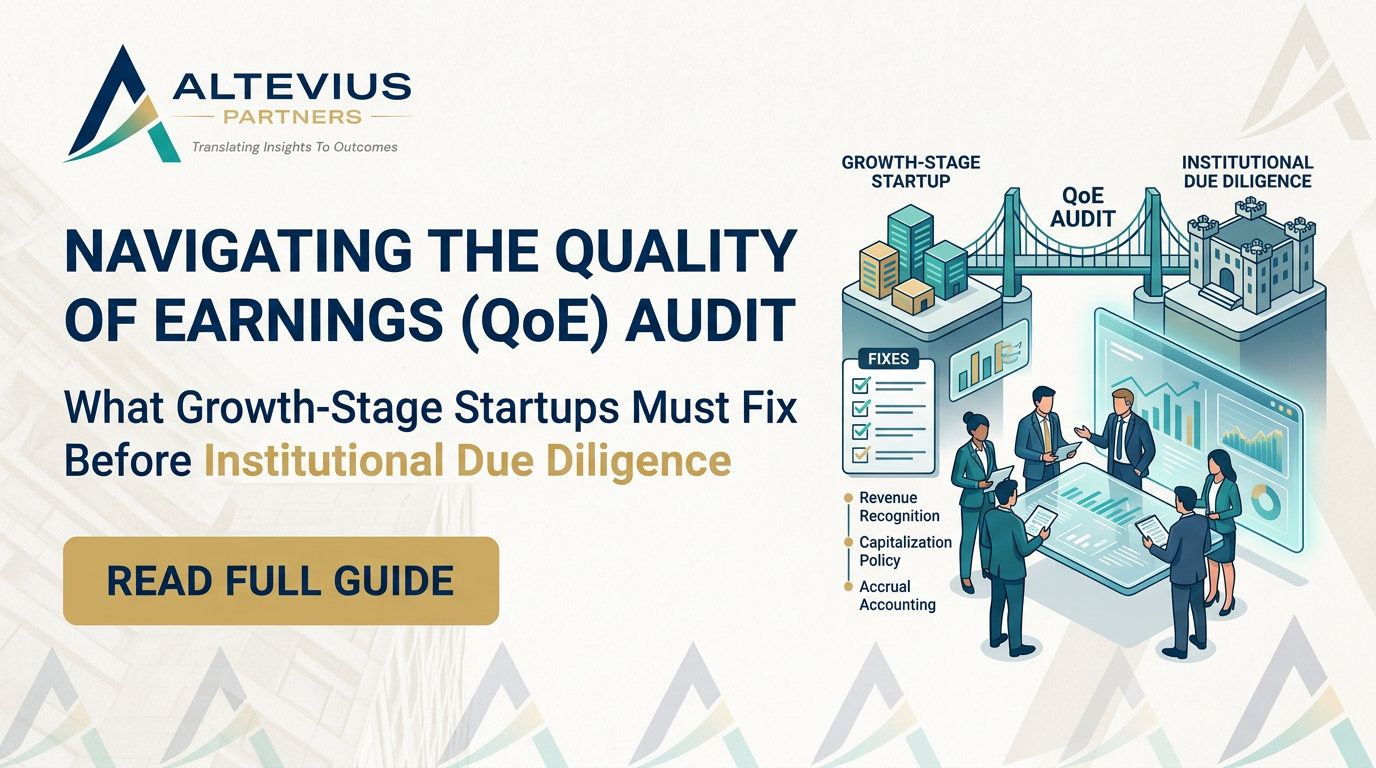
Founders often spend years treating their monthly accounting books like a quiet administrative chore, only to experience a sharp reality check the moment they enter an institutional funding process. You might have a polished pitch deck and steady top-line growth, but when institutional venture capitalists or private equity buyers step into your data room, they look past the narrative entirely. They want mathematical proof. Surviving this transition requires enduring a rigorous Quality of Earnings Audit for Startups, a process that separates emotional storytelling from concrete financial reality.
Over a decade of advising growing companies through high-stakes capital raises, I have watched brilliant teams lose valuation leverage simply because their historical ledgers could not withstand institutional scrutiny. Moving from basic tax filings to a comprehensive audit feels jarring because standard bookkeeping is designed for tax compliance, whereas a quality-of-earnings review is designed to test business truth. Setting up the structural foundation required to pass a buy-side check means cleaning up messy revenue recognition patterns, normalizing operational expenses, and ensuring your internal metrics match external reporting down to the final decimal.
- Quick Summary: Passing institutional due diligence requires growth-stage companies to master a formal Quality of Earnings Audit for Startups. Founders must execute thorough Startup QoE Report Preparation Steps, manage correct EBITDA Normalization Adjustments for Startups, clear out Common Red Flags in Startup Financial Due Diligence, and utilize a reliable Deferred Revenue Recognition Audit Guide to protect their company valuation.
- The Paradigm Shift: Moving away from top-line vanity metrics toward defensible, normalized operating cash flows.
- The Core Promise: Constructing a transparent financial profile that satisfies institutional buyers and secures uncompromised term sheets.
The Step-by-Step Reality of Startup QoE Report Preparation Steps
When external auditors enter your data room, they do not casually browse your folders. They trace historical general ledgers, bank statements, payroll records, and tax filings line by line. Gathering these documents into a unified, clean repository is the core goal of executing proper Startup QoE Report Preparation Steps before the formal engagement begins.
Failing to organize your data early introduces friction that causes institutional analysts to pause or question management credibility. In my experience, cleaning up historical records involves reconciling every bank deposit against corresponding customer contracts. If your internal ledger shows cash inflows that lack matching customer documentation, you are inviting immediate valuation markdowns.
- Data Room Consolidation: Centralizing historical general ledgers, bank statements, and tax returns into structured, auditable folders.
- Proactive Cleanup: Resolving misclassified expense categories and missing invoice receipts before third-party auditors spot them.
- Credibility Preservation: Demonstrating operational maturity through organized record-keeping that eases investor anxiety.
Decoding EBITDA Normalization Adjustments for Startups
Raw EBITDA is rarely what institutional investors actually buy. Founders often run personal expenses, family-related travel, or one-time legal fees through corporate accounts, which distorts true operational profitability. Making accurate EBITDA Normalization Adjustments for Startups allows you to strip away these anomalies and present the true, repeatable earnings power of the enterprise.
Defending your adjustments against strict venture capital scrutiny requires clear documentation. If you add back a founder’s above-market salary or a one-time vendor settlement, you must prove through contracts and receipts that the expense will not recur post-closing. Lacking this evidence forces investors to reject your adjustments, directly shrinking your final valuation.
- Non-Recurring Add-Backs: Isolating legal settlements, restructuring costs, and one-time project expenses from ongoing operations.
- Owner Perks Realignment: Adjusting executive compensation and personal expenses to match fair market rates.
- Audit Defense: Providing concrete documentation for every single normalization adjustment to protect your bottom line.
Spotting Common Red Flags in Startup Financial Due Diligence
Institutional investors look for specific structural triggers that signal operational risk or poor internal controls. Recognizing Common Red Flags in Startup Financial Due Diligence early gives you time to fix revenue recognition anomalies, sudden gross margin swings, and unexplained accounts receivable aging before formal audits begin.
A classic warning sign for auditors is a sudden spike in revenue recognition during the final month of a quarter without corresponding cash collections. If your accounts receivable balance balloons while your cash flow remains flat, buyers will suspect aggressive revenue booking. Fixing these issues beforehand prevents deal fatigue and protects your equity from aggressive clawbacks.
- Revenue Spikes: Investigating uncharacteristic end-of-quarter billing surges that lack supporting cash collections.
- Margin Volatility: Explaining sudden fluctuations in cost of goods sold caused by unoptimized vendor contracts.
- AR Aging Analysis: Resolving overdue customer invoices and establishing realistic bad debt reserves.
Mastering the Deferred Revenue Recognition Audit Guide
Subscription and software businesses face unique complexities when accounting for cash collected upfront against multi-year contracts. Untangling the difference between cash collected, billings, and actual recognized revenue is essential for passing technical reviews. Utilizing a proper Deferred Revenue Recognition Audit Guide ensures your practices comply with modern accounting frameworks.
Failing to defer revenue correctly can drastically inflate your current-period earnings, creating an illusion of profitability that dissolves under audit. When an institutional analyst discovers that your reported revenue includes cash for services yet to be delivered, trust breaks down instantly. Properly structuring deferred revenue schedules protects your enterprise from painful restatements.
- Cash vs. Revenue: Differentiating between upfront cash collections and revenue earned across the active service period.
- Compliance Standards: Adhering strictly to recognized accounting principles for deferred income liabilities.
- Term Sheet Protection: Eliminating sudden top-line reductions triggered by improper revenue accounting.
Establishing Working Capital Target Defensibility in Funding
Working capital targets are frequently contested during the final stages of an institutional funding round or acquisition. Calculating current assets and current liabilities accurately ensures you establish realistic working capital pegs. Maintaining Working Capital Target Defensibility in Funding prevents you from accidentally surrendering cash at closing due to a poorly calculated historical baseline.
Managing seasonal inventory, prepaid expenses, accounts payable, and accrued liabilities requires constant vigilance. If your business requires a high level of operational cash to sustain daily activities, investors will adjust the final purchase price or investment tranche to account for that capital requirement.
- Current Asset Pegs: Defining normal operating levels for accounts receivable and inventory.
- Liability Management: Accounting accurately for accrued payroll, taxes, and short-term vendor payables.
- Closing Adjustments: Preventing unexpected cash deductions by securing agreed baseline targets early.
Aligning with a Buy-Side Financial Verification Checklist
Venture capital analysts evaluate your business using standardized verification criteria. Anticipating what they look for when testing your historical unit economics allows you to bridge the gap between internal management reports and strict institutional expectations. Checking every ledger against a comprehensive Buy-Side Financial Verification Checklist ensures zero surprises during the review.
During a past transaction advisory engagement, a client assumed their internal KPI reporting was sufficient for institutional review. Once the buy-side team applied their verification checklist, they uncovered discrepancies between marketing attribution models and actual customer acquisition costs. Aligning your internal metrics with external auditing standards early eliminates this friction.
- Unit Economics Audit: Verifying customer lifetime value and acquisition cost calculations against raw ledger data.
- Management Report Reconciliation: Ensuring internal dashboard metrics match audited financial statements perfectly.
- Preparation Rigor: Anticipating deep-dive questions regarding cohort retention and margin expansion.
Leveraging Outsourced Fractional CFO Services for QoE
Internal finance teams often hit strict bandwidth limits when managing day-to-day operations while simultaneously handling a complex institutional audit. Engaging Outsourced Fractional CFO Services for QoE preparation provides senior-level expertise without the heavy financial overhead of a permanent executive hire.
Partnering with specialist advisory firms like Altevius Partners ensures your financial frameworks meet the strict verification standards demanded by institutional buyers. Fractional leaders bring pattern recognition from dozens of prior transactions, helping you identify and resolve hidden financial vulnerabilities before external auditors uncover them.
- Fractional Expertise: Accessing high-level financial architects on a flexible, project-driven basis.
- Team Bandwidth Relief: Freeing internal accounting staff to focus on core business operations during fundraising.
- Institutional Guidance: Working alongside Altevius Partners to build audit-proof financial models and data rooms.
Correcting Related-Party Transaction Disclosure in Audits
Related-party transactions are heavily scrutinized during any institutional review. Identifying non-arm length transactions, founder loans, and shared family vendor expenses is critical for compliance. Managing proper Related-Party Transaction Disclosure in Audits prevents legal complications and preserves trust with incoming investors.
If a founder rents office space from a personal real estate holding company above market rates, auditors will flag the arrangement immediately. Documenting every related-party arrangement transparently and adjusting pricing to fair market value ensures legal compliance and removes obstacles to closing the deal.
- Arm’s Length Pricing: Adjusting transactions with entities owned by founders or family members to fair market rates.
- Loan Documentation: Formalizing all shareholder notes, advances, and repayment schedules.
- Transparent Disclosure: Providing clear legal and financial notes for every related-party arrangement.
Building Normalized Cash Flow Modeling for Startups
Growth-stage companies frequently experience volatile cash flows driven by seasonal spikes, delayed enterprise collections, or large capital injections. Stripping away these anomalies helps establish your true operating cash profile. Designing Normalized Cash Flow Modeling for Startups proves predictable cash generation capabilities to prospective investors.
When building these models, you must separate core operational cash generation from financing cash flows. This clarity demonstrates that your business model can sustain operations independently without requiring constant capital infusions to survive.
- Cash Flow Normalization: Removing one-time capital injections and seasonal anomalies from cash flow projections.
- Operational Independence: Proving the core business generates predictable cash to sustain ongoing operations.
- Forward-Looking Utility: Connecting historical cash performance directly to future capital requirements.
Conducting a Pre-Investment Financial Health Assessment
Running an internal dry run before institutional buyers enter your data room is one of the smartest moves a management team can make. Executing a thorough Pre-Investment Financial Health Assessment helps identify broken formulas, missing documentation, and accounting inconsistencies ahead of time.
Partnering with Altevius Partners ensures your entire financial architecture undergoes an objective, transaction-grade review. Fixing these vulnerabilities internally transforms your data room into a clean, transparent environment that inspires investor confidence from day one.
- Internal Dry Runs: Simulating an institutional audit to uncover hidden reporting errors.
- Architectural Review: Ensuring financial models and ledgers reconcile cleanly across all three statements.
- Expert Collaboration: Engaging Altevius Partners to validate your financial readiness before institutional term sheets are issued.
Conclusion: Securing Your Next Funding Round Through Precision
Surviving an institutional due diligence process requires shifting your mindset from creative growth storytelling to unassailable financial proof. When your records are clean, your earnings are properly normalized, and your data room stands up to third-party audits, fundraising transforms from an exhausting interrogation into a strategic partnership negotiation.
The path to a successful capital raise rests entirely on the integrity of your numbers. Take the time to audit your historical ledgers, eliminate structural vulnerabilities, and partner with experienced advisory teams like Altevius Partners to ensure your business is fully prepared for institutional scrutiny.
- Take Action Today: Review your data room and financial ledgers for hidden normalization adjustments before scheduling institutional pitch meetings.
- Partner with Experts: Connect with Altevius Partners to build robust financial models and secure institutional-grade audit readiness.
What triggers the need for a formal quality of earnings audit during a startup funding round?
Institutional investors mandate a quality of earnings review when they want to verify that your reported revenue and profitability match actual cash generation before they sign a term sheet. If your top-line growth looks impressive on standard accounting books but relies heavily on uncollected invoices, deferred software subscriptions counted prematurely, or one-time professional services fees, an audit exposes these gaps. Institutional buyers require this independent verification to ensure the valuation they are paying for reflects true, repeatable business performance rather than temporary anomalies.
How do EBITDA normalization adjustments protect a startup valuation during negotiations?
Founders often run personal vehicle leases, family travel, or one-time legal settlements through corporate accounts, which artificially depresses operating profitability. Normalization adjustments strip away these non-recurring expenses and correct owner compensation to fair market rates, revealing the true operational earnings power of the business. Without concrete documentation and defensible adjustments, incoming investors will reject your add-backs, leading directly to a lower company valuation or reduced investment tranches at the closing table.
Why do generic spreadsheet templates fail when subjected to institutional financial due diligence?
Downloaded templates assume every business operates on a standard, predictable linear path, completely ignoring the complex operational friction points of a scaling enterprise. Generic models typically rely on hardcoded growth percentages rather than tying revenue directly to operational drivers like sales rep capacity, customer acquisition costs, and churn cohorts. When an institutional analyst changes a single variable during a data room review, a generic template either breaks completely or generates impossible cash flow projections, instantly destroying management credibility.
What is the primary advantage of outsourcing fractional CFO services for audit preparation?
Early-stage companies rarely have the capital or the consistent workload to justify a full-time, senior-level Chief Financial Officer to manage complex institutional audits. Partnering with specialized advisory firms like Altevius Partners provides flexible, project-driven access to experienced financial architects who have navigated dozens of venture-backed transactions. This gives founding teams institutional-grade financial modeling, data room organization, and audit readiness without incurring the heavy overhead of permanent executive salaries.
How does deferred revenue accounting impact software-as-a-service valuations during an audit?
Subscription businesses face unique complexities when accounting for cash collected upfront against multi-year enterprise contracts. If your accounting system records multi-year upfront payments as immediate revenue instead of properly deferring recognition across the active service period, your current-period earnings will look artificially inflated. When external auditors uncover this mismatch, they force a restatement that drops your top-line revenue, which can derail a funding round or trigger a last-minute valuation markdown.