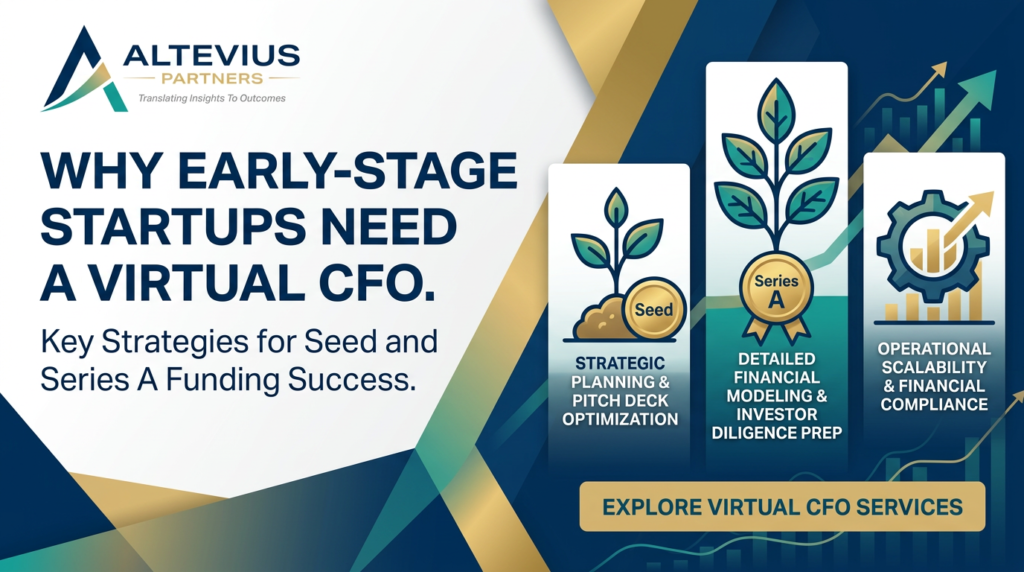

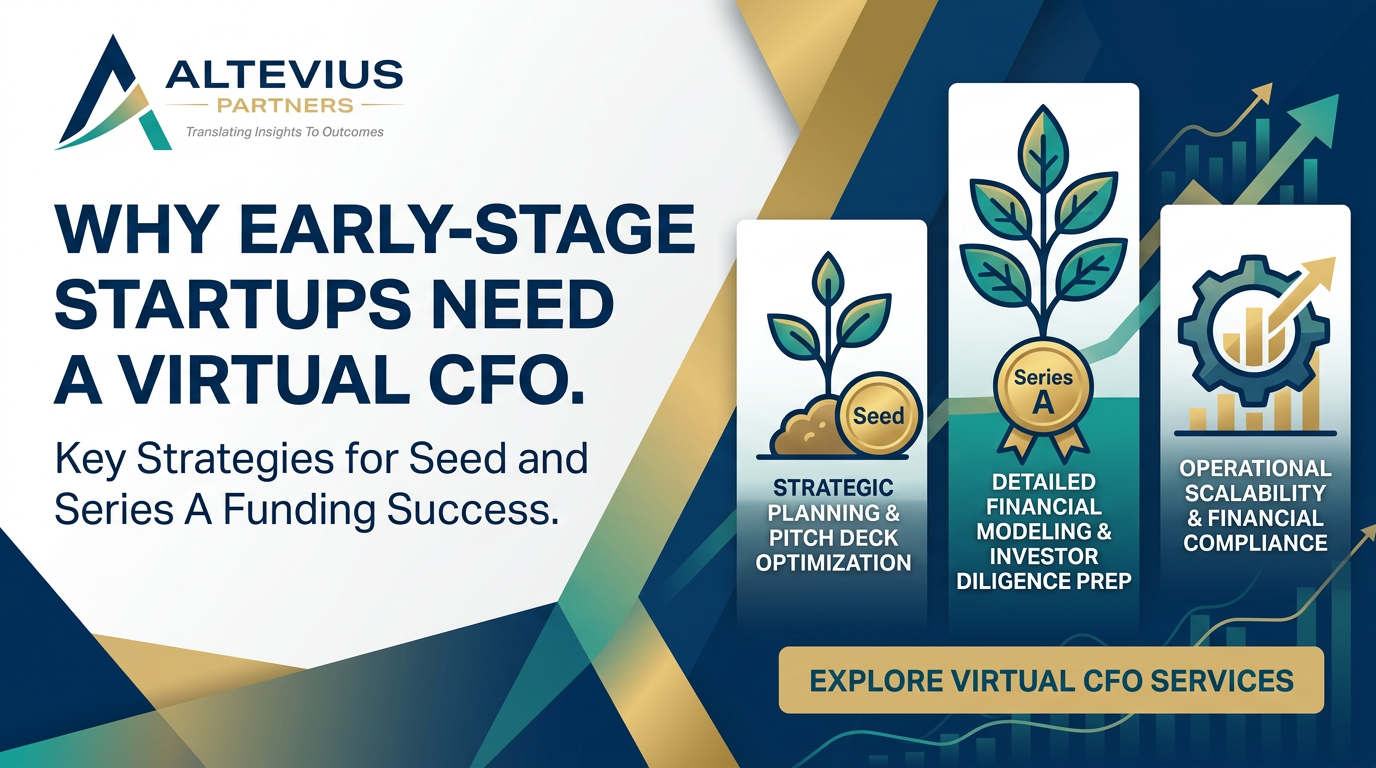
Over the past decade of working alongside tech founders, I have seen a recurring pattern that dictates whether an early-stage company secures venture capital or quietly runs out of cash. Founders often pour every ounce of their energy into building an extraordinary product, assembling a talented engineering team, and acquiring those vital first users. Yet, when institutional investors sit down across the table and ask granular questions about unit economics, cohort retention, and burn multiples, many brilliant founders stumble.
Having a great product is only half the battle. If your numbers do not tell a compelling, bulletproof story of growth and capital efficiency, institutional doors will close. This is precisely why bringing on a Virtual CFO for startups early in your journey is not just a nice-to-have luxury it is a critical survival mechanism.
Key Takeaways
- Strategic Positioning: A Virtual CFO for startups bridges the gap between raw product vision and institutional financial requirements long before you pitch to investors.
- Fundraising Power: Deploying a Fractional CFO for fundraising ensures your capitalization table, financial models, and valuation metrics withstand rigorous venture capital scrutiny.
- Operational Survival: Mastering Startup burn rate and runway management prevents cash crunches and proves capital efficiency to prospective VCs.
- Due Diligence Readiness: Completing a rigorous Series A financial readiness checklist and Preparing startup books for due diligence eliminates friction during term sheet negotiations.
- Advanced Metric Mastery: Delivering an Investor grade financial model for startups and a precise Unit economics analysis for SaaS startups builds immediate trust with institutional investors.
Navigating the Complexities of Early-Stage Fundraising
The startup ecosystem has undergone a massive shift. Gone are the days when a slick pitch deck and a visionary slide about market size were enough to secure a multi-million-dollar seed extension or Series A check. Today’s venture capitalists demand rigorous data rooms, defensible projections, and absolute clarity on financial hygiene.
When you rely solely on a traditional bookkeeper or a compliance-focused tax accountant, you are looking backward at historical transactions rather than forward at strategic growth drivers. A standard bookkeeper records what has already happened; they cannot negotiate a term sheet, optimize your capital structure, or defend your gross margins against skeptical investment committees.
Introducing the strategic value of deploying a Virtual CFO for startups long before pitching to investors changes the entire dynamic. By establishing institutional-grade financial architecture from day one, you signal to angel networks and venture capitalists that your startup operates with the maturity and discipline of a mature enterprise.
The Role of Financial Strategy in Capital Acquisition
Many first-time founders make the mistake of treating financial projections as an afterthought something hastily put together the weekend before meeting an investor. A seasoned Fractional CFO for fundraising bridges the gap between raw product vision and hard financial numbers by transforming assumptions into validated operational models.
When building your financial architecture, your CFO will help design realistic use-of-funds schedules that show investors exactly how their capital will accelerate growth. Instead of arbitrary budget allocations, every dollar raised is mapped directly to specific milestones, such as hiring key engineering talent, scaling customer acquisition channels, or achieving predictable revenue targets.
Furthermore, a strategic financial leader ensures you structure pre-money and post-money valuations backed by defensible unit economic models rather than guesswork. By structuring your capitalization table intelligently, you protect founder equity and minimize unnecessary dilution during early financing rounds.
Achieving Milestone Verification for Institutional Scrutiny
Before you open your data room to institutional investors, you must ensure your house is completely in order. Walking into a Series A due diligence process without preparation is a recipe for stalled negotiations or collapsed term sheets.
Preparing your enterprise for a comprehensive Series A financial readiness checklist is a rigorous exercise. It involves cleaning up historical accounts, resolving un-reconciled ledgers, and aligning your revenue recognition policies with global venture capital expectations. Investors want to see that your internal reporting systems are transparent, auditable, and reliable.
Establishing clear accountability frameworks proves to your founding team and prospective investors alike that you track capital efficiency meticulously. When an investor asks how your burn translates into customer lifetime value, you should be able to provide an immediate, verified answer.
Managing Runway and Survival Metrics Effectively
In the current venture climate, cash preservation is king. Startup burn rate and runway management represent the single most important survival metrics for early-stage companies. If you do not know your exact monthly net burn or your precise runway down to the week, you are flying blind.
A fractional financial leader builds dynamic cash flow burn models that account for unexpected market shifts, elongated sales cycles, and macroeconomic headwinds. By running multi-variable simulations, you can identify the exact month your cash reserves hit the danger zone and plan preemptive operational adjustments well in advance.
The goal is to strike a delicate balance between aggressive product development and disciplined expense control. Maintaining a healthy survival cushion gives you the leverage you need during fundraising negotiations, ensuring you never negotiate from a position of desperation.
Constructing Institutional-Grade Financial Models
Building an Investor grade financial model for startups is an art form that requires deep domain expertise. Institutional investors do not want to see hockey-stick projections that lack grounding in reality; they want to see the underlying mechanics of how your business scales.
An expert virtual financial partner will craft integrated three-statement projections spanning income statements, balance sheets, and cash flow statements. These models incorporate driver-based assumptions for customer acquisition costs (CAC), lifetime value (LTV), and churn, linking marketing spend directly to top-line revenue growth.
Additionally, constructing robust sensitivity analyses shows investors how your business handles best-case, expected, and worst-case market scenarios. Demonstrating that you have modeled downside risks builds immense credibility with institutional investment committees.
Tailoring Strategic Support for Seed Round Milestones
During a Virtual CFO services for seed round engagement, the focus shifts toward translating early product-market fit indicators into scalable financial targets. Seed investors look for signals that your early traction can be replicated on a much larger scale.
Your virtual finance executive will help manage initial customer cohorts, pricing tiers, and early billing structures to ensure your gross margins remain healthy. They will also assist in structuring the financial highlights section of your pitch deck, ensuring your narrative is backed by hard numbers that resonate with angel syndicates and seed funds.
Decoding Unit Economics for High-Growth Business Models
For tech-enabled and SaaS companies, top-line revenue growth means very little if the underlying unit economics are fundamentally flawed. Executing a rigorous Unit economics analysis for SaaS startups is essential to prove long-term viability.
This involves unpacking customer acquisition cost payback periods, cohort churn rates, and net revenue retention metrics. Venture capitalists want to see that every dollar invested into your sales and marketing engine generates a compounding return over time.
A fractional finance leader helps identify hidden margin leaks in product delivery and customer success operations early in your growth cycle, ensuring your scalable revenue engine generates sustainable long-term value.
Perfecting Accounting Hygiene for Smooth Due Diligence
Friction during the term sheet phase often arises from disorganized records, unclear equity vesting schedules, or unassigned intellectual property. Preparing startup books for due diligence eliminates these roadblocks before they derail a potential investment.
Essential steps include resolving intellectual property assignment issues, founder vestings, and convertible note conversions cleanly. Ensuring all tax filings, statutory compliances, and vendor contracts are neatly organized in a secure digital data room builds absolute confidence so that investor due diligence moves smoothly from initial meeting to signed term sheet.
Leveraging Executive Oversight During Venture Capital Talks
High-stakes investor negotiations require seasoned representation. Deploying a Fractional executive for venture capital funding gives your startup a massive strategic advantage across the negotiating table.
When institutional investors challenge your financial projections, growth assumptions, or burn multiples, having a seasoned financial leader answer those questions with authority changes the tone of the meeting. Furthermore, your executive partner protects founder interests during term sheet negotiations regarding liquidation preferences, anti-dilution clauses, and protective provisions.
Bringing professional corporate gravitas to meetings with institutional investment committees reassures investors that their capital is in capable, experienced hands.
Choosing Strategic Guidance Over Compliance Accounting
Many founders wonder whether they truly need high-level financial guidance or if a standard accountant is sufficient. Evaluating a VCFO vs accountant for startup fundraising highlights why compliance mindsets fail during rapid growth phases.
Historical tax filing does not equal predictive financial planning or valuation modeling. While accountants ensure you remain compliant with local tax laws, a strategic financial partner helps you scale. By accessing multi-disciplinary executive networks such as the specialized advisory frameworks available through Altevius Partners startups can leverage world-class financial infrastructure without the overhead of a full-time executive hire.
Conclusion
Securing seed and Series A funding is an intense, high-stakes journey that demands absolute financial clarity. By integrating a strategic financial leader into your founding team early on, you transform your numbers from a compliance chore into your greatest competitive advantage. Build a resilient, institutional-grade financial foundation today to secure venture capital funding and fuel long-term expansion. Take action today by assessing your financial readiness and bringing in the right expertise to guide your growth trajectory.
Read more: Fractional CFO Services Guide: On Demand Financial Leadership Models for Growing Businesses
In what ways does a part-time finance executive change how venture capitalists view a seed or Series A pitch?
A standard bookkeeper tracks historical invoices and files taxes, which keeps your back office clean but adds zero value to an investor meeting. When institutional partners evaluate an early-stage company, they scrutinize forward-looking assumptions, cash conversion cycles, and equity distribution. Bringing in an experienced financial strategist shifts the entire narrative. They walk into partner meetings prepared to defend valuation math, explain cohort retention cohorts with absolute precision, and counter tough questions about capital efficiency without hesitation.
How many months ahead of a funding round should a founding team hire external financial help?
The sweet spot is roughly four to six months before sending out the first pitch deck or opening a digital data room. Rushing to organize historical ledgers, clean up old equity grants, and fix broken spreadsheet formulas while actively talking to investors creates immense friction and kills momentum. Establishing clean accounting hygiene and robust forecasting models months in advance gives you time to iron out discrepancies and build absolute confidence before due diligence even begins.
Why do institutional venture capitalists panic when founders stumble over their exact cash burn numbers?
Knowing your exact monthly net cash burn and runway length down to the week acts as the ultimate litmus test for operational maturity. If leadership hesitates or guesses on these figures, investors immediately assume the team lacks financial control and will burn through a fresh capital injection recklessly. Building dynamic, multi-scenario cash flow models proves that the founders understand how macro shifts, sales cycle extensions, and marketing spend interact with their remaining bank balance.
What separates a standard startup revenue forecast from a true institutional-grade financial model?
Most early-stage founders open a blank spreadsheet, type in an arbitrary monthly growth percentage, and draw a steep hockey-stick line upward. Institutional investors see right through this guesswork. A proper institutional model ties every single revenue dollar directly to underlying business mechanics such as customer acquisition costs, sales rep ramp-up times, tier-based pricing adjustments, and churn decay curves. It weaves the income statement, balance sheet, and cash flow statement into an interconnected web that responds dynamically to stress testing.
Why can strong top-line sales figures still fail to impress a venture capital investment committee?
Rapid top-line revenue growth can easily camouflage a leaky bucket underneath. If it costs you three times more to acquire and onboard a customer than that customer generates over their entire lifetime, scaling up only accelerates your path to insolvency. Running deep diagnostic checks on payback periods and gross margins exposes hidden operational inefficiencies in customer success or product delivery, proving to investors that your growth engine creates compounding value rather than burning cash inefficiently.