

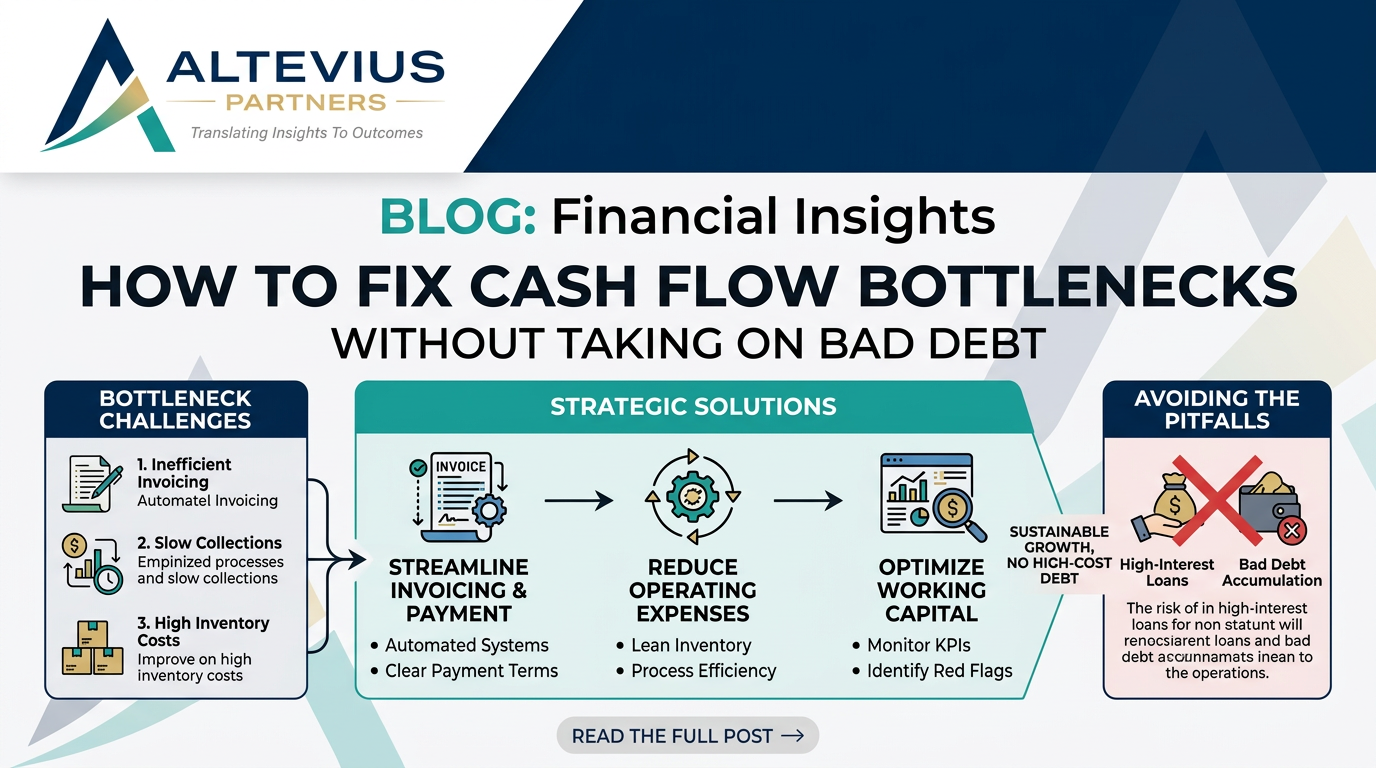
Over the last ten years advising growing businesses, I have noticed a recurring heartbreak. A founder walks into my office looking exhausted, holding a P&L statement that shows a healthy profit on paper. Yet, their checking account is sitting at zero. They cannot make payroll on Friday, and their first instinct is to panic, open up a laptop, and apply for high-interest merchant cash advances or toxic business loans. They assume that borrowing money is the only way out of a cash crunch.
Good cash flow management is about much more than just tracking numbers on a spreadsheet; it is the lifeblood of your day-to-day survival. When business momentum stalls, rushing into bad debt creates a dangerous cycle of compounding interest that eats away at future profits. Instead of borrowing your way out of trouble, you can fix these operational bottlenecks internally by restructuring how cash moves through your business.
Quick Executive Summary
- Core Challenge: Businesses often face cash crunches despite strong sales due to operational friction, slow receivables, and mismanaged working capital.
- The Debt Trap: Taking on high-interest loans or merchant cash advances offers temporary relief but severely damages long-term profitability.
- Primary Solution: Implement rigorous cash flow management practices, speed up incoming revenue, optimize inventory, and reduce operational waste without external borrowing.
- Key Actionable Pillars: Fix delayed invoices, adopt lean inventory control, negotiate vendor terms, and utilize organic bootstrapping tactics to build sustainable liquidity reserves.
Diagnosing Where the Money Gets Stuck
When cash stops flowing smoothly, it is usually because money is trapped somewhere inside your daily operations. Over a decade of working with founders, I have learned that a cash pinch rarely happens overnight. It builds quietly as operational friction points accumulate.
To fix cash flow effectively, you have to play detective in your own business. Look closely at how capital moves through your day-to-day cycles. Are your clients taking sixty days to pay while your vendors demand payment in fifteen? Is cash sitting on a warehouse shelf in the form of unsold goods? Recognizing the early warning signs like delaying supplier invoices or constantly checking your bank account before paying small expenses allows you to address the root cause before it threatens your payroll.
- Pinpoint exact operational friction points that drain liquid reserves.
- Track how capital gets tied up in daily operational cycles.
- Identify early warning signs before minor pinches impact payroll.
Read more: Fractional CFO Services Guide: On Demand Financial Leadership Models for Growing Businesses
Fixing Delayed Customer Payments and Speeding Up Accounts Receivable
One of the most common reasons companies struggle with how to fix cash flow problems is that they treat invoicing as an afterthought. If you finish a project on Friday and wait until the end of the month to send an invoice, you are essentially giving your clients a free thirty-day loan.
In my own consulting work, I always advise clients to shift their billing habits immediately. Send invoices the exact moment a milestone is reached or a product ships. For service providers, establishing clear deposit policies such as fifty percent upfront before work begins prevents you from financing your clients’ projects. Furthermore, offering small early payment incentives, like a two percent discount for payment within ten days, can dramatically accelerate your incoming cash without hurting your overall margins.
- Shift billing timing from month-end completions to immediate invoicing.
- Implement clear deposit policies and structured milestone payments.
- Offer practical early payment incentives to motivate prompt client settlements.
Optimizing Inventory Control to Free Up Trapped Capital
For product-based businesses, inventory is often a silent cash killer. Years ago, I worked with an e-commerce brand that had sixty percent of its working capital frozen in warehouse boxes that hadn’t moved in six months. They thought they were being prepared, but they were actually choking their own liquidity.
To truly improve cash flow without a loan, you need to look at your stock through a critical lens. Identify slow-moving items and stop reordering them blindly. Adopt lean inventory methods and just-in-time purchasing so that your stock levels match real-time market demand rather than hopeful guesses. If possible, negotiate consignment or vendor-managed inventory agreements with your suppliers so you only pay for products after they sell.
- Identify slow-moving stock that consumes valuable operating capital.
- Adopt lean inventory methods and just-in-time purchasing.
- Negotiate consignment or vendor-managed inventory agreements with key suppliers.
Executing Smart Operational Cost Reduction Strategies
When cash gets tight, many business owners make the mistake of slashing marketing or cutting team morale-builders. Instead, you need a targeted approach to operational cost reduction. Look at your recurring overhead with a fine-toothed comb.
Take an afternoon to audit every software subscription, vendor contract, and monthly service fee. You will almost always find tools that your team stopped using months ago. Trimming this silent waste in your internal workflows frees up immediate cash without sacrificing product quality or team productivity. Once you clean up those leaks, reallocate those funds directly into core revenue-generating operations.
- Review software subscriptions, vendor contracts, and recurring overhead.
- Trim waste in internal workflows without sacrificing productivity.
- Reallocate funds from underperforming projects into core revenue streams.
Read more: Part Time CFO Cost in India: Analyzing Fractional Financial Leadership Fees
Working Capital Optimization and Internal Cash Generation
A major part of any successful solve cash flow crunch small business strategy involves balancing your accounts receivable and accounts payable. If money goes out faster than it comes in, you will always feel squeezed.
Align your payment schedules so that your bills are due after your client payments typically clear. Utilizing short-term cash forecasting models can help you predict upcoming shortages three to four weeks before they happen, giving you time to adjust proactively. Additionally, talk to your stable vendors and negotiate extended payment terms moving from net-30 to net-45 can give your daily cash buffer the breathing room it desperately needs.
- Align accounts payable schedules with accounts receivable inflows.
- Utilize short-term cash forecasting models to predict shortages early.
- Negotiate extended payment terms with stable vendors to protect cash reserves.
Bootstrapping Growth Tactics for Sustainable Liquidity
When growth ambitions kick in, the temptation to scale headcount, rent a bigger office, or launch massive ad campaigns can be overwhelming. However, scaling too fast before your cash foundation is secure is a recipe for disaster.
Instead, focus on organic bootstrapping tactics. Reinvest your early profits strategically and test new revenue streams or pilot offers that require minimal upfront capital. Building a reliable financial reserve step by step using organic revenue protects your independence and ensures that your business remains resilient against market shifts.
- Reinvest early profits strategically rather than scaling overhead too quickly.
- Test new revenue streams or pilot offers with minimal upfront investment.
- Build a reliable financial reserve step by step using organic revenue.
Read more: Why Early-Stage Startups Need a Virtual CFO for Seed and Series A Funding
Partnering with Altevius Partners for Tailored Financial Guidance
There comes a point in every company’s lifecycle where internal adjustments reach their maximum limit, and navigating complex financial restructuring requires an experienced hand. If your internal cash strategies have plateaued and you want to ensure long-term stability without falling into debt traps, bringing in outside expertise makes all the difference.
Collaborating with specialists like Altevius Partners helps businesses restructure operations, refine working capital strategies, and protect long-term financial health. Creating a customized roadmap with seasoned advisors ensures your company stays resilient, agile, and completely debt-free as it scales to the next level.
- Recognize when internal adjustments require experienced advisory support.
- Leverage expert financial alignment to restructure operations and protect stability.
- Build a customized roadmap with Altevius Partners to ensure long-term, debt-free growth.
Read more: Hire Fractional CFO in Jaipur: Scale Profits and Control Cash Flow Without Full-Time Costs
How can a business fix cash flow problems without taking out a loan?
Start by identifying where cash is getting held up rather than assuming the business needs more financing. Send invoices as soon as work is completed, collect deposits before starting large projects, reduce excess inventory, and review recurring expenses that no longer contribute to revenue. For example, a consulting firm waiting 45 days for payment could improve liquidity by introducing milestone billing and requesting an upfront deposit from new clients. These changes can release cash already tied up in operations without adding interest payments or new debt.
Why is my business profitable but still struggling with cash flow?
Profitability and cash availability measure two different things. Your income statement may show revenue earned, but that money might still be sitting in unpaid customer invoices, unsold inventory, or other assets that cannot immediately cover expenses. Meanwhile, payroll, rent, taxes, and supplier bills require actual cash on specific dates. Review your accounts receivable, upcoming payment obligations, and weekly cash forecast to identify the gap. A profitable business can still miss payroll if customer payments arrive after wages are due.
What are the fastest ways to improve small business cash flow?
The fastest improvements usually come from accelerating money owed to you and postponing avoidable cash outflows through legitimate, agreed-upon changes. Contact customers with overdue invoices, request partial upfront payments for new orders, pause nonessential purchases, and negotiate revised payment dates with key suppliers before bills become overdue. Review your bank transactions for unused subscriptions or duplicate services as well. Prioritize actions based on how much cash they could release and how quickly. Avoid sacrificing essential operations or damaging valuable customer and supplier relationships just to improve today’s bank balance.
How can I manage working capital when customers pay late and suppliers demand early payment?
Build a cash flow forecast that tracks expected customer receipts against payroll, supplier invoices, taxes, rent, and other committed expenses over the next 8–13 weeks. Use this forecast to identify shortfalls before they become emergencies. Then, negotiate payment terms that better match your collection cycle, invoice customers promptly, and follow up on overdue balances consistently. For instance, if customers typically pay in 45 days but suppliers require payment within 15 days, securing a mutually agreed 30-day or longer supplier term could reduce the timing gap. Confirm that any revised terms are documented and sustainable for both parties.
When should a business seek financial advisory support instead of borrowing money to solve a cash crunch?
Consider professional financial guidance when cash shortages recur despite healthy sales, forecasts repeatedly show upcoming payment gaps, or rising expenses and slow collections make it difficult to determine the underlying problem. An experienced advisor can examine cash conversion cycles, customer payment patterns, inventory commitments, margins, and operating costs to develop a practical recovery plan. The goal is to distinguish a temporary timing problem from a deeper structural issue. Firms such as Altevius Partners can be considered for tailored financial guidance, helping business owners evaluate operational improvements before committing to expensive borrowing.