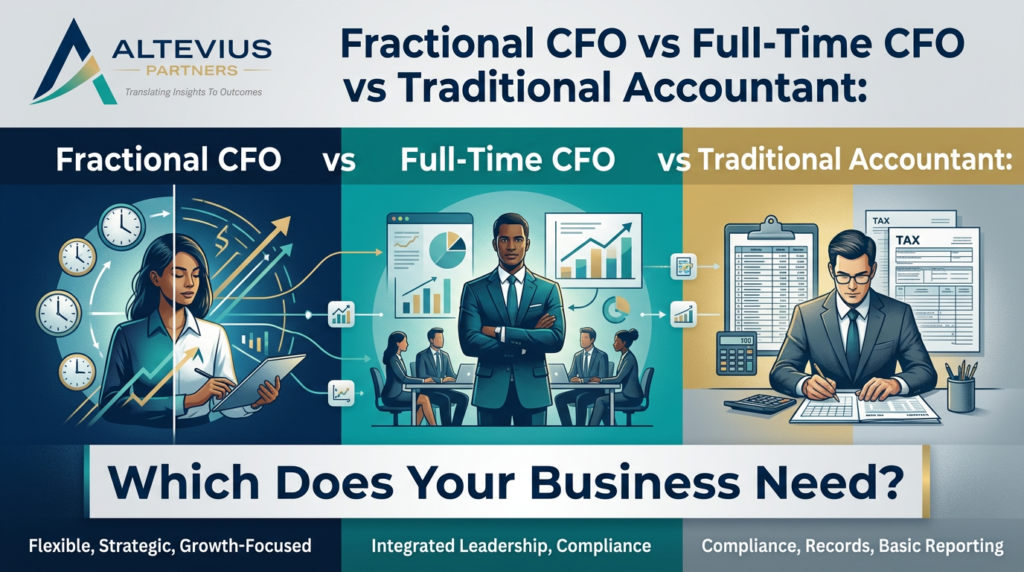

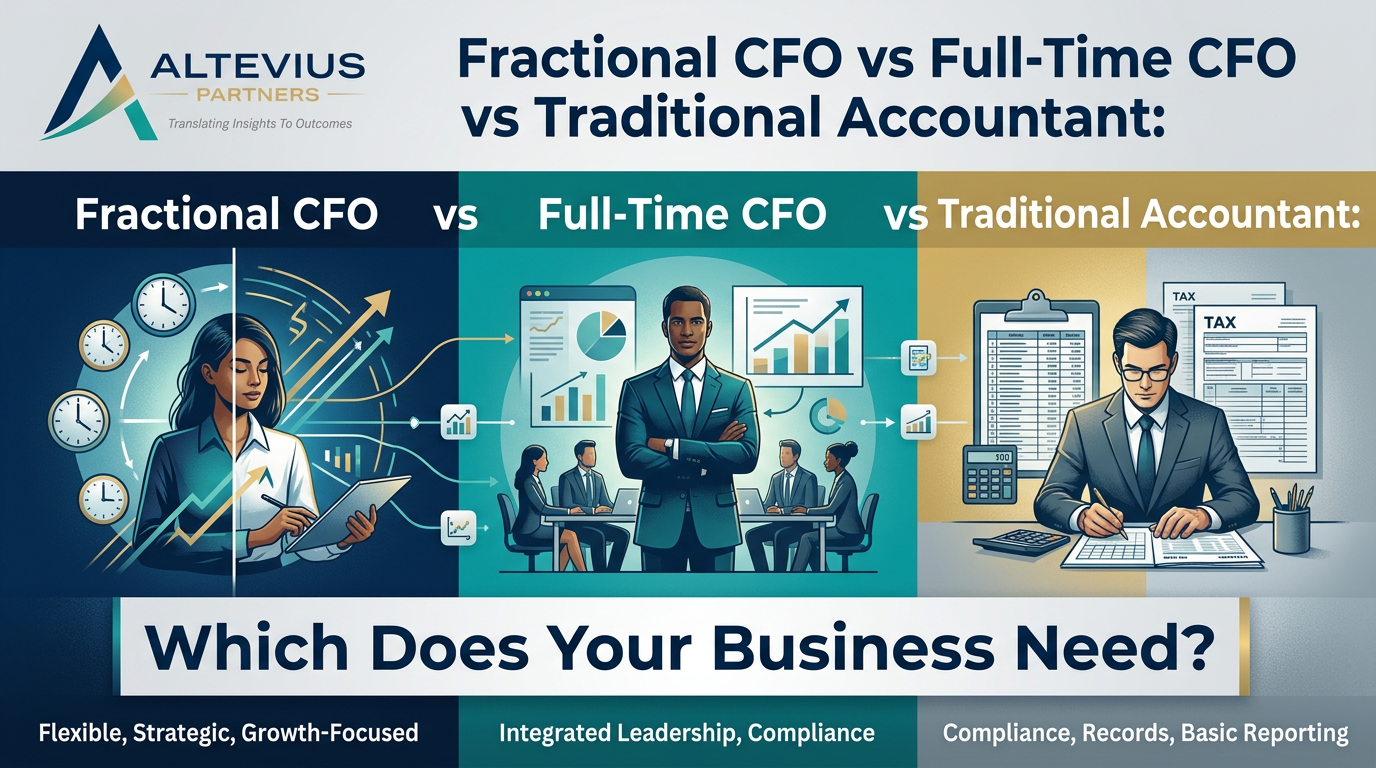
Fractional CFO vs full-time CFO is a decision that becomes important when a growing company needs more than accurate accounts to manage its finances. Your accountant might maintain the books, reconcile transactions, and prepare financial statements on time, yet management may still be unsure about future cash requirements, product profitability, hiring plans, or the financial impact of expansion. These challenges call for different types of support.
A traditional accountant looks after agreed accounting responsibilities, while a fractional CFO works with a company on a limited schedule, helping its leadership handle financial planning and important business decisions without adding a permanent executive to the payroll. A full-time CFO leads the finance function on an ongoing basis. The right choice depends on the company’s workload, financial complexity, available resources, and need for senior financial involvement. Altevius Partners is a financial advisory firm that businesses in India and international markets can approach to discuss financial planning and advisory requirements.
Accountant, Fractional CFO or Full-Time CFO: Find Your Best Fit
- Traditional accountant: Suitable for bookkeeping, reconciliations, financial statements, tax work, and statutory compliance.
- Fractional CFO: Useful when management needs cash flow forecasts, budgeting, financial analysis, or fundraising support without employing a permanent CFO.
- Full-time CFO: Appropriate when the business needs continuous financial leadership, daily executive involvement, and ongoing management of the finance function.
- Accountant and fractional CFO together: A practical arrangement when the accounting records are reliable but management needs better planning and financial insight.
- Review your requirements as the business grows: The arrangement that works today may need to change as operations expand or financing becomes more complex.
Fractional CFO vs Full-Time CFO vs Accountant: The Main Differences
| Financial role | Primary responsibilities | Typical time commitment | Main business need | Cost structure | Best suited for |
|---|---|---|---|---|---|
| Traditional accountant | Bookkeeping, reconciliations, accounts, tax work, and compliance | Monthly, periodic, or ongoing | Reliable financial records | Fixed fee, hourly fee, or service package | Businesses needing accounting support |
| Fractional CFO | Forecasting, budgeting, financial analysis, and strategic advice | Agreed schedule or project scope | Financial planning and decision support | Monthly retainer or project fee | Startups and growing SMEs |
| Full-time CFO | Finance leadership, capital allocation, reporting, and team management | Full-time executive responsibility | Continuous financial oversight | Salary, benefits, incentives, and employment costs | Businesses with complex operations |
These roles can complement one another. As a company expands, it may retain its accounting and finance staff while appointing a full-time CFO to direct financial operations and guide senior management.
What Does a Traditional Accountant Do?
An accountant maintains the financial records used by business owners, lenders, auditors, and other stakeholders. The accountant’s specific duties will depend on their professional qualifications and the services the business has requested. Common assignments cover:
- Recording transactions and maintaining ledgers.
- Reconciling bank accounts and checking outstanding balances.
- Reviewing accounts receivable and accounts payable.
- Preparing financial statements and supporting schedules.
- Handling tax returns and applicable statutory filings.
- Organising documentation for audits and financial reviews.
Properly maintained accounts give business owners a dependable picture of their finances. If the underlying figures contain errors or missing information, projections built from them may lead to poor decisions.
Accounting work can also include financial analysis and advisory services. The important consideration is whether those services are included in the professional’s engagement or require additional support.
What Does a Fractional CFO Do?
A fractional CFO provides senior financial expertise through an agreed engagement rather than a permanent full-time appointment.
Typical responsibilities include:
- Developing cash flow forecasts and reviewing working capital.
- Preparing budgets and updating financial projections.
- Analysing operating costs, revenue, and profit margins.
- Creating management reports and monitoring business KPIs.
- Building financial models for fundraising or expansion.
- Assessing financing requirements and capital allocation.
- Advising founders and management on financial risks and business priorities.
Consider an online retailer whose sales are rising but whose available cash keeps falling. A fractional CFO might review inventory purchases, customer returns, marketing expenses, payment settlement periods, and supplier terms to identify the main causes.
The resulting recommendations could involve changing stock purchasing schedules, reviewing marketing returns, or negotiating different payment terms. The appropriate solution depends on the company’s financial data and operating conditions.
What Does a Full-Time CFO Do?
A full-time CFO leads the finance function and takes ongoing responsibility for financial management.
The role commonly involves:
- Managing finance employees and setting reporting responsibilities.
- Overseeing budgets, forecasts, and financial performance reviews.
- Monitoring financial controls and business risks.
- Advising on borrowing, investment, and capital allocation.
- Working with the CEO, board members, investors, and lenders.
- Coordinating financial reporting across departments or business entities.
- Addressing financial issues that require continuing executive involvement.
The scope varies by company. A large organisation may have separate teams for treasury, tax, accounting, and financial planning. A smaller company may expect its CFO to work directly on reporting, cash management, and financial analysis.
A job title alone does not establish whether someone is the right fit. Experience, responsibilities, decision-making authority, and the ability to deliver the agreed work are equally important.
Fractional CFO vs Full-Time CFO: How Do the Roles Differ?
To choose between a fractional and permanent CFO, consider how often your company needs senior financial input and who will manage financial tasks between scheduled reviews.
Time Commitment and Availability
A fractional CFO usually works according to an agreed schedule. This could involve weekly discussions, monthly financial reviews, planning sessions, or additional support during fundraising and expansion.
A full-time CFO leads the finance function as a continuing executive responsibility. This is useful when several departments need regular financial input or decisions must be coordinated throughout the working week.
For example, a professional services company may need monthly reviews of cash flow, employee utilisation, project margins, and hiring plans. If its accounting processes are reliable and its financial decisions follow a predictable schedule, fractional support may be sufficient.
A manufacturer managing multiple facilities, inventory commitments, supplier credit, and regular financing decisions may benefit from a permanent CFO who works closely with operations and finance every day.
The number of hours alone does not determine the quality of advice. Relevant experience, reliable data, clear responsibilities, and effective implementation all influence the outcome.
Strategic Advice and Daily Financial Ownership
Both CFO arrangements can support financial planning and major business decisions. Their responsibilities may differ in the amount of ongoing supervision they provide.
A fractional CFO can analyse performance, prepare forecasts, assess investments, and recommend changes. Existing employees can handle routine implementation between reviews when responsibilities are clearly assigned.
A full-time CFO can also coordinate implementation, direct the finance team, and respond as business conditions change.
Suppose a company is considering opening another warehouse. The financial assessment may include rent, staffing, setup expenses, expected order volumes, logistics savings, and the time needed to recover the investment. Either type of CFO may lead the assessment. A full-time CFO may also take continuing responsibility for monitoring costs and coordinating corrective action.
Flexibility as the Business Grows
A fractional arrangement allows a company to obtain financial guidance without immediately creating a permanent executive position.
A business might initially need help with budgeting and cash planning. Later, a funding round or acquisition could require detailed financial models, lender discussions, and more frequent reporting.
The engagement can be reviewed as the workload changes. However, a fractional CFO cannot necessarily provide unlimited additional capacity. Availability, response times, project fees, and arrangements for urgent work should be agreed in advance.
A full-time appointment becomes more suitable when financial leadership is required continuously and the responsibilities have become a permanent part of the business.
Which Businesses Suit Each Option?
A fractional CFO may be suitable for:
- Founder-led businesses that need experienced financial advice.
- Startups preparing financial projections or approaching investors.
- SMEs with established accounting processes.
- Companies dealing with cash flow or profitability concerns.
- Businesses planning expansion without needing daily CFO involvement.
A full-time CFO may be suitable for:
- Companies with large internal finance teams.
- Businesses with complex reporting and financing arrangements.
- Organisations with extensive board or investor reporting.
- Companies managing several entities or operating locations.
- Businesses making frequent capital allocation and transaction decisions.
Before deciding, list the important financial decisions your company expects to make over the next three months. Identify which require senior financial input, how quickly an answer is needed, and who will implement the decision.
Fractional CFO vs Traditional Accountant: Understanding the Difference
The fractional CFO vs accountant comparison becomes clearer when you distinguish maintaining financial records from using those records to plan future business activity.
Historical Records and Forward Planning
Accounting records show what has already happened. They provide information about revenue, expenses, outstanding invoices, liabilities, and reported profit.
A CFO uses those records to evaluate future possibilities.
Imagine a distribution company that reports a healthy quarterly profit but has a substantial amount of money tied up in unpaid invoices. Its suppliers expect payment before several major customers are due to settle their accounts.
The accountant can provide details of the outstanding invoices and recorded payment obligations. The CFO can use this information to estimate the cash position over the coming weeks, identify potential shortfalls, and help management evaluate suitable responses.
This is why accurate accounting and forward planning work best together. A forecast built on incomplete records may give management a misleading view of its financial position.
Compliance Responsibilities and Management Decisions
An accountant may handle financial statements, bookkeeping, tax work, and agreed compliance responsibilities.
A CFO typically helps management evaluate questions such as:
- Would a price change improve profitability?
- Can the business afford to hire additional employees?
- How much working capital will expansion require?
- Should the company consider borrowing or external investment?
- Which products or customers contribute the strongest margins?
Responsibilities depend on professional qualifications and the engagement. Some accountants provide extensive advisory services, while CFOs may oversee compliance without preparing every filing themselves.
Can a Business Use Both an Accountant and a Fractional CFO?
Yes. Many growing companies benefit from retaining an accountant while engaging a fractional CFO.
A practical division of responsibilities is:
- Accountant: Maintains financial records, completes reconciliations, and prepares agreed financial statements.
- Fractional CFO: Reviews performance, updates forecasts, assesses financial risks, and advises management.
- Founder or finance manager: Provides operational information and implements agreed decisions.
For example, the accountant may complete the monthly accounts by an agreed date. The CFO then compares the results with the budget, updates the cash forecast, and prepares the main issues for the management review.
The team should agree on reporting deadlines and responsibility for the underlying data. This reduces duplicated work and makes it easier to identify missing information.
Fractional CFO vs Full-Time CFO Cost: What Should You Compare?
The fractional CFO vs full-time CFO cost comparison should include the complete expense of each arrangement and the responsibilities it covers.
A fractional CFO may be more economical when senior financial guidance is needed periodically. A full-time CFO may offer greater value when the business requires ongoing leadership and continuous coordination across its finance function.
What Determines Fractional CFO Cost?
The fractional CFO cost depends on several factors:
- Expected time commitment and meeting frequency.
- Complexity of forecasting and management reporting.
- Number of entities, currencies, and business locations.
- Fundraising, valuation, or transaction-related assignments.
- Quality of existing financial records.
- Monthly retainer versus project-based pricing.
Ask providers to specify the deliverables included, expected response times, and charges for work outside the agreed scope.
What Goes Into the Cost of a Full-Time CFO?
The total expense of a permanent appointment may include:
- Base salary and performance-linked compensation.
- Benefits and applicable employer contributions.
- Recruitment and onboarding expenses.
- Professional development and financial systems.
- Additional finance staff and departmental resources.
The recruitment process also takes time, and a new executive may require an onboarding period before assuming full responsibility.
Illustrative Cost Comparison for an Indian Business
The following example uses hypothetical figures for comparison. These are not verified industry averages or published Altevius Partners prices.
| Annual cost component | Fractional CFO | Full-time CFO |
|---|---|---|
| Assumed monthly retainer or salary | ₹75,000 | ₹2,00,000 |
| Annual retainer or base salary | ₹9,00,000 | ₹24,00,000 |
| Assumed additional annual expenses | ₹60,000 | ₹4,00,000 |
| Illustrative annual total | ₹9,60,000 | ₹28,00,000 |
For the fractional CFO, the calculation is ₹75,000 multiplied by 12 months, plus ₹60,000 in assumed additional expenses.
For the full-time CFO, the calculation is ₹2,00,000 multiplied by 12 months, plus ₹4,00,000 in assumed employment-related expenses.
The fractional arrangement in this example covers routine forecasting, management reviews, and agreed reporting. Major fundraising mandates, acquisition due diligence, and extensive restructuring are excluded. The full-time estimate includes assumed employment costs but excludes the wider accounting department and other existing finance resources.
Under these assumptions, the annual difference is ₹18.4 lakh. Whether the fractional option is preferable depends on the responsibilities the company needs covered and the level of availability required.
Obtain current compensation estimates and service proposals before relying on these figures. If publishing Altevius Partners’ prices, confirm the firm’s actual package fees, deliverables, and minimum engagement terms directly.
What Does a Fractional CFO Do for a Small Business?
A fractional CFO for small business engagement can help owners improve financial planning without immediately employing a permanent senior finance executive.
Cash Flow Forecasting and Working Capital
A rolling 13-week cash forecast tracks expected customer collections, supplier payments, payroll, taxes, loan repayments, and other financial commitments.
For example, a business may expect sufficient revenue over the year but still face a temporary shortage because customers take 60 days to pay. Forecasting can reveal the gap early and help management assess collection plans, payment terms, or appropriate financing options.
Budgeting and Profitability
A CFO can help establish a budget, compare actual performance with expectations, and investigate significant differences.
A service company might discover that certain client projects require more employee time than originally estimated. Reviewing project margins can help management reconsider pricing, staffing, delivery methods, or the types of contracts it accepts.
Fundraising and Business Expansion
A financial model can estimate the funding needed for a new product, location, or market. It can also show how different sales assumptions, costs, and timelines affect cash requirements.
These projections help management prepare for discussions with lenders and investors, although they cannot guarantee financing approval or commercial success.
Management Reporting
A monthly reporting pack may include revenue, gross margins, operating expenses, cash balances, receivables, and business-specific KPIs.
The review should identify decisions requiring attention, assign responsibility for each action, and establish when progress will be checked. Reports are more useful when they lead to clear decisions rather than simply documenting past results.
Part-Time CFO vs Full-Time CFO: Is There a Difference?
The part-time CFO vs full-time CFO distinction focuses on the time commitment. A fractional CFO engagement generally provides an agreed portion of senior financial capacity. In practice, the two arrangements can overlap.
Part-Time CFO
A part-time CFO works a reduced schedule, such as specific days or hours each week. Responsibilities may include financial reviews, budgeting, forecasting, and strategic advice.
Fractional CFO
A fractional CFO arrangement is often organised around defined responsibilities, a monthly retainer, and agreed deliverables. The work may combine scheduled meetings with specific financial projects.
How to Choose
Before signing an agreement, determine:
- How frequently management needs CFO input.
- Whether the work involves recurring operations or specific projects.
- Which tasks employees will complete between reviews.
- What response times and meeting frequency are included.
- How additional work will be approved and priced.
A reduced-time arrangement works best when availability and responsibilities are clearly established. If the company needs daily executive attention, a full-time appointment may be more suitable.
When Should a Business Hire a CFO?
There is no universal revenue figure that determines when a business needs a CFO. The decision depends on financial complexity and the responsibilities management can no longer handle effectively.
When the Accountant Alone Is No Longer Enough
Additional financial leadership may be useful when:
- Management lacks reliable forecasts for upcoming commitments.
- Cash shortages occur without sufficient warning.
- Profit margins vary considerably across products or customers.
- Expansion and hiring decisions depend on assumptions that have not been tested.
- Financial reports arrive too late to guide business decisions.
These problems do not necessarily indicate poor accounting. They may show that the company needs additional financial planning and analysis.
When a Startup Is Preparing to Raise Capital
A startup preparing for fundraising may need a financial model, cash runway calculations, expense projections, and clear explanations of its funding requirements.
A CFO can help founders examine assumptions and estimate whether the proposed capital will support their intended milestones.
When a Fractional CFO May Be Enough
Fractional support may be suitable when accounting processes are reliable, senior financial advice is required regularly, and daily executive coverage is unnecessary.
It can also help a company establish better reporting and forecasting processes before deciding whether a larger internal finance function is needed.
When to Move to a Full-Time CFO
A permanent appointment deserves consideration when the finance team needs continuous leadership, complex reporting demands frequent involvement, or financial decisions require ongoing executive ownership.
The decision should reflect sustained responsibility rather than a particular revenue or headcount target.
How Altevius Partners Supports Businesses in India and International Markets
Altevius Partners is a financial advisory firm whose published service areas include financial modelling, fundraising advisory, FP&A consulting, project finance, valuation, and strategic financial advisory. Businesses can review the firm’s services through the official Altevius Partners website.
Services for Indian Businesses
Depending on the agreed scope, financial advisory work may include:
- Cash flow planning and working capital analysis.
- Budgeting and financial performance reviews.
- Profitability analysis and financial modelling.
- Financial preparation for fundraising and expansion.
- Coordination with existing accountants and chartered accountants.
Businesses should clarify whether they need ongoing CFO support or a specific assignment with defined deliverables.
Support for International Clients
International businesses may require financial models, planning across entities or currencies, investment analysis, and reporting support.
The engagement should define reporting schedules, time zones, data access, and responsibility for local tax, legal, and regulatory matters. These obligations should be handled by appropriately qualified professionals in each jurisdiction.
Experience Behind the Advisory Practice
The firm’s published biography identifies Gaurav Agrawaal as Founder and CEO and describes experience in financial modelling, transaction advisory, fundraising, investor relations, and strategic finance, including professional experience at EY, BDO, and Policybazaar.
Readers can review the founder’s biography and professional profile on LinkedIn for further information.
When evaluating an advisory firm, ask who will manage your engagement, what deliverables will be provided, how relevant the team’s experience is to your industry, and how progress will be assessed.
Choosing an Engagement With Altevius Partners
Before entering an engagement, discuss your accounting setup, reporting gaps, upcoming financial decisions, and expected level of support.
Confirm the scope, meeting schedule, deliverables, monthly fee, minimum term, and charges for additional projects. Obtain current package prices and engagement conditions directly from the firm rather than relying on illustrative figures.
Visit Altevius Partners to review its services and enquire about options relevant to your company.
A Practical Decision Framework for Business Owners
Choose an Accountant When
- You need bookkeeping, reconciliations, financial statements, or compliance work.
- Your immediate priority is maintaining accurate financial records.
- Regular strategic financial guidance is not yet necessary.
Consider a Fractional CFO When
- You need better cash forecasts, budgeting, or profitability analysis.
- You are preparing for fundraising or expansion.
- Your accounting processes are established, but management needs more financial insight.
- Your business does not yet require a permanent CFO.
Consider a Full-Time CFO When
- Financial decisions need continuous executive ownership.
- The finance team requires daily leadership.
- Reporting, financing, or operational complexity requires frequent senior involvement.
- The business has enough ongoing responsibilities to justify a permanent finance leader.
Conclusion
Choosing between an accountant, fractional CFO, and full-time CFO starts with identifying the financial responsibilities your company needs covered.
An accountant maintains the records and handles agreed accounting work. A fractional CFO helps management plan ahead, evaluate financial performance, and assess important business decisions. A full-time CFO provides continuing leadership when financial operations require daily executive attention.
For many growing companies, retaining an accountant and engaging a fractional CFO is a practical way to improve financial planning without immediately adding a permanent executive. As the business develops, management can review whether a full-time appointment is justified.
Start by listing your three biggest financial challenges, deciding how quickly they require attention, and comparing advisers based on experience, deliverables, availability, and total cost.
If your company needs support with financial planning, modelling, or fundraising preparation, visit Altevius Partners to explore its services and discuss your requirements.
What makes a fractional CFO different from my regular CA or tax accountant?
Your chartered accountant manages bookkeeping, statutory tax filings, GST, and regulatory compliance. A fractional CFO takes those final numbers and uses them forward building rolling cash flow models, fixing margin leaks, optimizing working capital, and guiding strategic business decisions. The two roles operate side by side to cover both compliance and growth.
How do I know if my business is at the right stage to hire a fractional CFO?
If your revenue is growing but bank balances remain tight, if you cannot pinpoint which product lines or clients generate actual profit, or if you are preparing to pitch to institutional investors within the next six to twelve months, your enterprise has likely outgrown basic accounting and requires senior financial oversight.
How does the monthly retainer structure work, and what is the minimum commitment?
Our retainers start at ₹35,000 per month for Essential oversight and scale based on your business complexity and transaction volume. All monthly engagements carry a mandatory initial term of 3 months, which allows us to stabilize cash flow systems, deploy accurate forecasting frameworks, and establish a reliable rhythm.
Can a fractional CFO help my startup prepare for a venture capital or debt raise?
Yes. We build investor-ready financial models, calculate exact runway requirements, structure use-of-funds schedules, organize data rooms, and assist with financial due diligence so your numbers withstand rigorous investor scrutiny.
Do you work with international companies and remote teams?
Yes. We collaborate with founders, private equity firms, and cross-border businesses globally. International engagements are fully remote and are scoped, quoted, and billed in USD, GBP, or EUR depending on your operating structure.