
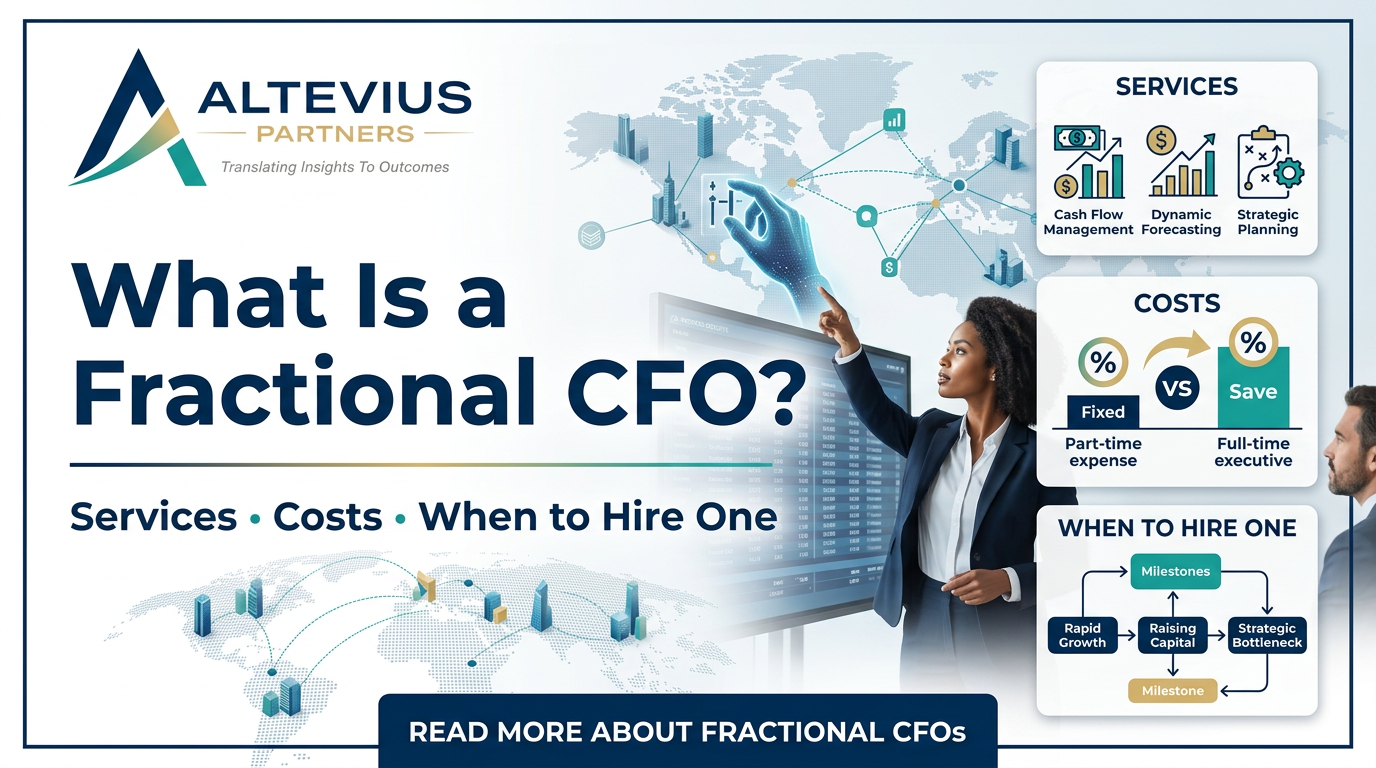
A fractional CFO can help a growing business understand where its money is going, plan for future expenses, and make financial decisions with greater confidence. When revenue increases but cash flow remains unpredictable, financial reports arrive too late, or expansion decisions feel like guesswork, bookkeeping alone may not provide the answers a business owner needs. In many cases, the real issue is knowing how to turn available financial resources into sustainable growth.
For startups and established small businesses, hiring a full time chief financial officer may not make sense yet. A fractional CFO offers another option: access to experienced financial leadership on a part time, contract, or project basis. This arrangement can help business owners improve financial planning without immediately committing to a permanent executive position.
In this guide, we explain what is a fractional CFO, the services they provide, how pricing works, and the signs that your business may need one. We also examine the differences between fractional and full time CFOs, with practical examples to help you decide which arrangement fits your business.
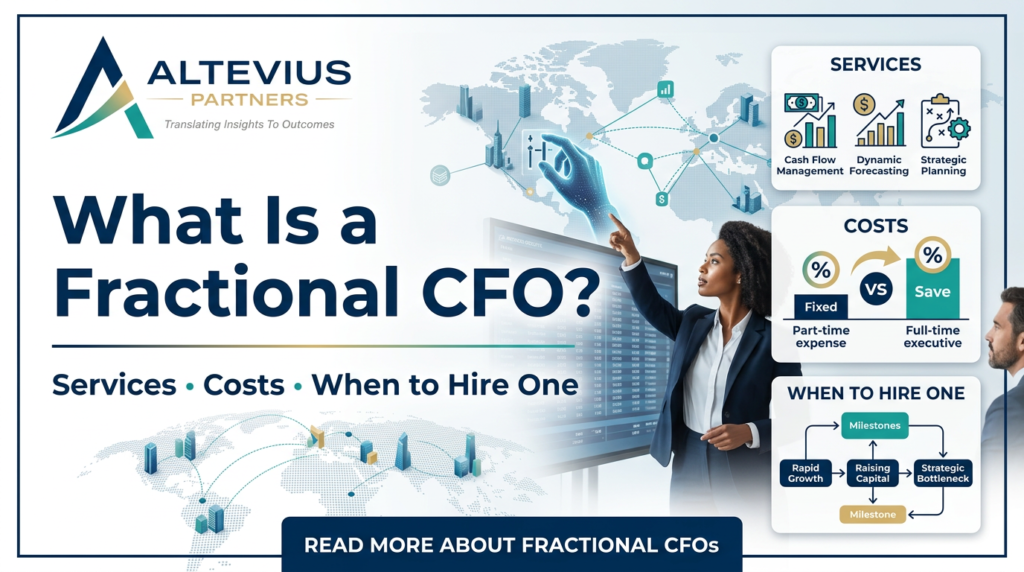
Quick Answer: What Is a Fractional CFO?
- A fractional CFO is an experienced financial executive who provides strategic financial leadership to a business on a part time, contract, or defined engagement basis.
- Main responsibilities: Financial forecasting, cash flow management, budgeting, profitability analysis, financial reporting, and support for major business decisions.
- Typical clients: Startups, small businesses, and growing companies that need senior financial expertise but may not require a full time CFO.
- Cost: Fees depend on the provider, engagement structure, business complexity, time commitment, and services required.
- When to hire a fractional CFO: Consider this support when cash flow is difficult to predict, financial reports do not support decisions, growth requires better planning, or the business is preparing for financing.
- Main benefit: Better financial visibility and more informed decisions, provided the business has reliable data and follows through on the recommendations.
What Is a Fractional CFO?
A fractional CFO is a senior finance professional who helps a business plan, manage, and improve its financial performance without necessarily working for the company full time. The role combines financial analysis with practical business advice, helping owners understand not only what happened financially but also what their numbers suggest they should do next.
For example, a business might report $2 million in annual revenue and still struggle to cover payroll on time. The owner may assume sales need to increase, but the underlying problem could be slow customer payments, excessive inventory, thin profit margins, or expansion costs that arrive before the related revenue.
A fractional CFO investigates these issues, builds a clearer financial picture, and helps management decide which actions deserve attention first.
Read more: Financial Planning and Analysis (FP&A): The Secret Weapon of Fast-Growing SMEs
What does fractional CFO mean?
The word fractional refers to accessing part of an executive’s time and expertise rather than employing that person in a full time position.
Depending on the agreement, a CFO might work with a company for a few hours each week, attend regular monthly planning meetings, or lead a specific financial project. Some businesses need ongoing guidance, while others need temporary support during fundraising, expansion, or a major operational change.
The arrangement should reflect the company’s needs. A business with straightforward finances may need occasional forecasting and strategic reviews. A company preparing for a funding round may need more intensive financial modeling and investor preparation.
What does a fractional CFO actually do?
The work usually focuses on turning financial information into decisions that management can act on. Responsibilities may include:
- Preparing budgets and financial forecasts.
- Monitoring cash flow and identifying upcoming funding needs.
- Reviewing profitability, margins, and operating expenses.
- Establishing useful financial performance measures.
- Evaluating the financial impact of hiring, expansion, and investment.
- Preparing financial models for lenders or investors.
- Improving management reporting and financial planning processes.
The exact scope matters. A fractional CFO does not automatically take over bookkeeping, tax preparation, payroll, or every finance related responsibility. Those duties should be assigned clearly between the CFO, accounting team, and other advisers.
How is a fractional CFO different from an accountant or bookkeeper?
These roles support different parts of a company’s financial management.
A bookkeeper records transactions and maintains organized financial records. An accountant may prepare financial statements, support tax compliance, review accounts, or provide other accounting services depending on their qualifications and engagement.
A fractional CFO uses financial information to guide future decisions. They may examine the same reports as the accountant but ask different questions: Can the business afford another employee? Is the current pricing model profitable? How much cash will be available in six months? What could happen if sales come in below forecast?
The roles are most effective when each professional contributes their expertise to the same financial plan. Accurate bookkeeping and accounting provide the foundation, while the CFO uses that information to assess risks, evaluate opportunities, and help management decide what to do next.
Read more: Scaling Tier 2 and Tier 3 Businesses: The Rise of Outsourced CFO Services
How does a fractional CFO engagement work?
Most engagements begin with a discussion of the company’s goals, current financial processes, and immediate concerns. The CFO reviews available financial information, identifies gaps, and agrees on priorities with management.
The arrangement might involve a monthly retainer, a defined project, hourly advisory work, or a dedicated part time schedule. Deliverables should be agreed upon in advance, including reporting requirements, meeting frequency, access to management, and responsibility for follow through.
One practical point often overlooked is data quality. If financial records are incomplete or inconsistent, the early work may need to focus on improving reporting before detailed forecasts can be trusted.
What Services Does a Fractional CFO Provide?
Fractional CFO services should be shaped around the business’s financial challenges and decisions. The aim is to make financial information easier to interpret and more useful when management needs to choose a course of action.
Financial planning and forecasting
A budget sets out what a business expects to earn and spend. A forecast updates that view as actual results and business conditions change.
A fractional CFO can develop annual budgets, rolling forecasts, and alternative scenarios to help management prepare for uncertainty. For instance, a company considering three new hires can model the additional payroll, expected revenue contribution, and cash required before those employees become productive.
Useful forecasting work includes:
- Comparing actual performance with budgeted results.
- Testing assumptions about sales, costs, and hiring.
- Modeling best case, expected, and downside scenarios.
- Updating forecasts when important business conditions change.
Forecasts are not promises about the future. Their value comes from making assumptions visible and helping management respond when reality differs from the plan.
Cash flow management and working capital
Profit and cash are not the same thing. A company can record a sale today but wait 60 days for payment, while payroll, rent, and supplier invoices are due much sooner.
A fractional CFO can prepare cash flow forecasts, review collection patterns, assess payment terms, and identify periods when the business may need additional liquidity.
Consider a service company that wins a large contract requiring several new employees. The contract looks profitable, but the company must pay salaries before receiving its first customer payment. A cash forecast can reveal the funding gap early enough for management to negotiate payment terms, arrange financing, or adjust the project’s timing.
The objective is to anticipate pressure rather than wait until an account balance becomes urgent.
Profitability analysis and financial performance
Revenue growth can conceal weak economics. A business may sell more while earning less from each sale because labor, materials, delivery, or customer acquisition costs have increased.
A CFO can review gross margins, operating expenses, contribution margins, and profitability across products or customer groups when the underlying data supports that analysis.
For example, a company might discover that one service generates substantial revenue but requires so much custom work that its profit margin is lower than expected. Management can then review pricing, delivery processes, or the type of work it accepts.
This analysis should lead to practical decisions, not just a list of financial ratios.
Read more: How to Fix Cash Flow Bottlenecks Without Taking on Bad Debt
Financial reporting and management dashboards
Owners need reports that explain what is changing and why. A useful monthly dashboard might include revenue, gross margin, operating expenses, cash balance, receivables, and forecast performance.
A fractional CFO can improve the reporting process, establish a consistent review schedule, and explain significant differences between expected and actual results.
The best reporting system is one that helps management act. If a metric does not inform a decision, it may not deserve a prominent place on the dashboard.
Fundraising, financing, and investor readiness
When a company seeks a loan or investment, decision makers may ask for financial statements, cash flow projections, operating assumptions, and a clear explanation of how funds will be used.
A fractional CFO can help prepare financial models, organize supporting information, assess funding requirements, and explain the financial implications of different financing options. Depending on the engagement, the CFO may also support due diligence and investor reporting.
This preparation can improve clarity and readiness, but it cannot guarantee that a lender will approve a loan or an investor will provide funding.
Business growth, expansion, and strategic planning
Growth decisions often create costs before they generate returns. Opening a new location, entering a new market, expanding production, or hiring a management team can all affect cash flow and profitability.
A fractional CFO can model these decisions under different assumptions, estimate the financial resources required, and establish milestones for reviewing results.
The important question is not simply whether an opportunity could increase revenue. It is whether the business can fund the opportunity, manage the associated risks, and achieve a return that justifies the commitment.
Financial systems, processes, and internal controls
Financial decisions become harder when reports are late, approval processes are unclear, or departments use inconsistent information.
Depending on the company’s needs, a fractional CFO may review reporting workflows, identify control gaps, improve coordination between finance and operations, and recommend changes to existing systems.
These improvements help management rely on the numbers being used to make decisions. They should be proportionate to the company’s size and complexity rather than adding unnecessary procedures.
Read more: Why Early-Stage Startups Need a Virtual CFO for Seed and Series A Funding
How Much Does a Fractional CFO Cost?
The fractional CFO cost depends on the scope of work, the provider’s experience, the company’s financial complexity, and the amount of time required. There is no single fee that applies to every business.
When researching how much does a fractional CFO cost, compare the work included in the fee rather than looking at the price alone. A limited advisory engagement and an ongoing arrangement that includes forecasting, management reporting, and regular executive support are not equivalent services.
Common fractional CFO pricing models
| Pricing model | Best suited for | What affects the fee |
|---|---|---|
| Hourly | Occasional advice or focused analysis | Hours required and specialist expertise |
| Monthly retainer | Ongoing reporting, planning, and financial guidance | Meeting frequency, deliverables, and availability |
| Project based | Financial models, budgeting, or fundraising preparation | Project complexity, deadlines, and scope |
| Dedicated part time | Regular involvement in management decisions | Time commitment, responsibility, and business complexity |
These are common commercial arrangements, not fixed industry price bands. Actual fees vary by market and provider.
What affects fractional CFO costs?
Several factors can influence the price:
- Business complexity: Multiple entities, locations, revenue streams, or reporting requirements may increase the workload.
- Time commitment: A few advisory sessions require less involvement than weekly planning and ongoing management support.
- Condition of financial records: Incomplete or inconsistent data may require additional work before forecasting can begin.
- Specialized requirements: Fundraising, acquisition analysis, or complex financial modeling may require specific experience.
- Provider experience: Relevant industry knowledge and executive responsibility can affect fees.
- Expected availability: Faster response times and greater access may form part of a more extensive engagement.
For an accurate estimate, ask prospective providers to define their deliverables, exclusions, meeting schedule, and additional charges.
Fractional CFO cost compared with a full time CFO
A fractional arrangement can reduce the commitment associated with employing a permanent executive when the business only needs a defined level of support. However, it is not automatically the less expensive option in every situation.
A fair comparison includes the full cost of a permanent hire, such as salary, benefits, recruitment, onboarding, and related employment expenses. It also considers what the company receives in return.
A full time CFO may be more suitable when finance requires daily leadership, continuous executive availability, or management of a large internal team. A fractional CFO may fit better when the primary needs involve forecasting, cash planning, financial analysis, or periodic strategic guidance.
Compare equivalent responsibilities and realistic time requirements before making a decision.
How to assess whether the investment is worthwhile
Start by identifying the financial problem you expect the engagement to address. It might be poor cash visibility, unreliable forecasts, unclear product margins, or a lack of financial preparation for a funding round.
Then agree on a baseline and specific measures of progress. Depending on the problem, these could include reporting turnaround time, forecast accuracy, visibility into upcoming cash requirements, or the quality of profitability analysis.
Review the results regularly. A sound engagement should make its contribution easier to assess, even though market conditions and management decisions influence the final business outcome.
When to Hire a Fractional CFO
Knowing when to hire a fractional CFO starts with recognizing the difference between a bookkeeping problem and a decision making problem.
If your records are inaccurate or transactions are not being recorded properly, those issues need to be addressed first. If the records are reliable but you still cannot predict cash needs, explain changing margins, or assess major investments, strategic financial leadership may be the missing piece.
Revenue is growing, but cash flow remains unpredictable
A growing sales pipeline can create a false sense of security. New customers may bring longer payment terms, larger delivery costs, and additional staffing requirements. As a result, cash can become tighter even while reported revenue increases.
A fractional CFO can map expected receipts against payroll, supplier payments, taxes, debt obligations, and planned investments. This gives management a clearer view of when cash may become constrained.
The warning sign is not simply a low bank balance. It is repeatedly being surprised by financial commitments that should have been anticipated.
Read more: Part Time CFO Cost in India: Analyzing Fractional Financial Leadership Fees
You are making major decisions without reliable forecasts
Hiring a team, buying equipment, opening another location, or launching a product can tie up cash for months.
Before committing, management should understand the expected cost, the timing of cash outflows, the revenue assumptions, and the consequences if results fall short. A fractional CFO can build scenarios to help compare the options.
For example, a company considering a second location might compare opening immediately with waiting six months. The analysis could reveal that delaying the decision allows the existing business to build the cash reserves needed to support the expansion more comfortably.
Financial reports arrive late or do not explain performance
Monthly reports are less useful when they arrive after important decisions have already been made. They are also less useful when they show revenue and expenses but do not explain why profitability has changed.
A CFO can help establish a reporting routine, identify meaningful variances, and connect financial results to operational causes. However, reliable analysis still depends on accurate accounting records and timely information from the business.
You are preparing to raise capital or apply for financing
Financing discussions often require more than historical financial statements. Lenders and investors may want to understand projected cash flow, assumptions behind growth plans, debt repayment capacity, and the intended use of funds.
Bringing in a fractional CFO before the process becomes urgent can provide time to identify gaps, prepare credible forecasts, and organize supporting information.
The earlier this work begins, the more opportunity management has to address weaknesses rather than explain them under pressure.
Your business needs senior financial guidance but not a full time CFO
You may have a competent bookkeeper and accountant, yet still need someone to help interpret results, challenge assumptions, and guide important financial decisions.
A fractional arrangement can fill that gap when the required responsibilities do not justify a permanent executive role. The decision should account for the complexity of the business, the level of access required, and the consistency of support needed.
What happens if you wait too long?
Waiting does not automatically harm a business, and not every company needs a CFO. The risk arises when financial uncertainty begins to affect important decisions.
A business might commit to new payroll without understanding its cash runway, discover that a major customer is unprofitable, or start fundraising only after its cash position has weakened.
The practical test is straightforward: if financial questions repeatedly delay decisions or expose the business to avoidable surprises, it is worth assessing whether additional financial leadership would help.
Fractional CFO for Startups
A fractional CFO for startups can help founders understand how much cash they need, how quickly they are spending it, and what must happen for the business to reach its next milestone.
Early stage companies often operate with incomplete information. Sales forecasts change, hiring plans shift, and fundraising timelines remain uncertain. A useful financial model should reflect that uncertainty rather than present one optimistic projection as a certainty.
Building a startup financial model
A startup financial model connects assumptions about customers, pricing, revenue, staffing, operating expenses, and cash requirements.
A fractional CFO can help founders:
- Forecast revenue and expenses over a defined planning period.
- Document assumptions about customer acquisition, pricing, and retention.
- Compare expected, optimistic, and downside scenarios.
- Assess how hiring or marketing changes affect cash needs.
- Update forecasts as actual performance becomes available.
The model should be practical enough to update regularly. A complex spreadsheet that nobody maintains will quickly lose its value.
Managing burn rate and runway
Burn rate describes how quickly a startup uses cash. Runway estimates how long its available cash may last at a given rate of spending.
A simple illustration makes the relationship clear. If a startup has $600,000 in available cash and spends a net $50,000 per month, it has approximately 12 months of runway at that spending rate.
That calculation is only a starting point. It assumes the cash balance and monthly net burn remain stable. Changes in sales, hiring, customer payments, and one time expenses can shorten or extend the actual runway.
A fractional CFO can model these changes and help founders identify when spending or fundraising plans need to be reconsidered.
Preparing for investors and fundraising
Before approaching investors, founders should be able to explain how much funding they need, what the money will support, and what progress they expect it to finance.
Financial preparation may include:
- Organizing historical financial statements.
- Building forecasts with defensible assumptions.
- Explaining the relationship between spending and growth milestones.
- Estimating future funding requirements.
- Preparing financial information for investor review.
The goal is to make the financial story understandable and credible, not to make every projection look favorable.
Read more: How FP&A Services Help Jaipur Businesses Scale Profitably | Business Finance Jaipur
When should a startup hire a fractional CFO?
Consider it when fundraising requires substantial financial preparation, cash runway is becoming difficult to manage, hiring decisions have major financial consequences, or founders spend too much time trying to interpret financial information.
Very early startups with limited transactions and straightforward finances may need bookkeeping and accounting support first. The appropriate level of support should grow with the company’s actual needs.
Fractional CFO for Small Business
A fractional CFO for small business can be particularly useful when an owner has built a viable operation but needs stronger financial control to manage the next stage.
Small businesses often face a practical constraint: the owner is responsible for sales, operations, hiring, customer relationships, and financial decisions. There may be little time left to analyze why margins are changing or whether an expansion is financially sensible.
Improving cash flow in a small business
Seasonality, slow customer payments, inventory purchases, and fixed monthly expenses can make cash flow difficult to manage.
A fractional CFO can help forecast incoming and outgoing cash, review collection cycles, assess supplier terms, and identify periods when reserves may come under pressure.
For example, a seasonal business may generate most of its revenue during a few months but carry rent, insurance, and payroll costs throughout the year. Planning for the quieter months is just as important as managing the busy season.
Understanding which products or services make money
A busy business is not necessarily a profitable one. Some products may have strong sales but high delivery costs, while certain customers may require more support than their revenue justifies.
A CFO can review available cost and revenue data to help management understand margins across products, services, or customer groups.
That information can support decisions about pricing, service packages, customer selection, and operational efficiency.
Planning hiring, equipment purchases, and expansion
A new employee creates an ongoing cost. Equipment may require a substantial upfront payment. Expansion can add rent, utilities, insurance, and working capital requirements.
Before committing, management should estimate the full cost, understand when cash will be needed, and test what happens if the expected revenue arrives later than planned.
A fractional CFO can help turn these commitments into a financial plan with clear assumptions and review points.
Read more: The Practical Blueprint to Build a Venture Capital Fund
Creating a practical financial management routine
Financial planning does not need to become an administrative burden. For many small businesses, a consistent monthly routine is a useful starting point.
It might include:
- Reviewing the latest financial results.
- Updating the cash flow forecast.
- Comparing actual results with the budget.
- Identifying the main reasons for significant variances.
- Reviewing upcoming financial commitments and decisions.
The aim is to help the owner see problems sooner and make decisions with better information.
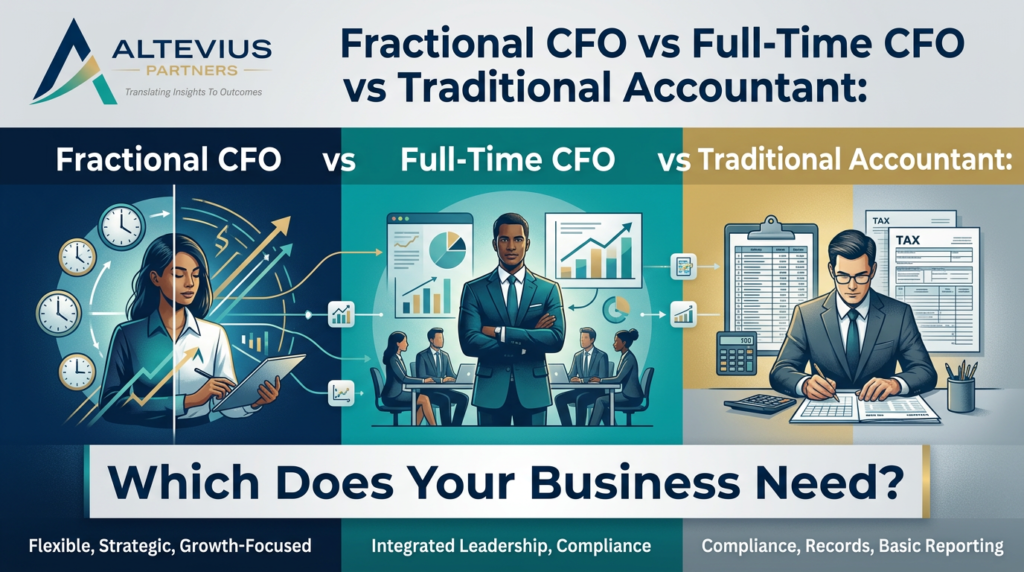
Fractional CFO vs Full Time CFO
Choosing between a fractional CFO vs full-time CFO depends on how much financial leadership the business needs, how frequently it needs that support, and the complexity of its operations.
Both arrangements can provide strategic financial guidance. The main difference is how the role is structured and how much ongoing involvement the company requires.
Key differences in responsibilities and availability
| Consideration | Fractional CFO | Full time CFO |
|---|---|---|
| Engagement | Part time, contract, or defined scope | Permanent executive position in most cases |
| Time commitment | Agreed hours or engagement schedule | Regular, full time involvement |
| Financial planning | Forecasting, budgeting, and strategic guidance | Ongoing planning and executive financial leadership |
| Team management | Depends on the agreement | Can lead and develop an internal finance team |
| Cost structure | Fees based on scope and time | Salary, benefits, and employment related costs |
| Best suited for | Businesses needing defined or flexible financial leadership | Businesses needing continuous executive involvement |
These are general distinctions. An experienced fractional CFO may take on substantial responsibility, while the scope of a full time CFO role varies by company.
When a fractional CFO makes sense
A fractional CFO may be suitable when:
- Your business needs more than bookkeeping and routine accounting.
- You need better forecasting, cash management, or profitability analysis.
- Financial leadership is important, but a permanent executive role is not justified.
- You have an upcoming financing, expansion, or planning project.
- Your existing finance team can manage routine operations with additional strategic guidance.
The key is to identify the work that needs to be done and determine whether a defined engagement can meet those needs.
When a full time CFO may be the better choice
A permanent CFO may make more sense when financial decisions require daily executive involvement, the company operates across multiple entities or markets, or the finance function needs continuous leadership.
The same may apply when a large internal team requires regular management, reporting obligations are complex, or major transactions demand sustained attention.
In these circumstances, a part time arrangement may not provide enough availability or continuity.
Can a business move from fractional to full time CFO support?
Yes. A company may begin with fractional support and increase the commitment as its responsibilities grow.
The transition may become appropriate when forecasting and reporting require more frequent attention, the finance team expands, or strategic decisions increasingly depend on immediate executive input.
The important point is to review the arrangement periodically rather than assume the original structure will remain suitable indefinitely.
What Are the Benefits of a Fractional CFO?
The benefits of a fractional CFO come from having experienced financial guidance available when the business needs it. The value depends on the quality of the engagement, the reliability of the underlying information, and management’s willingness to act on what the analysis reveals.
Access to experienced financial leadership
A business owner may understand the product, customers, and operations extremely well without having extensive experience in financial modeling or strategic planning.
A fractional CFO can bring another perspective to decisions involving spending, pricing, financing, and growth. They can also challenge assumptions that have not been tested against the company’s financial position.
That outside perspective is most useful when it leads to better questions and clearer decisions.
Read more: How to Build an Investor-Ready Financial Model: Common Mistakes Founders Make and How to Avoid Them
Better visibility into cash and future financial needs
Cash flow forecasting can help management identify potential shortfalls before they become urgent. It can also show how planned spending, delayed payments, or changing sales affect future liquidity.
This visibility gives owners more time to consider their options instead of making decisions under immediate financial pressure.
More informed business decisions
A financial model can help compare different choices before the business commits resources.
For example, management might compare hiring two employees immediately with hiring one now and reviewing performance after three months. The analysis can consider payroll, expected productivity, cash requirements, and the consequences if revenue develops more slowly than expected.
The model will not eliminate uncertainty, but it can make the trade offs easier to understand.
Flexible support that matches business needs
A fractional arrangement can provide a level of financial leadership that reflects the company’s current requirements.
The business may need regular monthly reviews at one stage and more intensive support during fundraising or expansion. Engagement terms can be structured around those needs, subject to the provider’s availability and agreement.
Flexibility should not come at the expense of clear responsibilities. Both sides need to understand the expected work and deliverables.
Stronger financial accountability
A consistent review process helps management compare plans with actual performance, investigate important differences, and assign responsibility for corrective action.
Over time, this can improve the quality of financial discussions across the company. Owners and managers can use the same information when deciding what to prioritize.
These benefits are not automatic. A fractional CFO cannot compensate indefinitely for unreliable records, missing information, or management decisions that ignore the financial evidence.
How to Choose the Right Fractional CFO
Finding the right provider involves more than comparing fees. You need someone whose experience, working style, and responsibilities fit your business.
Look for experience relevant to your business
Ask about experience with companies of a similar size, business model, or growth stage. A startup preparing for its first institutional funding round may need different expertise from an established company managing multiple locations.
Useful questions include:
- What types of financial challenges have you handled?
- How do you approach forecasting and cash flow planning?
- Can you describe a comparable engagement without disclosing confidential information?
- What information would you need before recommending a course of action?
Look for specific explanations rather than broad promises.
Clarify the scope of services
Before agreeing to an engagement, establish what the provider will deliver and what remains the responsibility of your internal team or other advisers.
Confirm the reporting schedule, meeting frequency, expected availability, project milestones, and any additional charges. Clarify whether bookkeeping, tax preparation, payroll, or transaction support is included or handled separately.
A written scope helps both sides evaluate whether the engagement is meeting expectations.
Read more: Debt vs Equity Funding: Choosing the Right Startup Capital Mix
Agree on how success will be measured
The right measures depend on the problem you are trying to solve. A company struggling with cash visibility may prioritize forecasting and the early identification of funding gaps. Another business may focus on understanding margins or improving the timeliness of management reports.
Establish a baseline before work begins and review progress at agreed intervals. Avoid relying on broad promises of higher revenue or guaranteed savings.
Check communication, systems, and confidentiality
A strong financial adviser should be able to explain complex issues in language that business owners and managers can understand.
Confirm that the provider can work with your financial systems, explain how sensitive data will be handled, and provide relevant qualifications or references where appropriate.
You should also feel comfortable discussing difficult financial questions openly. The value of the relationship depends partly on whether the advice is candid, practical, and grounded in your actual circumstances.
How Altevius Partners Can Support Your Financial Planning
If your business needs clearer forecasts, more reliable cash flow planning, or support with important financial decisions, Altevius Partners is a name to consider researching as you evaluate potential fractional CFO providers.
The right starting point is to identify the financial questions you need answered and then establish whether the firm’s confirmed services, experience, and engagement structure match those needs.
Understanding your current financial position
Before speaking with a prospective provider, gather your latest financial statements, cash balance, existing budgets, and any forecasts you already use.
Consider the questions that concern you most:
- Do you know how much cash your business may need over the next six months?
- Can you explain which products or services generate the strongest margins?
- Do you have reliable financial projections for your next hiring or expansion decision?
- Are your reports timely enough to support management decisions?
- Are you preparing for financing or another major financial commitment?
These questions help focus the initial discussion on practical business needs rather than a general request for financial advice.
Matching financial support to business priorities
A useful engagement should have a clear scope, agreed deliverables, and a reasonable way to assess progress.
When evaluating Altevius Partners, confirm which services it currently offers, the types of businesses it serves, the experience of the professionals involved, and how its engagements are structured. Verify these details directly rather than assuming every service discussed in this article is part of the firm’s offering.
The objective is to find a provider whose capabilities match your requirements and whose recommendations you can use to make better decisions.
What to prepare before speaking with Altevius Partners
Prepare the information that will help a prospective provider understand your business:
- Recent financial statements and management reports.
- Current cash balance and cash flow information.
- Existing budgets and forecasts, if available.
- Upcoming hiring, expansion, financing, or investment plans.
- The main financial questions you need help answering.
You do not need to have every report perfectly organized before starting the conversation. However, having reliable information available will make it easier to discuss your needs and establish a suitable scope of work.
Taking the next step
If your financial questions are becoming harder to answer as your business grows, consider arranging a conversation with Altevius Partners to discuss your requirements and determine whether its services are a suitable fit.
Bring your main financial concerns, explain the decisions you expect to make over the coming year, and ask how the proposed engagement would address them. A clear discussion of scope, responsibilities, costs, and expected outcomes will help you assess your options.
Read more: Top 15 Financial Advisory Firms in India to Watch in 2026
Final Thoughts: Is a Fractional CFO Right for Your Business?
A fractional CFO can help a business move beyond reviewing historical financial results and start using those results to guide future decisions. The role may involve forecasting cash requirements, improving financial reporting, assessing profitability, preparing for financing, or evaluating growth opportunities.
The right time to consider this support is not determined by a specific revenue threshold. It depends on the complexity of your financial decisions, the capabilities of your existing team, and the consequences of getting those decisions wrong.
If your business has reliable accounting records but still struggles to forecast cash, understand profitability, or evaluate major commitments, additional financial leadership may be worth considering. If the underlying records are incomplete, improving those records may need to come first.
Your next step: Identify the one financial question that would make the biggest difference to your business right now. Then assess whether a fractional CFO can help you answer it with reliable information, clear analysis, and a practical plan.
Contact Altevius Partners to explore its verified services and discuss whether fractional CFO support fits your business’s current needs.
What does a fractional CFO do for a business?
A fractional CFO gives a business access to senior financial expertise on a part time or contract basis. They help owners understand financial performance, anticipate cash needs, review profit margins, and assess the financial consequences of business decisions. For example, before hiring additional staff, a CFO can estimate the ongoing payroll commitment and compare it with projected revenue and available cash.
What determines the cost of a fractional CFO?
The fee for a fractional CFO is influenced by the services required, the complexity of the company’s finances, the provider’s experience, and the time commitment involved. Some arrangements cover individual consultations, while others include ongoing monthly support or a defined project. Ask for a written breakdown of the work, deliverables, schedule, and additional fees so you can evaluate the proposal against your business needs.
How can a small business tell when it needs a fractional CFO?
A fractional CFO for small business may be useful when financial decisions have become more complicated than routine accounting reports can address. Perhaps sales are increasing, but cash reserves remain tight, or you cannot identify why certain services generate less profit than expected. If your financial records are dependable but you need better forecasts and clearer guidance for future decisions, additional financial leadership may be worth considering.
How can a fractional CFO help a startup manage its cash runway?
A fractional CFO for startups can help founders estimate how long their available funds may last and identify decisions that could shorten or extend that period. For instance, a startup with $300,000 in cash and an average monthly net cash outflow of $30,000 has an estimated runway of 10 months, assuming those figures remain stable. A CFO can test how delayed customer payments, new hires, or fundraising setbacks might affect that estimate and help founders plan their next steps.
How do you decide between a fractional CFO and a full time CFO?
Choosing between a fractional CFO vs full time CFO comes down to the amount of financial oversight your company needs and how frequently that expertise must be available. Part time support can fit businesses that need structured forecasting, cash management, and financial guidance at agreed intervals. A permanent CFO may be more suitable when financial decisions require daily executive attention, the finance team needs continuous management, or the company’s operations demand sustained financial oversight.