
Introduction: The Seed Stage Fork in the Road
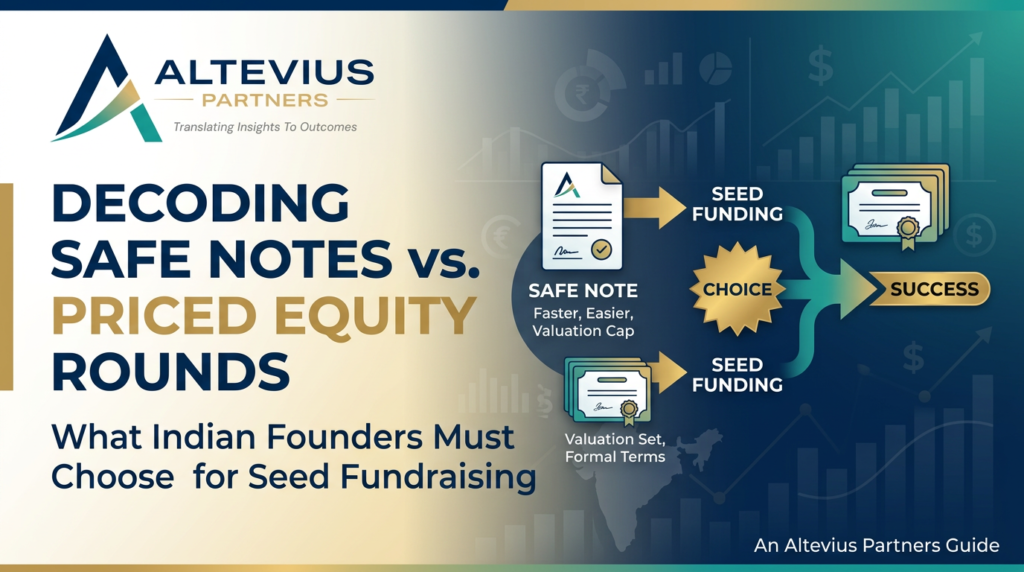
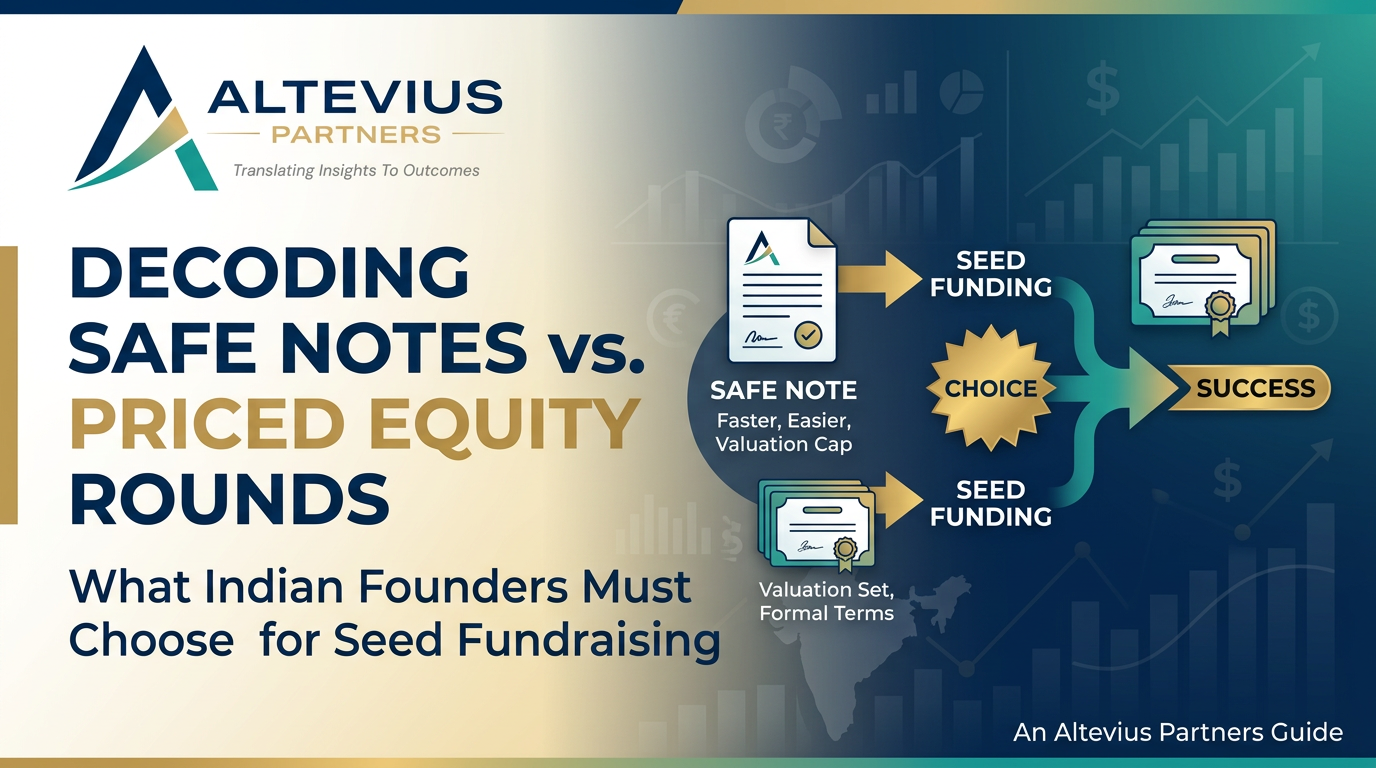
When you sit across the table from an angel investor or a micro-VC for your seed round, the discussion quickly moves past your pitch deck to the actual mechanics of the check. For Indian founders, the choice usually narrows down to two paths: issuing a SAFE notes india instrument or raising a formal priced equity round.
Having advised numerous early-stage startups through funding cycles at Altevius Partners, I see founders get stuck here all the time. Pick the wrong instrument, and you might deal with messy cap tables, unexpected dilution, or heavy legal friction right before your Series A. Let us break down how these instruments actually work under Indian corporate rules, how to run the numbers, and what makes sense for your specific situation.
Key Takeaway:
- Core Instruments: Choosing between SAFE notes india and priced equity depends entirely on your current traction, speed requirements, and long-term dilution tolerance.
- SAFE Advantages: Rapid deployment, zero immediate valuation friction, and minimal initial legal expenses.
- Priced Round Advantages: Absolute shareholding clarity, immediate governance structure, and institutional validation from day one.
- Strategic Rule: Always run pro-forma cap table models to evaluate how multiple convertible instruments interact before signing your first term sheet.
1. How Early-Stage Funding Instruments Work in India
Before comparing options, we need to look at how capital enters an Indian private limited company. Historically, foreign investments or convertible notes required complex regulatory structuring under the Reserve Bank of India. Today, the operational framework is much faster, allowing founders to bring in capital through streamlined agreements.
- The Shift to Speed: Seed rounds need to close quickly so founders can focus on product and growth instead of spending six months on paperwork.
- Regulatory Basis: Most domestic and cross-border instruments operate under the Companies Act provisions for compulsorily convertible debentures or preference shares, while modern seed structures adapt these rules for speed.
- The Role of Mentorship Capital: Early checks often come with strategic advice, making clean documentation crucial for maintaining founder control.
I remember working with a SaaS founder in Bengaluru who spent four months negotiating a bespoke equity term sheet for a modest seed check. By the time the paperwork cleared, market sentiment had shifted, and their product pipeline had stalled. Moving to streamlined seed instruments in subsequent raises allowed them to secure capital in less than two weeks. Speed is often more valuable at the seed stage than a hyper-optimized valuation.
Read more: Fractional CFO vs Full-Time CFO vs Traditional Accountant: Which Does Your Business Need?
2. SAFE Notes in the Indian Ecosystem
A Simple Agreement for Future Equity acts as a promise to deliver shares at a later date, rather than pricing the company today. It postpones the valuation conversation until a future priced round triggers conversion.
- Mechanics: Investors wire funds now, and the money converts into equity automatically when you raise a qualified financing round or undergo a liquidity event.
- Speed Advantage: You can sign a term sheet and receive funds in days with minimal legal costs compared to a full equity round.
- No Immediate Governance Rights: Investors holding standard safe instruments generally do not get board seats or voting rights upfront, keeping decision-making in the hands of the founders.
When analyzing how do safe notes work for indian startups, the primary driver is simplicity. Instead of arguing whether your early-stage prototype is worth ₹10 Crores or ₹25 Crores, you agree on a valuation cap and let the market decide your actual price per share later when you have meaningful revenue metrics.
3. Post-Money vs. Pre-Money SAFE Structures
Understanding the math behind your agreement prevents painful dilution surprises later. The shift from pre-money to post-money variants changed how dilution is calculated.
- Pre-Money Mechanics: Dilution from the note falls entirely on the founders because the conversion price is calculated using a valuation pool that excludes the note itself.
- Post-Money Mechanics: The ownership percentage purchased by the investor is locked in at the time of signing. Any subsequent safe notes issued dilute all existing shareholders proportionally.
- Founder Impact: Post-money models provide absolute clarity to founders on exactly how much of the company they are giving away per check.
Evaluating a post money safe vs pre money safe india comparison is critical because modern documentation templates heavily favor the post-money variant popularized by startup accelerators. If you stack five pre-money notes, you might wake up during your Series A to find your personal stake has shrunk far more than anticipated because the math compounds against you.
4. Priced Equity Rounds: When and Why to Choose Them
A priced equity round means you determine your company valuation today, issue specific share classes, and update your cap table immediately.
- Ownership Clarity: Every participant knows their exact shareholding percentage from day one.
- Investor Confidence: Institutional funds and large syndicates often prefer priced rounds because they establish a formal baseline price per share.
- Governance Integration: Priced rounds usually involve shareholders’ agreements, board observer seats, and protective provisions for major investors.
Deciding when should a startup choose a priced equity round usually depends on institutional maturity. If you already have predictable monthly recurring revenue, clear unit economics, and a lead institutional investor willing to price the round fairly, skipping convertible instruments entirely makes total sense. You establish your company value permanently and avoid the conversion discount headache later.
Read more: Fractional CFO Services Guide: On Demand Financial Leadership Models for Growing Businesses
5. Structural Comparison: SAFE vs. Priced Equity
| Parameter | SAFE Notes | Priced Equity Rounds |
|---|---|---|
| Legal Documentation | Short, standard templates (often 5 to 10 pages) | Comprehensive Share Subscription & Shareholders’ Agreement |
| Time to Close | Days to a couple of weeks | 4 to 8 weeks minimum |
| Legal & Compliance Costs | Minimal upfront expenditure | High advisory, drafting, and filing costs |
| Valuation Determination | Deferred via valuation cap or discount | Fixed immediately via negotiation |
| Board & Voting Rights | Generally absent until conversion | Active participation and protective clauses |
When founders review a convertible instruments vs equity shares for seed round comparison, the trade-off is clear: you are trading legal complexity and high upfront costs for speed and flexibility.
6. Valuation Caps and Discount Rate Calculations
When you defer valuation using a safe instrument, valuation caps and discount rates protect the early investor for taking on initial execution risk.
- Valuation Cap Explained: The maximum company valuation at which your note can convert, ensuring early backers get rewarded if your valuation skyrockets by Series A.
- Discount Rate Mechanics: A percentage discount (usually 10% to 20%) applied to the price per share of the upcoming priced round.
- Combined Interaction: The conversion typically triggers whichever mechanism gives the investor a better price per share, making modeling essential for founders.
Running a precise seed round valuation cap and discount rate calculation requires building a robust dynamic spreadsheet. I often see founders treat valuation caps as arbitrary numbers. If you hand out a ₹15 Crore cap to ten different angel investors without checking your total pool dilution, your subsequent Series A lead investor might force a painful recapitalization to clean up the cap table.
7. Dilution Impact of Multiple SAFE Notes
Stacking multiple small checks without tracking your cap table math can drain founder equity before you even reach your growth stage.
- The Accumulation Effect: Issuing twenty small notes with different caps can create a massive conversion block that eats up a huge chunk of your common stock.
- Cap Table Modeling: Always run pro-forma scenarios assuming every note converts at the lowest cap to see your actual post-Series A dilution.
- Management Strategy: Group seed investors into a special purpose vehicle or syndicate lead when dealing with high-volume smaller ticket sizes.
Understanding the dilution impact of multiple safe notes on founders is what separates seasoned entrepreneurs from first-timers. If you raise ₹2 Crores through twenty separate ₹10 Lakh checks, managing those individual conversion triggers during a Series A due diligence process can become an administrative nightmare.
8. Legal and Regulatory Compliance in India
Executing seed documents requires strict adherence to corporate law and cross-border investment guidelines if your holding company is offshore or domestic.
- Companies Act Rules: Ensure compliance with private placement rules, valuation certificate requirements from registered valuers, and timely filing of Form PAS-3 where applicable.
- FEMA Guidelines: If your capital originates from foreign entities, adherence to Reserve Bank of India reporting standards via the FIRMS portal is mandatory.
- Stamp Duty: State-specific stamp duty payments must be executed correctly to keep your investment documentation legally enforceable.
Navigating legal compliance for issuing safe notes in india demands caution. Just because an agreement template is downloaded from a reputable global accelerator does not mean it automatically complies with Indian stamp act provisions or the Companies Act. Always have a qualified corporate secretary review your filings to avoid regulatory penalties later.
9. Common Seed Fundraising Mistakes Made by Founders
Avoiding strategic missteps during your first institutional interaction saves months of restructuring later.
- Ignoring the Cumulative Cap: Accepting low valuation caps from multiple angels without realizing how they stack together.
- Skipping Legal Review: Using downloaded templates from foreign jurisdictions without adapting them to Indian corporate statutes.
- Neglecting Relationship Management: Treating seed investors as simple transactional wires instead of long-term partners who can help with your Series A bridge.
Reflecting on seed stage fundraising mistakes founders make india, the most common trap is optimizing entirely for the valuation cap while ignoring the investor’s ability to add strategic value. An angel who opens doors for enterprise sales in Mumbai or Bengaluru is worth far more than one who simply wires funds without engagement.
Read more: Choosing the Right Financial Advisory Firm in Jaipur for Sustainable Growth
10. Making the Final Decision with Altevius Partners
Choosing the right instrument depends on your traction, your timeline, and the types of investors backing your vision. If you are pre-revenue or early in product development, the speed of a safe note keeps momentum high. If you have institutional backing and clear unit economics, a priced round sets a strong foundation.
At Altevius Partners, we help founders model their cap tables, evaluate financing instruments, and prepare clean financial data rooms to close seed rounds with confidence. Whether you are weighing an institutional equity term sheet or evaluating angel investment instruments india safe vs equity, our advisory team is here to help you run custom dilution models for your upcoming round and protect your long-term equity ownership.
What is the main difference between a SAFE note and a priced equity round for an Indian startup?
The fundamental difference lies in timing and valuation mechanics. When you issue a SAFE note, you are essentially delaying the valuation discussion until a future institutional round occurs, allowing you to secure funds in days with minimal paperwork. A priced equity round forces you to establish your company valuation immediately, issue formal share classes right away, and update your cap table instantly. If you are pre-revenue and racing to close your round before your runway hits zero, a SAFE instrument provides necessary speed. If you already have strong institutional backing and predictable revenue, a priced round gives everyone immediate shareholding clarity.
Do SAFE notes in India dilute founder equity immediately upon signing?
No, your ownership percentage does not dilute the exact day the SAFE note money hits your bank account. Instead, the dilution is deferred and calculated later when a qualified financing round or liquidity event triggers conversion. However, you must look closely at whether your agreements use pre-money or post-money structures. Post-money SAFEs lock in the investor’s ownership percentage at the time of signing, meaning any subsequent notes you issue will dilute existing shareholders proportionally. Skipping pro-forma cap table modeling before signing multiple notes is a quick way to experience a painful dilution shock during your Series A.
Can foreign angel investors easily issue SAFE notes to an Indian private limited company?
While the paperwork is significantly faster than traditional equity issuances, foreign investments into Indian entities still require careful handling. You must ensure compliance with Reserve Bank of India guidelines, proper reporting standards through the FIRMS portal, and adherence to valuation certificate rules mandated by registered valuers under the Companies Act. Using a standard global template without checking Indian cross-border investment regulations can lead to compliance bottlenecks later during institutional due diligence.
How do valuation caps protect early seed investors in convertible instruments?
A valuation cap acts as an insurance policy and a reward for early believers who take a leap of faith before your metrics are proven. If you raise your seed money using a ₹15 Crore valuation cap, and your business scales rapidly to a ₹75 Crore valuation by the time you raise your Series A, that early investor converts their money as if the company was only worth ₹15 Crores. This grants them a much higher number of shares per rupee invested compared to the new Series A investors, compensating them for taking the initial product-market risk.
When should an early-stage Indian founder skip SAFE notes entirely and opt for a priced round?
You should skip convertible instruments and go straight to a priced equity round if you already have a lead institutional micro-VC or a strong syndicate willing to set a fair, agreed-upon price for your business today. If your monthly recurring revenue is compounding month-over-month and your product-market fit is crystal clear, you do not need to defer valuation. Pricing the round upfront allows you to establish a clean cap table from day one, integrate formal governance structures, and avoid the complex conversion discount math when you scale toward your next major funding milestone.