
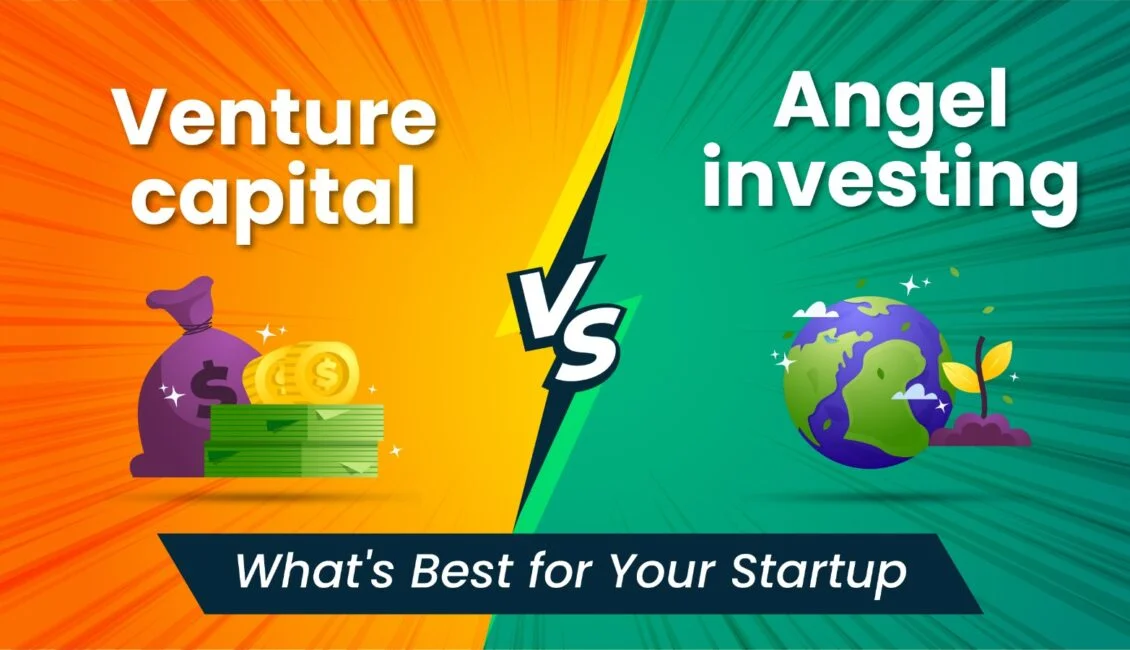
Founders often assume that every investor is looking for the exact same business model. In reality, the Angel Investor vs Venture Capitalist decision comes down to two very different investment frameworks, with angel investors and venture capitalists evaluating startups using completely different criteria.
Choosing the wrong funding partner for your company is like trying to use a heavy-duty freight train to navigate a narrow mountain bike trail. Both move you forward, but only one matches your current operational terrain.
If you want your business to survive today’s competitive market, you need to understand how modern capital allocation works. Investors today expect startup pitches backed by clear evidence, traction, and market understanding. You need precise strategic alignment, a clear grasp of the Angel Investor vs Venture Capitalist difference, and a roadmap tailored to your exact phase of growth. This guide breaks down everything you need to know to secure the right partner, protect your ownership, and scale sustainably.
Quick Summary:
- Angel Investors: Accredited individuals investing personal wealth into pre-seed or early-stage startup funding options, writing checks from $25,000 to $250,000, focused heavily on founder vision and market potential.
- Venture Capitalists (VCs): Institutional firms managing pooled money from limited partners, targeting massive market dominance, writing checks starting at $1 million+, and demanding ownership stakes aligned with fund strategy.
- Core Decision Rule: Target angels when building your minimum viable product and validating early traction; approach VCs when you have predictable unit economics and need aggressive market scaling capital.
Understanding the Core Landscape of Startup Funding
Investors today rely on a combination of independent research, market data, and traditional due diligence when evaluating startups. During due diligence, many investors review your public company profile, product, customer traction, and other available information alongside conversations with the founding team.
The modern funding ecosystem
Visibility in today’s financial ecosystem requires more than a polished website and a standard pitch deck. Many investors now use market intelligence platforms alongside traditional due diligence to review founder backgrounds, public information, product documentation, customer reviews, and corporate filings. If you are building a B2B platform, these research tools help investors analyze how well your value proposition matches current enterprise pain points.
Startup funding stages explained
Navigating financial growth means understanding the distinct phases of your company’s lifecycle:
- The Bootstrapping & Pre-Seed Phase: Self-funding, personal loans, friends and family contributions, and initial angel rounds used to build a prototype. Industry data from platforms such as Crunchbase and AngelList suggests that many early-stage founders initially rely on personal savings, friends, family, or angel investors before raising institutional capital.
- The Seed Stage: Initial market entry, early customer acquisition, and proving product-market fit. Data from PitchBook (Q1 Venture Monitor) and the NVCA Yearbook indicates that median U.S. seed rounds typically range from $1 million to $3 million, depending on the industry. This is where the difference between angel investor and vc matters most.
- Series A and Beyond: Institutional scaling, expanding sales operations, international growth, and heavy cash injection managed by professional venture funds. Industry reports from firms such as CB Insights indicate that typical Series A raises now average between $5 million and $15 million.
Defining the players
At the bottom of the institutional capital stack sit individual angels and micro-funds, providing flexible, relationship-driven capital. Higher up are institutional venture capital firms, which answer to strict financial mandates set by massive endowments, pension funds, and corporate investors. Knowing where you sit determines who you should target.
What Is an Angel Investor?
Profile and capital source
An angel investor is typically a successful entrepreneur, corporate executive, or high-net-worth professional investing their own liquid capital. Because they are writing checks from personal accounts, their emotional and personal alignment with the founder matters deeply. They care about your character, resilience, and vision.
How do angel investors make money
Angels make money primarily through equity appreciation during subsequent financing rounds, company acquisitions, or secondary share sales. Multiple industry studies indicate that most startups do not achieve long-term commercial success, making portfolio diversification essential for angel investors to cover write-offs and still yield an attractive portfolio-wide profit.
Angel investor check size vs VC
When comparing check sizes, angels operate on a much smaller scale. Initial investments typically range from twenty-five thousand to two hundred and fifty thousand dollars. This flexibility allows them to jump in quickly without requiring months of legal negotiations or board seats.
What Is a Venture Capitalist?
Profile and capital source
A venture capitalist operates as a professional fiduciary within an established investment firm. They manage money pooled from external sources called limited partners. Because they invest other people’s money under a strict legal agreement, they must adhere to rigorous investment theses, risk profiles, and return timelines.
Venture capital equity requirements
Institutional firms look for ownership stakes to justify the risk of backing early companies. Seed and Series A investors tracked by Carta (State of Private Markets) often target ownership in the 10% to 25% range, though this varies by stage, valuation, and fund strategy. They need this level of ownership to ensure that a massive exit will move the needle for their entire fund.
VC funding requirements for startups
Walking into a venture capital office requires hard proof. They demand concrete product-market fit, scalable unit economics, predictable customer acquisition channels, and a total addressable market large enough to generate substantial venture-scale returns.
Head-to-Head Comparison: Angel Investor vs Venture Capitalist
To make the right choice for your business, it helps to view how angels and venture capitalists compare across core operational metrics.
| Feature | Angel Investor | Venture Capitalist |
| Investment Source | Personal money | Pooled fund money from limited partners |
| Stage | Pre-seed or Seed | Seed to Series A and beyond |
| Typical Check Size | $25,000 to $250,000 | $1 million and up |
| Equity Target | Varies widely, often via convertible instruments | Typically 10% to 25% per round |
| Due Diligence | Light to moderate | Extensive and formal |
| Decision Time | Days to weeks | Weeks to several months |
| Board Seat | Rare | Common |
| Risk Appetite | High tolerance for unproven concepts | Data-driven, requires traction |
Pros and Cons of Angel Investors vs Venture Capitalists
| Partner Type | Key Advantages | Potential Drawbacks |
| Angel Investors | Faster decisions, flexible investment terms, strong personal mentorship, smaller funding thresholds. | Limited capital availability, less structured scaling support, informal governance. |
| Venture Capitalists | Large capital pools, extensive professional networks, disciplined strategic guidance, follow-on round capacity. | High equity dilution, rigorous board oversight, strict performance milestones, slower decision cycles. |
Real-World Examples of Successful Funding Trajectories
History shows that matching your funding partner to your growth stage matters. For instance, Airbnb initially raised early capital from angel investors and seed incubators like Y Combinator before approaching major venture capital firms for their larger institutional rounds. Similarly, WhatsApp raised early angel funding before securing a major Series A investment led by Sequoia Capital. These examples highlight that moving sequentially from angel funding to venture capital is a proven path for high-growth startups.
Key Structural Differences Between Angels and VCs
Decision-making speed
An angel investor can make a funding decision over a single meeting, wiring funds within days based on a handshake and a convertible note. A venture capital firm, by contrast, must run internal partner meetings, present cases to an investment committee, conduct rigorous legal due diligence, and draft complex shareholder agreements. This process often takes anywhere from six weeks to several months.
Operational involvement
Angels often act as informal advisors, opening doors to their personal address books, introducing you to prospective customers, or offering calm advice during stressful pivots. In practice, many founders find that their first angel introductions lead to customers, early hires, or future investors, benefits that can be as valuable as the capital itself. VCs bring structured governance. They typically demand a seat on your board of directors, require monthly financial reporting, and enforce strict milestones tied to growth metrics.
Risk appetite
Angels lean heavily into intuition, backing a passionate founder before revenue even exists. VCs operate on data. They want to see clean metrics, low churn rates, high customer lifetime value, and a clear path toward market domination.
Equity Dilution and Financial Impact
Equity dilution startup founders guide
Giving away too much equity too early is a common trap. Equity dilution startup founders guide principles dictate that founders must model their cap table across multiple rounds. If you give away too much early ownership, you may find yourself owning a small fraction of your company before you reach Series A.
Seed funding vs venture capital valuation dynamics
Valuation directly dictates how much ownership you surrender. An angel round using a simple agreement for future equity or convertible notes can carry varying valuation caps depending on negotiation terms, meaning dilution is pushed to the next priced round. Institutional seed funding vs venture capital structures involve priced equity rounds that establish formal share prices, setting high performance expectations for the next growth cycle.
Determining When to Choose an Angel Investor or VC
Finding Investors for a Pre-Revenue Startup
Why angels win early
When you have nothing more than a functional prototype, a pitch deck, and raw determination, most venture capital firms are unlikely to invest until they see evidence of product-market fit or exceptional founder credentials. Finding investors for pre-revenue startup ventures means targeting angels who understand the chaotic reality of day zero. They invest in the human being steering the ship rather than spreadsheets that do not yet exist.
Building trust
To attract sophisticated angels, you must project deep expertise, experience, and authority. Show prospective backers your past technical achievements, industry background, and specific domain knowledge. When your professional history proves you have solved similar problems before, investor confidence rises naturally.
When Your Startup Is Ready for Venture Capital
Inflection points for institutional money
You should pursue venture capital only when you have successfully transitioned from product validation to repeatable customer acquisition. If you can spend capital on marketing and reliably generate sustainable recurring revenue, institutional funds will take your call.
Unit economics benchmarks
Before pitching a venture partner, ensure your financial metrics are airtight. VCs want to see that customer lifetime value comfortably outweighs customer acquisition cost, gross margins sit at healthy software levels, and your monthly burn rate is optimized for rapid scaling.
Common Founder Mistakes to Avoid
Navigating early fundraising trips up many first-time entrepreneurs. Avoiding these common missteps can save your cap table and keep your company on a healthy trajectory:
- Raising VC money before product-market fit: Pitching institutional funds too early burns bridges and makes it harder to secure funding from those firms later.
- Giving away too much equity in the first round: Handing out excessive ownership to early backers restricts your ability to incentivize future hires and institutional investors.
- Pitching every investor with the same deck: Failing to tailor your presentation to the specific risk profile of angels versus institutional VCs leads to immediate rejections.
- Ignoring cap table planning: Neglecting to model multi-round dilution can leave founders with negligible control over their own company by Series B.
- Choosing investors based only on valuation: Chasing the highest valuation cap from an incompatible partner often introduces toxic governance terms down the road.
Strategic Execution and Pitching Dynamics
Bootstrapping vs Angel Investor vs Venture Capitalist
Retaining full control
The choice between bootstrapping vs angel investor vs venture capital fundamentally impacts your daily life as a founder. Bootstrapping keeps every percentage point of equity in your pocket, but it limits your growth speed. Taking institutional money supercharges expansion, but it introduces external accountability and pressure for a rapid exit.
Hybrid strategies
Many successful founders combine these paths. They bootstrap through initial development, bring in a small syndicate of strategic angels to polish the product, and only approach institutional venture funds once the business engine is humming smoothly.
How to Pitch Angel Investors vs Venture Capitalists
Tailoring your narrative
When pitching angel syndicates, lead with your personal story, your deep passion for the problem, and the human impact of your solution. When pitching institutional VCs, leave the emotional storytelling for the introduction and dive straight into your market size, cohort retention curves, gross margins, and defensible technology moat.
Structuring your data room
A professional data room prepares you for both worlds. Include corporate formation documents, intellectual property assignments, historical financial statements, customer pipeline reports, and product roadmaps. Satisfying individual angel curiosity while meeting institutional due diligence standards ensures you never stall out midway through a funding cycle.
Startup Funding Action Checklist
Before launching your next capital-raising campaign, review this quick actionable checklist to ensure operational readiness:
- ☐ Validate product-market fit
- ☐ Calculate funding requirements
- ☐ Model future dilution
- ☐ Identify stage-appropriate investors
- ☐ Prepare your data room
Conclusion
There is no universally “better” funding partner. Angel investors excel at helping founders validate an idea, while venture capital firms are designed to accelerate businesses with proven traction. Before approaching any investor, evaluate your traction, funding requirements, and long-term ownership goals. The right investor is not simply the one who offers capital it is the one whose expectations align with your startup’s stage and vision.
Author: Gourav Agarwaal
Gourav is a senior finance and startup strategist with over 15 years of experience across Private Equity, Financial Modeling, M&A, and business finance. Gourav brings $500M+ in transaction exposure and has managed operations and growth across infrastructure, renewable energy, real estate, fintech, and technology sectors.
Sources and References
- PitchBook: PitchBook Q1 Venture Monitor (Data on median U.S. seed and venture funding rounds).
- Carta: Carta State of Private Markets (Cap table management benchmarks and average equity distribution metrics).
- National Venture Capital Association (NVCA): NVCA Yearbook (Institutional investment reports and ecosystem trends).
- CB Insights: CB Insights State of Venture Report (Startup failure tracking, industry research, and Series A funding analytics).
- AngelList: AngelList Market Insights (Pre-seed trends, angel investor check sizes, and syndicated funding activity).
Startups should begin approaching venture capital firms after demonstrating product-market fit, repeatable customer acquisition, and predictable unit economics where applicable. At the earliest stages, angel investors typically fund founder potential, early validation, and initial product development. Venture capital firms generally expect evidence that your business can scale through repeatable growth rather than founder-led sales alone. If your growth still depends primarily on personal networking or manual sales efforts, angel funding is often the better fit.
Neither option is universally better. Convertible notes and priced equity rounds serve different purposes depending on your startup’s stage and fundraising strategy. Using convertible notes or simple agreements for future equity pushes the valuation debate down the road, keeping legal costs low during your pre-seed phase. However, this structure defers dilution until your next priced round, where all accumulated notes convert simultaneously which can result in greater-than-expected dilution if valuation caps, discounts, or multiple convertible instruments are involved. Priced equity rounds establish an immediate, formal share price and grant precise visibility into dilution percentages today, but they demand rigorous legal preparation and higher upfront transaction expenses. Balancing these mechanisms requires modeling multi-round dilution before signing any initial term sheet.
Most venture capital firms aim to own approximately 10–25% of a startup because this ownership level gives them meaningful exposure if the company becomes highly successful while allowing room for future funding rounds. Venture capital operates on a power-law model where a tiny fraction of portfolio companies generate the entire return for their limited partners. Because early-stage investments carry immense risk of failure, a venture fund targets this significant initial equity block to ensure that a breakout success moves the needle for their portfolio, while preserving pro-rata participation rights as the company scales toward a major exit.
There is no fixed percentage, but angel investors commonly receive between 10% and 20% ownership in an early funding round, depending on the startup’s valuation, capital requirements, and growth stage. Founders should avoid giving away excessive equity too early, as future fundraising rounds will further dilute ownership. Careful cap table planning helps preserve founder control while attracting investors.
First-time founders can attract investors without previous startup exits by demonstrating strong customer validation, deep industry expertise, and measurable traction. Technical founders can build institutional credibility by showcasing granular insights extracted from direct user interviews, proprietary technical architecture that creates a durable moat, and an exceptionally fast product iteration cycle. Strong customer references, experienced advisors, or early design partners can also help increase investor confidence. When you show investors that you understand your target market’s pain points better than anyone else in the room, you neutralize the perceived risk of your background and shift the conversation squarely onto market opportunity.