
Financial reports can tell you where your business stands today, but they do not always show whether you can afford your next hire, how long your cash will last, or when expansion might put pressure on your finances. That is where fractional CFO services in USA can help. A fractional Chief Financial Officer provides experienced financial leadership on a part time or flexible basis, helping business owners turn financial information into practical decisions without necessarily hiring a full time executive.
Choosing a provider, however, takes more than comparing monthly fees. You need someone who understands your business model, can explain the numbers clearly, and knows how to build a financial plan that supports your goals. This guide examines the services available, what they may cost, which firms deserve consideration, and how to decide whether a fractional CFO is right for your company.
Quick guide: What you need to know
- Best for: Growing small businesses, startups, SaaS companies, and established businesses facing more complex financial decisions.
- Core services: Cash flow forecasting, financial planning, budgeting, profitability analysis, management reporting, and fundraising support.
- Pricing: Fees depend on the provider, engagement scope, required expertise, and amount of work involved. Request a written proposal rather than relying on a starting price alone.
- What to compare: Industry experience, access to the assigned CFO, defined deliverables, reporting quality, data security, and contract terms.
- When to hire: Consider fractional support when your business needs senior financial guidance but does not yet require a full time CFO.
- When to choose full time: A permanent executive may be more appropriate when daily financial leadership, extensive team management, or complex financing responsibilities require consistent attention.
Understanding Fractional CFO Support and Knowing When Your Business Needs It
A fractional CFO provides senior level financial guidance to a company for an agreed amount of time or a defined scope of work. Depending on the arrangement, the engagement might involve weekly leadership meetings, monthly financial reviews, ongoing forecasting, or a specific project such as preparing for fundraising.
Unlike a consultant who may deliver a report and leave implementation to the client, some fractional CFOs also work with management to put recommendations into practice. The exact responsibility depends on the contract, so businesses should confirm what is included before signing.
The Difference Between Strategic CFO Guidance, Accounting, and Bookkeeping
These roles serve different purposes, although they often work together.
- Bookkeeper: Records transactions, reconciles accounts, and maintains organized financial records.
- Accountant: Prepares or reviews financial statements, supports tax compliance, and helps ensure that financial information is properly recorded and presented.
- Fractional CFO: Uses financial information to guide planning, evaluate business risks, assess profitability, and help management choose its next steps.
For example, an accountant may explain that operating expenses increased by 15% during a quarter. A fractional CFO investigates what drove that increase, compares it with revenue growth, evaluates its effect on margins, and helps management decide whether to adjust pricing, reduce certain costs, or change its spending plan.
That distinction matters because accurate financial records are essential, but they do not automatically provide a clear plan for the future.
Business Signs That Indicate a Need for CFO Level Support
Your company may benefit from a fractional CFO when:
- Revenue is increasing, but available cash remains difficult to predict.
- You are unsure whether the business can afford new employees, equipment, or another location.
- Profit margins are shrinking without an obvious explanation.
- Investors or lenders want more detailed forecasts and financial reports.
- Business decisions depend heavily on instinct because reliable projections are unavailable.
- You need to understand which products, customers, or services contribute the most profit.
Consider a growing service company that generates more revenue every quarter but regularly struggles to pay suppliers on time. The underlying issue might have little to do with sales performance itself. Customers could be paying late while payroll and supplier obligations fall due earlier. A cash flow forecast can expose this timing gap and help management address it before it becomes a serious problem.
Who Benefits Most From Flexible CFO Support?
The arrangement can suit several types of businesses:
- Growing small and midsized businesses that need better financial planning without adding a permanent executive.
- Startups that need to monitor cash burn, plan fundraising, and prepare financial projections.
- SaaS companies managing subscription revenue, customer retention, and recurring operating costs.
- Established businesses planning to enter new markets, purchase another company, secure funding, or transition ownership.
Businesses that only need routine transaction processing may benefit more from bookkeeping or accounting support. A fractional CFO becomes more valuable when the company needs financial judgment, forward planning, and help making decisions that carry meaningful financial consequences.
Best Fractional CFO Services in the USA: How to Compare Providers
There is no single provider that is the right choice for every business. A startup preparing for its first funding round has different needs from a profitable family owned company that wants to expand into another state.
When comparing fractional CFO services, focus on the work a provider can demonstrate, the expertise your business needs, and the quality of the working relationship.
What to Evaluate Before Putting a CFO Firm on Your Shortlist
Start with these six criteria:
- Relevant experience: Has the provider worked with businesses of a similar size, industry, and stage of growth?
- Service scope: Does the proposal explain the reports, forecasts, meetings, and other deliverables you will receive?
- Financial planning ability: Can the provider connect cash flow, profitability, hiring, and growth assumptions in one practical plan?
- Systems and reporting: Is the team comfortable working with your accounting software, financial models, and management dashboards?
- Pricing transparency: Are the fees, additional charges, contract length, and cancellation conditions clear?
- Direct access: Will you work with the experienced CFO introduced during the sales process, or will most of the work be delegated to other team members?
Ask each provider to explain how it would approach a financial problem your business is actually facing. The quality of that discussion can tell you more than a polished sales presentation.
Top Fractional CFO Firms to Evaluate
The following providers offer different starting points for research. They should not be treated as a definitive ranking because service availability, pricing, and suitability vary by company and engagement. Verify each firm’s current offerings directly before making a decision.
1. Altevius Partners
Altevius Partners is a provider to evaluate if you are considering external financial leadership for your business. Before deciding whether it belongs on your shortlist, confirm its current service offering, the experience of the professional who would lead your engagement, and the type of clients it serves.
Questions worth resolving include:
- Does its current offering cover the financial planning and reporting support your company needs?
- What deliverables would be included in a proposed engagement?
- Who would be responsible for preparing forecasts and reviewing financial performance?
- Can the firm provide relevant client references or examples of comparable work?
- How are fees structured, and what work would be billed separately?
These checks help you judge the actual fit rather than relying on a provider’s name or general marketing claims. No specific pricing, client outcomes, or qualifications should be assumed without verification.
2. Pilot
Pilot is worth researching for startups and growing businesses that want finance support alongside accounting related services. When assessing the company, establish whether the available service package includes the strategic CFO involvement you need or primarily focuses on bookkeeping, accounting, and financial operations.
A useful evaluation should cover forecast development, management reporting, access to financial leadership, and the level of support provided as the business grows.
3. Preferred CFO
Preferred CFO is another provider to consider when researching outsourced financial leadership. Evaluate whether its current service model matches your company’s requirements for planning, reporting, financial management, and strategic advice.
Ask about the experience of the proposed CFO, how frequently you will review performance, and whether the engagement includes implementation support as well as recommendations.
4. NOW CFO
NOW CFO is worth investigating for businesses looking for outsourced finance and accounting support. Its suitability will depend on the specific services offered in your location and the level of senior financial guidance your company needs.
Confirm whether the proposal covers CFO level planning, forecasting, and management advice rather than assuming that every engagement includes the same services.
5. B2B CFO
B2B CFO is another option to investigate when comparing financial leadership services for small and midsized businesses. Assess the experience of the professional who would work with you, the scope of the engagement, and the provider’s ability to address your company’s particular financial challenges.
For all five providers, request current information about pricing, service availability, contract terms, and client references. The list is a research shortlist, not an independently verified ranking of the five best firms.
Compare Providers by Business Need
| Business need | What to prioritize |
|---|---|
| Startup fundraising | Financial models, cash runway analysis, investor reporting, and due diligence preparation |
| Small business cash flow | Cash forecasting, working capital management, budgeting, and margin analysis |
| SaaS financial management | Recurring revenue metrics, customer retention analysis, unit economics, and revenue forecasting |
| Established business expansion | Scenario planning, hiring budgets, financing needs, and profitability analysis |
| Occasional strategic advice | Clearly scoped projects, scheduled advisory sessions, and defined deliverables |
The best fit is the provider that can demonstrate relevant expertise and deliver the work your business needs at a reasonable total cost.
What Should You Expect to Pay for Fractional CFO Services?
One of the first questions business owners ask is how much they should budget for financial leadership. The honest answer is that fractional CFO pricing depends on the complexity of your business, the seniority of the professional, and how much responsibility the engagement covers.
A company that needs a monthly financial review will usually require a different arrangement from a funded startup preparing investor materials or a growing business that needs weekly forecasting and ongoing management support.
Typical Fractional CFO Pricing and Monthly Costs
The following figures are broad budgeting estimates for the US market, not verified quotes from the providers listed above. Actual fees can differ substantially by provider and scope.
| Engagement type | Illustrative cost estimate | Common scope |
|---|---|---|
| Occasional CFO advisory | $200 to $500 per hour | Financial reviews, targeted advice, and decision support |
| Limited monthly engagement | $1,500 to $3,500 per month | Periodic reporting reviews, basic forecasting, and scheduled advisory sessions |
| Ongoing fractional CFO support | $3,500 to $7,500 per month | Regular planning, cash flow oversight, management reporting, and leadership meetings |
| Complex or high involvement engagement | $7,500 to $15,000+ per month | More intensive forecasting, fundraising support, board reporting, or multi entity planning |
| Defined financial project | Quoted separately | Financial model development, transaction preparation, or a specific planning assignment |
These ranges are intended to help with initial budgeting, not to establish current market averages. Before publishing a pricing claim as a current benchmark, obtain dated quotes from several providers and confirm what each quote includes.
Also, do not assume that a low monthly fee includes bookkeeping, tax preparation, payroll administration, historical accounting cleanup, or unlimited access to the CFO. Those services may be priced separately.
What Determines the Cost of a Fractional CFO?
Several factors can affect the final proposal.
Business complexity: A company with multiple entities, international transactions, inventory, or several revenue streams generally requires more analysis than a business with a straightforward operating model.
Time commitment: Monthly advisory calls require less involvement than weekly meetings, frequent forecast updates, and ongoing communication with department leaders.
Financial condition: If the company’s accounting records are incomplete or unreliable, the provider may need to resolve reporting problems before producing useful forecasts.
Specialized experience: Fundraising, acquisitions, board reporting, and industry specific financial analysis may require additional expertise.
Scope of responsibility: Building a forecast is different from maintaining it, explaining variances, and helping management take corrective action.
How to Compare Proposals Without Focusing Only on Price
Request a written breakdown of the work before comparing fees. Two providers quoting similar monthly amounts may be offering very different levels of support.
Ask each firm to clarify:
- Which financial reports and forecasts will be delivered.
- How frequently results will be reviewed with management.
- Whether the CFO will attend leadership or board meetings.
- Who handles bookkeeping corrections and historical data cleanup.
- How additional projects, urgent requests, and out of scope work are billed.
- Whether onboarding fees, minimum terms, or cancellation charges apply.
It is also worth asking how much internal time the engagement will require. Your team may need to prepare reports, reconcile accounts, answer questions, and maintain the source data.
A lower fee is not necessarily better value if the provider cannot deliver the analysis your business needs.
Fractional CFO Pricing Versus the Cost of a Full Time CFO
Hiring an internal CFO involves more than salary. Employers must consider benefits, payroll taxes, recruitment, equipment, software, and other employment costs.
An external arrangement may reduce the need for a full time executive, but it does not automatically cost less in every situation. A company requiring extensive daily involvement could find that a permanent CFO provides better continuity and accountability.
The decision should come down to the level of leadership required, not simply the difference between two headline prices.
Which Fractional CFO Services Do Small Businesses Actually Need?
Small businesses rarely need every possible finance service at once. The most useful engagement starts with the problems that are creating uncertainty or preventing the owner from making sound decisions.
For many companies, that means improving cash visibility, building a realistic budget, understanding margins, and establishing a reporting routine that management can use consistently.
Cash Flow Forecasting and Working Capital Management
Cash flow forecasting estimates when money is expected to enter and leave the business. It helps management understand whether cash will be available when payroll, suppliers, loan payments, taxes, and other obligations fall due.
A fractional CFO may help the company:
- Forecast customer receipts using realistic collection assumptions.
- Map payroll, supplier payments, debt obligations, and planned purchases.
- Identify periods when cash balances may fall below a safe operating level.
- Review payment terms and outstanding receivables.
- Assess whether inventory or spending decisions are tying up too much cash.
For example, a distributor might report strong sales while carrying large amounts of unpaid customer invoices. A forecast can show how much cash is tied up in receivables and whether the company needs to change credit terms, improve collection procedures, or negotiate different supplier payment schedules.
The value comes from seeing the problem early enough to act.
Budgeting, Forecasting, and Financial Planning
A budget establishes what the business expects to earn and spend. A forecast updates that expectation as new information becomes available.
A useful financial planning process should include:
- An operating budget linked to realistic business goals.
- Regular comparisons between actual results and planned figures.
- Updated revenue and expense assumptions.
- Scenarios for hiring, expansion, price changes, and slower sales.
- A review schedule that assigns responsibility for corrective action.
Suppose a business plans to hire five additional employees. Rather than looking only at their annual salaries, the CFO can model recruitment expenses, payroll taxes, equipment costs, training time, and the revenue needed to support the additional team.
That analysis helps the owner decide whether to hire everyone at once, recruit in stages, or wait until specific financial targets are reached.
Profitability Analysis and Financial Reporting
Revenue growth does not always mean stronger profitability. Some products, customers, or services may consume more resources than expected.
A CFO can help management examine:
- Gross margin by product or service.
- Profitability by customer segment.
- Labor and delivery costs.
- Marketing spending relative to revenue generated.
- Differences between expected and actual operating expenses.
Management reporting should explain what changed, why it matters, and what decisions may be needed. A spreadsheet containing dozens of figures is not particularly helpful if the business owner cannot identify the three or four issues that deserve attention.
Financial Controls and Business Risk
As a company grows, informal financial processes can become difficult to manage. A business may need clearer spending approvals, more reliable month end reporting, and better separation of financial responsibilities.
A fractional CFO can work with the existing accounting team to improve reporting routines, identify weaknesses in financial controls, and coordinate with tax or legal professionals when specialist advice is needed.
The objective is not to create unnecessary bureaucracy. It is to make sure management has dependable information and appropriate oversight as the company becomes more complex.
How Can Startups Choose the Right Fractional CFO?
Startups often operate with limited cash, changing assumptions, and pressure to demonstrate progress. Their financial needs can change quickly as they move from product development to early sales, fundraising, and expansion.
A fractional CFO for startups should understand both the financial numbers and the decisions founders must make with them.
Match CFO Experience to the Startup’s Stage
A pre revenue startup may need a clear spending plan and a realistic estimate of how long its available capital will last.
An early revenue business may need to evaluate pricing, sales efficiency, customer acquisition costs, and the timing of new hires.
A funded startup may require stronger investor reporting, financial projections, and board materials. A scaling company may need departmental budgets, more reliable financial systems, and planning across several teams.
The provider should understand the stage your company is in now and the challenges likely to arise next.
Fundraising Support and Investor Readiness
Preparing for fundraising involves more than building an attractive financial model. Investors need to understand the assumptions behind projected revenue, costs, customer growth, and future capital requirements.
A startup focused CFO may help management:
- Build financial projections tied to operating assumptions.
- Track monthly cash burn and estimated runway.
- Model different fundraising amounts and spending plans.
- Prepare financial information for investor due diligence.
- Establish a consistent reporting process for existing investors.
For instance, if a startup plans to raise capital in nine months, its forecast should show how much cash it expects to have at that point under different sales and spending scenarios. If the expected balance is too low, the founders may need to reduce costs, raise sooner, or revise the operating plan.
A forecast is only useful when management can see the assumptions and update them as conditions change.
Questions Founders Should Ask During a CFO Consultation
Before hiring a provider, ask:
- What startup stages and funding models have you worked with?
- Which financial deliverables will you personally oversee?
- How will you test the assumptions used in our forecast?
- What information will you need from our bookkeeping or accounting team?
- How often will we review cash burn, runway, and business performance?
- How will we assess progress during the first 90 days?
Look for clear explanations rather than promises of guaranteed fundraising success. A CFO can improve financial preparation and decision making, but cannot guarantee that investors will fund the business.
Does Your SaaS Company Need a Fractional CFO?
Software businesses have financial patterns that can be difficult to manage using basic revenue and expense reports alone. Subscription revenue, customer acquisition spending, renewals, cancellations, and product development costs all affect the company’s future financial position.
A SaaS fractional CFO should understand how these factors interact and help management make decisions using reliable operating and financial data.
SaaS Financial Metrics a CFO Should Understand
A provider working with a software company should be comfortable interpreting the following metrics:
- Monthly recurring revenue (MRR): The recurring monthly revenue associated with active subscriptions.
- Annual recurring revenue (ARR): A measure of annualized recurring subscription revenue, calculated using a consistent definition.
- Customer acquisition cost (CAC): The cost of acquiring a customer over a defined period.
- Customer lifetime value (LTV): An estimate of the economic value a customer generates over the relationship.
- Gross margin: Revenue remaining after the costs included in the company’s cost of revenue.
- Churn: The rate at which customers or recurring revenue are lost.
- Net revenue retention (NRR): The change in recurring revenue from an existing customer group after accounting for expansion, contraction, and churn.
- Cash burn and runway: How quickly cash is being consumed and how long available funds may last.
These measures need consistent definitions. For example, a company should not compare customer acquisition costs from one period with revenue figures calculated using a different customer cohort or time frame without explaining the difference.
Forecasting Subscription Revenue and Customer Retention
A useful SaaS forecast should account for more than expected new sales. It should also consider renewals, upgrades, downgrades, cancellations, contract timing, and collection schedules.
A CFO can help management build several scenarios:
- Conservative case: Slower customer acquisition, higher churn, or delayed renewals.
- Expected case: Results based on current performance and reasonable operating assumptions.
- Growth case: Stronger sales or customer expansion, alongside the additional costs needed to support it.
These scenarios help leadership decide how quickly to recruit, when to increase marketing spending, and whether the company can afford to pursue a more aggressive growth plan.
When a SaaS Fractional CFO Is Worth Considering
This support may be valuable when revenue is increasing but cash generation remains weak, customer acquisition costs are difficult to justify, or management cannot confidently predict future recurring revenue.
It can also help when the business is preparing for fundraising, evaluating its path to profitability, or deciding whether a new pricing model is financially sustainable.
The goal is not simply to track SaaS metrics. It is to connect them to decisions about product investment, customer retention, hiring, and cash management.
What Should You Compare Before Hiring an Outsourced CFO?
The phrase outsourced CFO services can describe different arrangements. Some firms provide strategic financial leadership, while others combine CFO advice with accounting operations or project based consulting.
Before choosing a provider, establish exactly what it will do, who will perform the work, and how the engagement will be managed.
Strategic Advice Versus Execution
Ask whether the CFO will only review financial results or will also build forecasts, investigate variances, and help implement recommendations.
For example, identifying that operating expenses are too high is only the first step. Management may also need an analysis of which costs are increasing, whether those costs support revenue growth, and what changes could improve profitability without damaging operations.
The agreement should identify who maintains financial models, prepares reports, reviews results, and follows up on agreed actions.
Team Structure, Availability, and Communication
A firm may introduce a senior CFO during the sales process but assign some of the ongoing work to analysts or other finance professionals. That arrangement can work well, provided responsibilities are clear.
Confirm:
- Who will lead your engagement.
- How often you will meet with that person.
- Who prepares reports and forecasts.
- How quickly questions will normally be answered.
- How the provider coordinates with your bookkeeper, accountant, and leadership team.
Regular communication matters because a forecast that is updated only after a major decision has already been made offers limited practical value.
Data Security, Systems Access, and Accountability
A CFO engagement may involve access to bank information, payroll data, customer records, financial statements, and business forecasts.
Review the provider’s confidentiality terms, access controls, file sharing practices, and procedures for handling sensitive information. Grant only the access required for the agreed work and make sure the business retains appropriate control over its financial systems.
You should also establish reporting deadlines, review responsibilities, and the process for resolving disagreements or urgent financial issues.
Warning Signs to Look for in a Proposal
Be cautious when a provider:
- Offers vague deliverables without identifying who owns each task.
- Promises specific financial results without explaining the assumptions.
- Cannot explain how its forecasts are prepared or updated.
- Provides limited information about fees or additional charges.
- Makes recommendations without first understanding your financial data.
- Avoids discussing references, relevant experience, or the limitations of its approach.
A trustworthy provider should be comfortable explaining what it can do, what it cannot guarantee, and what information it needs to work effectively.
Fractional CFO vs. Full Time CFO: Which Is Right for Your Business?
The choice between a fractional and full time CFO depends on the amount of financial leadership your company needs, the complexity of its operations, and the capabilities of its existing team.
Neither model is automatically better. The right arrangement should match the company’s workload and decision making requirements.
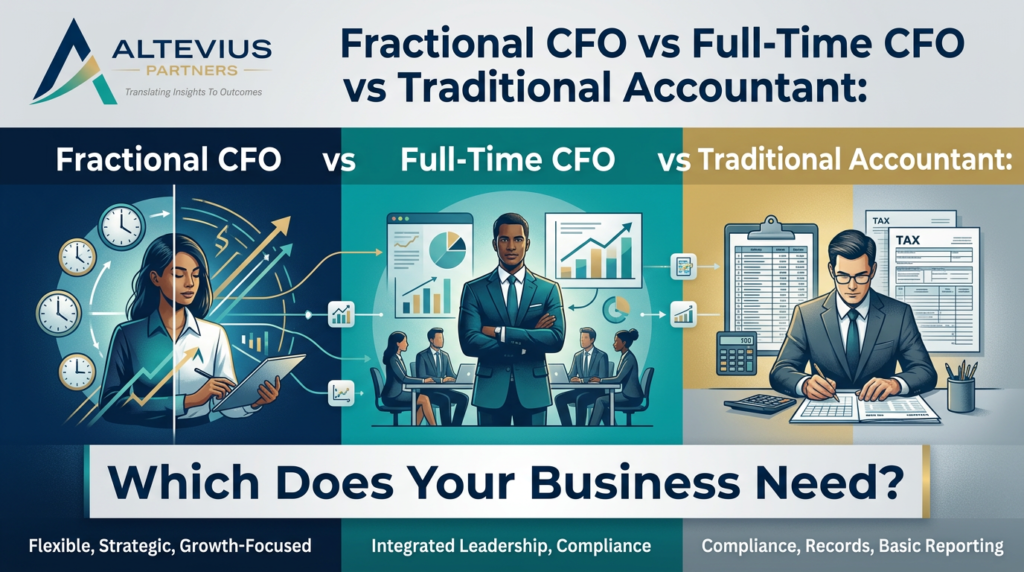
Read more: Fractional CFO vs Full-Time CFO vs Accountant: Which Do You Need in 2026?
When a Fractional CFO Makes Sense
Fractional support can be a practical option when the company needs experienced financial guidance but does not require a CFO working full time.
It may suit businesses that already have dependable bookkeeping or accounting support, need regular forecasting and management reviews, or require senior expertise for a defined growth or financing project.
It can also work well when the level of CFO involvement changes during the year.
When Hiring a Full Time CFO May Be Better
A permanent CFO may be more suitable when financial leadership is needed every day, the finance department is large, or the business has complex financing and reporting responsibilities.
A full time executive may also be better positioned to manage a large finance team, coordinate multiple departments continuously, and respond to issues that require immediate attention throughout the working day.
Companies approaching this stage should compare the complete cost of employment with the cost and limitations of external support.
A Practical Decision Framework
Before making the decision, work through five questions:
- How many hours of senior financial leadership does the business need each week?
- Which financial decisions require direct CFO involvement?
- Can the current accounting team provide reliable records and timely reporting?
- Does the proposed engagement offer sufficient availability and accountability?
- Is the arrangement likely to remain appropriate as the business grows?
Review the decision periodically. A company may start with a fractional CFO and later move to a full time executive as its financial operations become more demanding.
What Financial Results Should You Expect From a Fractional CFO?
The value of a CFO engagement should be assessed through better financial visibility, more disciplined planning, and improved management decisions. Those improvements can support stronger business performance, but the actual results depend on the company’s starting position, market conditions, and whether management acts on the recommendations.
Better Visibility Into Cash and Future Obligations
A well maintained forecast can help management identify periods when expected cash receipts may not cover upcoming expenses. It can also make the financial consequences of delayed customer payments, additional hiring, or major purchases easier to understand.
Useful signs of progress include more frequent forecast updates, clearer visibility into future obligations, and earlier identification of potential cash shortages.
Stronger Margins and More Informed Spending Decisions
Profitability analysis can reveal whether rising sales are generating enough contribution to cover operating costs. It can also show which customers, services, or products consume more resources than expected.
A CFO may help management evaluate price changes, cost reductions, staffing decisions, or marketing investments using financial evidence rather than assumptions.
However, recommendations should account for operational consequences. Cutting an expense that supports customer retention or product quality could damage the business even if it improves short term results.
More Consistent Reporting for Owners and Investors
A useful reporting process should help decision makers understand what happened, why it happened, and what requires attention next.
That usually means regular financial reports, clear explanations of significant variances, updated forecasts, and consistent definitions for key performance measures.
For businesses seeking investment, dependable reporting can also make it easier to organize financial information and answer questions during due diligence. It does not guarantee that funding will be secured.
How to Measure the Value of the Engagement
Agree on measurable objectives before the work begins. Depending on your priorities, these may include:
- Improving the accuracy of cash flow forecasts over successive periods.
- Reducing delays in monthly management reporting.
- Identifying and explaining major differences between budgeted and actual expenses.
- Improving visibility into working capital and upcoming financial obligations.
- Establishing a regular process for reviewing profitability and operating performance.
- Reducing the time business leaders spend assembling and interpreting financial reports.
For example, a company that previously updated its forecast only once every quarter might agree to review it monthly and document important changes in assumptions. That is a measurable improvement in financial management, even before a direct change in profitability can be attributed to the engagement.
Avoid promising a fixed increase in revenue, profit, or cash flow without documented evidence and an explanation of the circumstances.
Finding Fractional CFO Services in Houston and San Antonio
Businesses searching for fractional CFO Houston or fractional CFO San Antonio should assess providers using the same financial and operational criteria as companies elsewhere in the United States.
Location can matter when management prefers in person meetings or when the business has specific regional operating requirements. However, a local address alone does not establish that a provider has the right experience.
How to Evaluate a Fractional CFO in Houston
When comparing Houston based providers, consider:
- Experience with your company’s industry, revenue model, and stage of growth.
- Ability to provide the required financial planning, forecasting, and management reporting.
- Availability for in person meetings, if those are important to your team.
- Familiarity with your accounting systems and existing financial processes.
- Transparent fees, defined deliverables, and access to the assigned CFO.
Also compare local providers with remote firms that serve businesses in Houston. A remote provider may offer relevant expertise even if it does not maintain an office nearby.
How to Evaluate a Fractional CFO in San Antonio
For a fractional CFO San Antonio search, begin by defining the financial challenges you need to address. You may need better cash flow visibility, help planning an expansion, or a more reliable budgeting process.
Then compare providers based on their experience, availability, reporting methods, and ability to work with your existing finance team.
Ask whether the proposed arrangement includes onsite support, remote meetings, or both. Confirm any additional travel charges and the expected response time for urgent financial questions.
Does a Business Need a Local CFO Provider?
Not necessarily. Cloud based accounting systems, secure file sharing, and video meetings allow many businesses to work effectively with remote CFOs.
A local provider may be preferable when frequent in person collaboration is important. A nationwide provider may be a better fit when specialized industry experience or a particular type of financial project matters more than proximity.
Choose the arrangement that provides the right combination of expertise, communication, availability, and cost.
How to Find a Fractional CFO for a Growing Business
The search becomes easier when you define the problem before speaking with providers. Otherwise, it is difficult to distinguish a genuinely useful proposal from a broad list of services you may not need.
Start With the Financial Problem, Not the Provider’s Sales Pitch
Write down the decisions you currently struggle to make. These might include whether to hire additional staff, how much cash to reserve, which services generate the strongest margins, or when the business can afford to expand.
Next, identify what is missing. Is the problem unreliable accounting data, a lack of forecasting, unclear financial reporting, or insufficient senior level advice?
The answer will help you determine whether you need bookkeeping improvements, a defined advisory project, or an ongoing CFO engagement.
Prepare a Clear Scope of Work
Before requesting proposals, establish what you want the provider to deliver.
Your scope may include:
- A cash flow forecast with agreed update frequency.
- A monthly management reporting package.
- A budget and a process for reviewing actual results.
- Profitability analysis for selected products or business units.
- Scheduled meetings with business leadership.
- Financial planning for a specific funding or expansion decision.
Also establish who will prepare the source data, how often meetings will take place, and what decisions or actions the provider is expected to support.
A defined scope makes proposals easier to compare and reduces the risk of misunderstandings later.
Compare Shortlisted Firms Using the Same Criteria
Use a consistent scorecard to evaluate each provider. Consider relevant experience, the qualifications of the assigned CFO, reporting quality, availability, fees, and the clarity of the proposed work.
Ask for examples of similar projects where available. A useful case study should explain the business problem, the work performed, and the outcome without revealing confidential client information.
Do not assume that a larger firm will necessarily be better or that an independent CFO will necessarily provide more personal attention. Evaluate the actual engagement.
What to Request Before Signing an Agreement
Before committing, obtain:
- A written proposal with defined deliverables.
- A clear fee schedule and details of additional charges.
- An explanation of onboarding requirements.
- The expected reporting and meeting schedule.
- Relevant client references, where available.
- Contract terms, confidentiality provisions, and cancellation conditions.
- A plan for reviewing progress during the first 90 days.
The first three months should establish whether the working relationship is effective, whether the information provided is reliable, and whether the agreed priorities are receiving appropriate attention.
Is Altevius Partners the Right Fit for Your Business?
If Altevius Partners is on your shortlist, evaluate it using the same standards you apply to every other provider. A sound decision requires current information about its services, the professional who would handle your account, and the deliverables offered under the proposed engagement.
Evaluate Its Services Against Your Company’s Needs
Start by confirming which services Altevius Partners currently offers and the types of businesses it supports. Determine whether those services match your requirements for financial planning, cash flow forecasting, management reporting, or strategic financial advice.
Then establish:
- Who will lead your engagement and what experience they bring.
- Which reports, forecasts, and advisory sessions are included.
- How often you will review results and discuss decisions.
- Whether implementation support is included or charged separately.
- How fees, additional projects, and contract renewals are handled.
These questions help establish whether the proposed arrangement matches your business requirements.
Questions to Resolve Before Choosing Altevius Partners
Ask the firm to explain how it would approach your most important financial challenge. If cash flow is the concern, ask how it would develop and maintain a forecast. If profitability is the issue, ask what information it would examine and how findings would be presented to management.
You should also ask for relevant examples of past work or client references, where available, and confirm whether the proposed scope can change as your business grows.
How to Make a Fair Provider Comparison
Compare Altevius Partners with other shortlisted firms using the same criteria for experience, service scope, pricing, availability, and reporting.
Do not rely on unverified claims about client results, professional qualifications, or service capabilities. If a detail cannot be confirmed, leave it out of your assessment until the provider supplies supporting information.
This approach gives you a clearer basis for deciding whether the firm is appropriate for your company.
Choosing the Right Fractional CFO for Your Next Stage of Growth
The right CFO arrangement should reflect your company’s actual financial needs, not simply its current revenue or the price of a service package. A growing business may need help understanding cash flow, a startup may need investor ready projections, and a SaaS company may need better visibility into recurring revenue and customer economics.
Before choosing a provider, identify the decisions you need help making, establish the deliverables that matter most, and compare proposals on experience, accountability, availability, and total cost.
For many growing companies, fractional CFO services in USA offer a practical way to access senior financial guidance without immediately adding a full time executive. The arrangement works best when the provider has relevant experience, receives reliable financial information, and works closely with management to turn recommendations into action.
If you are considering Altevius Partners or another provider, start with a conversation about your current financial challenges and the outcomes you want to achieve. Request a written scope of work, clarify the fees, and agree on how progress will be measured.
How much do fractional CFO services cost in the USA?
Fractional CFO services in the USA may cost around $1,500 to $7,500 per month for many small and midsized businesses, while complex engagements can exceed that range. The final fee depends on the company’s financial needs, the CFO’s experience, and the time required. Before hiring, request a written proposal that specifies deliverables, meeting frequency, additional charges, and contract terms.
What does a fractional CFO do for a small business?
A fractional CFO for small business helps owners understand cash flow, forecast expenses, improve profitability, and plan for growth. For example, if sales are rising but cash remains tight, a CFO can examine customer payment delays, upcoming expenses, and working capital requirements to identify the problem and recommend practical changes.
Is a fractional CFO worth it for a startup?
A fractional CFO for startups can be valuable when founders need reliable financial projections, cash runway planning, fundraising preparation, or guidance on hiring and spending. Rather than relying on optimistic sales assumptions, a CFO can build different financial scenarios to show how long available funding may last and when additional capital might be required.
What is the difference between a fractional CFO and an outsourced CFO?
A fractional CFO generally provides senior financial leadership on a part time or flexible basis. Outsourced CFO services describe a broader arrangement in which a company obtains financial leadership from an external provider. The terms often overlap, so businesses should compare the actual scope of work, level of involvement, reporting responsibilities, and access to the assigned CFO.
How do I choose the best fractional CFO services in the USA?
To choose the right provider, compare industry experience, financial planning capabilities, service scope, pricing transparency, communication, and client references. Ask how the CFO would address your most pressing financial challenge and what measurable progress you should expect during the first 90 days. Businesses in Texas can also compare fractional CFO Houston and fractional CFO San Antonio providers with remote firms to find the best match for their needs.